
Vandaag of morgen in huis

Kwaliteit gegarandeerd

Welkomstaanbiedingen ontgrendelen: GRATIS bezorging | Tot 80% korting | Gratis 30 dagen JoyPlus-proefperiode
Download de app
A good knife should suit what you do in the kitchen every day. Yet many households buy a large knife set because of the number of pieces, when only two or three knives are used regularly. Terms like “extra sharp” or “professional” also say very little on their own if information about material, dimensions and care is missing.
When choosing kitchen knives, these are the main pitfalls to watch out for:
The right choice depends on your cooking routine. A home cook who mainly prepares vegetables and chicken needs different kitchen tools from someone who regularly handles bread, meat or bones.
With stainless steel kitchen knives, the name alone is not enough. Look at whether the product states the type of material and whether the specification is clear. Stainless steel is practical for everyday use, but “stainless” does not mean care is unnecessary. Salt, acids and prolonged moisture can affect the surface.
Also check whether the manufacturer recommends any particular care. Some models state that they are dishwasher safe; other products must be washed and dried by hand.
A long knife is not automatically more convenient. A bread knife of 33 or 34 cm needs more storage space, whereas a blade of around 18 to 21 cm remains manageable for many daily cutting tasks. Weight affects control: a light knife can be pleasant for fine cutting, while a heavier cleaver provides more power.
Pay attention to the difference between total length and blade length. Product information does not always state these measurements in the same way.
A handle should feel sturdy and offer enough grip. Check the material, the fixing and whether the handle suits your cleaning routine. With a wooden knife block, such as in a 13-piece set, you also need to allow for extra worktop space.
A wooden or plastic chopping board is generally more suitable for knives than a hard glass or stone surface. Do not use a cleaver for tasks that a chef’s knife or Santoku knife is meant for.
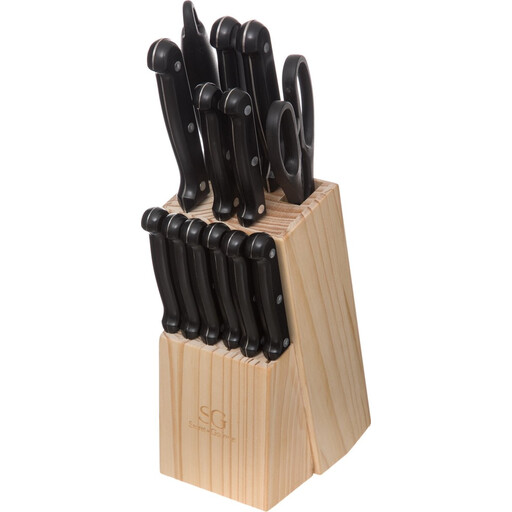
Why this suits the profile: This set includes a chef's knife, bread knife, six steak knives, kitchen scissors and a knife sharpener, among other items. That gives a household several options for everyday food preparation straight away.
The contents of the set are clearly specified. However, please note: according to the product information, this set is not dishwasher safe.
13-piece contents, stainless steel blade materials and a wooden knife block.
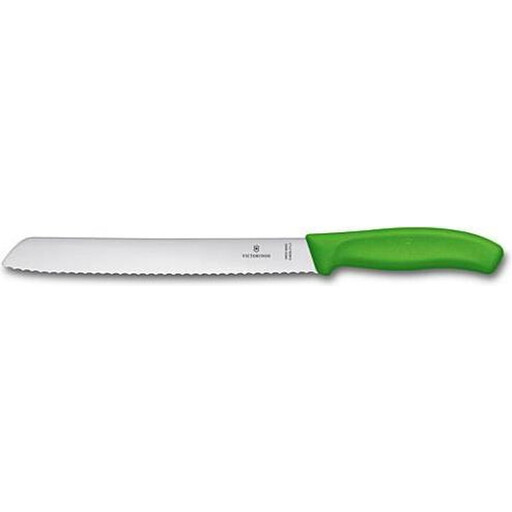
Why this suits the profile: If you mainly cut bread and products with a hard crust, this specific bread knife gives you a targeted addition rather than a full set.
The product information states a serrated stainless steel blade of 21 cm, so the application is clear.
21 cm blade, stainless steel and dishwasher safe according to the product description.
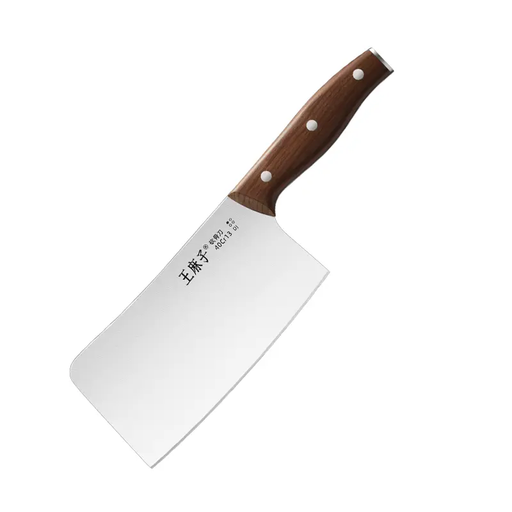
Why this suits the profile: This cleaver is designed for heavier tasks such as bones, ribs and poultry. It is therefore not a replacement for a general-purpose chef's knife.
The described application makes it clear what the knife is intended for. Do not use it on an unsuitable surface or for fine cutting work.
Designed for bones, ribs and poultry; the product description mentions a sturdy construction and secure grip.
Wash knives according to the manufacturer's instructions and dry them immediately when hand washing is recommended. Do not store them loose in a cutlery drawer: the blade can knock against other items and it becomes difficult to find what you need. A knife block, protective sheath or magnetic holder can be a more practical solution.
Only use a sharpener when it is suitable for the type of knife. A serrated bread knife is maintained differently from a smooth chef's knife. Also check regularly whether the handle is loose or damaged. If in doubt, replace the knife rather than trying to repair it yourself.
We have put together a full, up-to-date list of products that fully meet these strict selection criteria and current European safety regulations.
Start with a chef's knife or Santoku knife, a bread knife and possibly a pair of kitchen scissors. Add steak knives or a carving knife when you regularly carry out those tasks. A large knife set is mainly worthwhile if you actually use the different pieces.
That depends on the steel, the chopping board, your cutting technique and how you care for them. Do not cut on glass or stone, do not use the knife for bones when it is not designed for that, and sharpen it in good time. How long they last varies from household to household; there is no fixed period that applies to every knife.
Some models are, according to their product information, and others are not. Check this for each product. Even with dishwasher-safe knives, hand washing and drying immediately can help keep the blade and handle in good condition for longer.
