
Vandaag of morgen in huis

Kwaliteit gegarandeerd

Welkomstaanbiedingen ontgrendelen: GRATIS bezorging | Tot 80% korting | Gratis 30 dagen JoyPlus-proefperiode
Download de app
A toaster might seem like a simple appliance, but the differences between models really become apparent with daily use. A slot that's too narrow can damage thick sourdough bread, a limited browning control doesn't always give you the colour you want, and a toaster without a decent crumb tray quickly becomes a nuisance to keep clean.
If you only look at the appearance or the wattage, you could end up with an impractical purchase. Instead, pay attention to the space for your bread, the controls, and the features you'll actually use. Below, you'll find out what to look for and which models suit different needs.
A standard slice of bread isn't the only thing that goes into a toaster. Think about sourdough, bagels, English muffins, croissants or thicker sandwiches too. A model with narrow slots can squash these items or only heat them partially.
So check the stated slot width. A toaster with wide slots is more practical if you regularly eat thick bread or bagels. The KitchenAid models in this selection have slots of 3.8 cm. That's a concrete detail you can use to compare.
A toaster with only a few settings offers less scope to adjust the toasting for different types of bread. Thin white bread, for example, needs a different setting to a thick, moist slice of sourdough.
A toaster with adjustable browning settings gives you more control. Don't just look at the number of settings, but also at automatic bread centring. This feature keeps the slice in position while toasting. According to the product descriptions, the Philips, KitchenAid, Haier and WMF models all feature self-centring slots.
A bagel button, reheat function or high-lift mechanism sounds appealing, but check what the feature actually does. With the KitchenAid 5KMT2115EWH, the product information states that the inside of a bagel is toasted and the outside is warmed. That's different from toasting both sides evenly.
A high-lift lever is also useful for small slices. Without it, it can be trickier to safely remove a short piece of bread from the slot.
A 2-slot toaster or 2-slice toaster is suitable for one or two people and generally takes up less space. For a small household, this is often a practical choice. If you need several slices of toast at once in the morning, look for a model with two long slots or four separate slots.
Pay attention to the dimensions of the appliance and the space around it. A toaster gets hot and shouldn't be placed directly under a low kitchen cupboard or next to flammable materials. A compact toaster is handy in a small kitchen, but compact doesn't automatically mean all types of bread will fit.
The stated wattage in this selection ranges from 650 W to 1,400 W. A higher wattage doesn't in itself mean a toaster works better or more evenly. It's mainly a technical specification you should consider alongside slot layout, controls and features.
Examples:
Always check the current specifications on the product page when buying, especially if a model has multiple versions.
A toaster with a crumb tray is easier to maintain. The tray catches loose crumbs and can be removed for cleaning. Empty the tray regularly and don't use the appliance without the tray correctly fitted if the manufacturer instructs you to do so.
Don't use metal objects to remove stuck bread. Unplug the toaster and let it cool down completely before moving or cleaning it. The exterior and metal parts can get hot during and shortly after use.
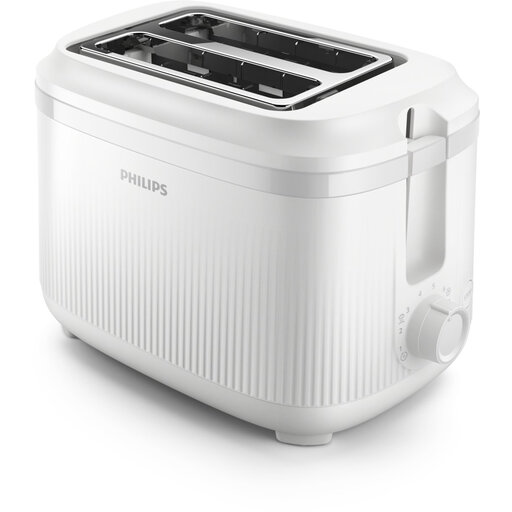
Why this suits the profile: This 2-slice toaster has straightforward controls with 8 browning settings and is suitable for everyday bread in a smaller household.
The adjustable settings mean you're not reliant on a single fixed toasting time. The self-centring slots are designed for different thicknesses.
8 browning settings, automatic shut-off, variable slot width and a removable crumb tray.
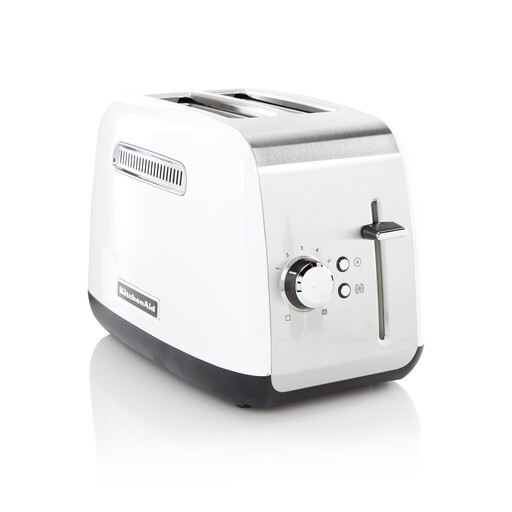
Why this suits the profile: The metal casing, wide slots and separate functions suit users who prepare different types of bread and value familiar controls.
The 3.8 cm slots are designed, according to the product information, for bagels, English muffins and thicker bread. The high-lift helps with small slices.
2 extra-wide slots, 5 browning settings, bagel function, reheat function and removable crumb tray.
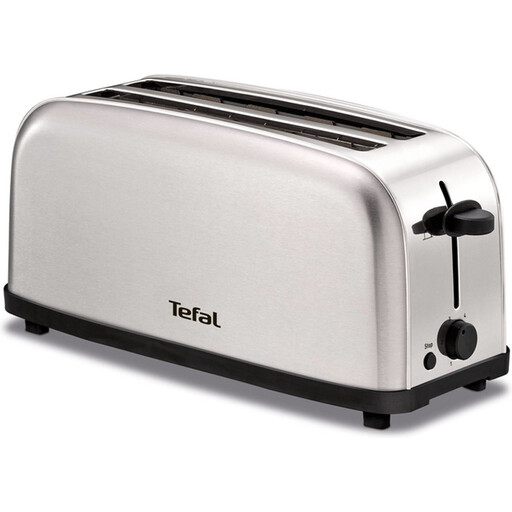
Why this suits the profile: The two long slots can hold up to four slices at once, making it interesting for families or users who prepare multiple portions.
The long slots mean you don't need multiple toasting rounds for each batch. The crumb tray supports regular maintenance.
Capacity for 4 slices, 1,400 W, 6 browning settings, stainless steel casing and a bun warmer.
We've put together a full, up-to-date list of products that fully meet these strict selection criteria and current European safety regulations.
First, unplug the toaster and let it cool down. Remove and empty the crumb tray according to the instructions. Don't shake the toaster vigorously to dislodge crumbs, and never immerse the toaster, cable or plug in water. Don't use metal objects in the slots.
The lifespan depends on use, maintenance and the quality of the components. Regularly emptying the crumb tray, using the slots correctly and ensuring enough ventilation space all help to prevent unnecessary strain. In the product information for several of the models mentioned, a statutory warranty of at least two years is stated. This is a warranty arrangement and not a fixed prediction of the lifespan.
The consumption depends on the wattage and how long you use it. A 1,400 W model uses more power during one minute than an 850 W model, but the actual cost depends on how long and how often you use the appliance. So don't just compare the wattage; also consider the capacity, the toasting time needed and your daily use.
