
Vandaag of morgen in huis

Kwaliteit gegarandeerd

Welkomstaanbiedingen ontgrendelen: GRATIS bezorging | Tot 80% korting | Gratis 30 dagen JoyPlus-proefperiode
Download de app
Choosing a new lamp for your exterior wall, garden, balcony or patio seems straightforward. Yet problems often only become apparent after purchase. The lamp may give off less light than expected, the sensor may react to every movement, or the housing may turn out not to be suitable for the place where you want to install it.
With this practical guide, you can compare outdoor lighting based on verifiable specifications. This makes it easier to choose between solar outdoor lighting, a solar wall light, an outdoor light with a motion sensor or a standard LED outdoor light.
An IP44 outdoor light is protected against solid objects larger than 1 millimetre and against splashing water. This does not mean that the lamp is waterproof. Direct jets of water, immersion and prolonged exposure to extreme weather conditions can still cause problems.
So, check not only the IP rating but also the installation location. A weather-resistant outdoor light with IP44 is usually suitable for a sheltered exterior wall, balcony, veranda or patio. For a completely exposed location, it is especially important to follow the installation instructions.
Wattage mainly indicates energy consumption, not the amount of light produced. When choosing LED lighting, look at lumens. A 300-lumen lamp is suitable for guidance or ambient lighting, while 1,000 lumens is more suitable for functional lighting around an entrance or shed.
Colour temperature also affects the overall feel. Warm white lighting at around 2,700 to 3,000 K generally creates a softer effect. Cooler white light can be more practical when visibility is more important than ambience.
Solar outdoor lighting does not need a fixed mains connection, but the solar panel must receive enough daylight. Under a deep canopy, on the north-facing side of a property or between closely built-up façades, the battery may charge less effectively. The days are also shorter in winter.
A solar wall light is therefore a convenient choice for a spot with direct sunlight and simple installation, but it is less suitable when you need a consistently bright light level every evening.
Use lumens as the first indication of brightness:
Also pay attention to light distribution. A wall light with a single GU10 fitting mainly provides focused light. A fitting with a diffuser distributes the light more evenly.
Choose between mains power, solar power or a rechargeable lamp. Mains power is suitable when you need a permanent light source, but installation may require wiring and sometimes a qualified installer. Solar lighting works without a mains connection. A USB-rechargeable lamp is flexible, but needs to be recharged regularly.
A motion sensor is practical by a front door or along a garden path. Check whether the lamp can also be switched on manually and whether the sensor settings are specified. A dusk or daylight sensor can prevent the lamp from being unnecessarily switched on during the day.
For a lamp without a light source, check the fitting and maximum wattage. A GU10 outdoor light works with a GU10 spotlight, while a fitting with an E27 bulb uses a larger standard fitting. Always check whether the light source is included.
Also consider dimmability. A fitting is not automatically dimmable; the lamp, dimmer and combination of the two must all be suitable. For indoor spaces, possible choices include a table lamp, floor lamp, pendant light or desk lamp, as well as wall and ceiling lighting. IP20 products, such as many indoor lights, are not suitable for outdoor use.
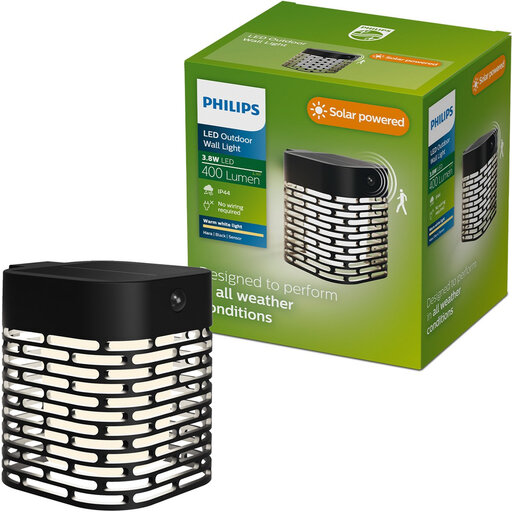
Why it suits this profile: This solar wall light works without fixed wiring and has an automatic mode with a dusk sensor. This makes installation straightforward for anyone putting up outdoor lighting for the first time.
The specifications clearly state 2700 K, 400 lumens per light point, two lighting modes and IP44. Make sure you position the lamp so that the panel receives direct daylight.
Solar power, warm white light, motion sensor and a housing with an IP44 rating.

Why it suits this profile: For an entrance, driveway or shed where more light is needed, the product information states 1,000 lumens, 3000 K and a built-in motion sensor.
The light output is stated clearly, so you do not have to rely solely on marketing terms such as ‘bright’. IP44 indicates protection against splashing water, not a guarantee that the lamp is waterproof.
1,000 lumens, a 3-metre cable for connecting the panel and two lighting modes according to the product description.
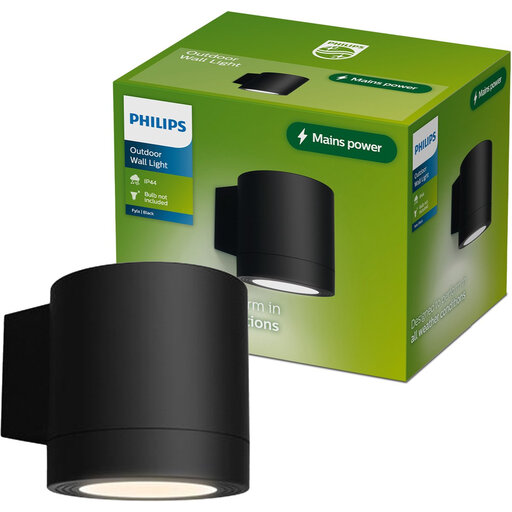
Why it suits this profile: This outdoor wall light is supplied without a GU10 spotlight. You can therefore choose your preferred colour temperature, brightness or a suitable smart bulb.
The fitting and the fact that the light source is not included are made clear in advance. This prevents you from buying a fitting whose supplied lamp is unsuitable for your intended use.
GU10 fitting, replaceable light source, aluminium housing and IP44 rating.
We have put together a complete, up-to-date list of products that fully meet these strict selection criteria and the applicable European safety regulations.
Clean the solar panel and light cover regularly with a soft, dry cloth. For wall lights, check that the fittings are still securely attached. If the lamp has a battery, it is advisable to follow the charging instructions and not open the housing yourself.
Switch off the power before carrying out fixed electrical installation work. A product such as an outdoor wall light with an E27 fitting may require installation by a qualified electrician, according to its specifications. Also check the maximum wattage and use only a suitable light source.
Indoor lighting requires a different approach. A ceiling light with IP20 is intended for dry rooms. A table lamp, desk lamp, pendant light or floor lamp should not be placed in a damp location unless the product information explicitly permits it.
For decorative garden lighting or balcony lighting, 100 to 200 lumens is often sufficient. For an entrance or path, 300 to 500 lumens is usually more appropriate. For broad functional lighting, you can look at around 1,000 lumens. The right value also depends on the installation height and light spread.
An IP44 lamp is resistant to splashing water, but is not designed for immersion or powerful jets of water. Install the lamp according to the instructions, preferably in a sheltered location when the manufacturer recommends this. Also check cable entries and mounting points.
Solar outdoor lighting does not use electricity from the mains while it is switched on. Its practical performance does, however, depend on sunlight, battery capacity, the season and the operating mode. A motion sensor or automatic dusk sensor can prevent the lamp from staying on unnecessarily long.
