
Vandaag of morgen in huis

Kwaliteit gegarandeerd

Welkomstaanbiedingen ontgrendelen: GRATIS bezorging | Tot 80% korting | Gratis 30 dagen JoyPlus-proefperiode
Download de app
A ceramic frying pan may seem straightforward to choose at first glance. However, pans vary considerably in size, heat source compatibility, coating and maintenance. A low price says little about how convenient a pan will be for everyday cooking. Conversely, you may sometimes pay extra for features you will not use in your kitchen.
For UK households, three pitfalls are particularly important:
Not checking “suitable for all heat sources”
A pan may be suitable for gas and electric hobs, but not induction. Always check that induction is explicitly mentioned. If you have an induction hob, also look at the diameter of the base, not just the top edge.
Mistaking PFAS-free for a general safety guarantee
Ceramic coatings are often described as PFAS-free or PTFE-free. You should assess this based on the product specifications and information provided by the manufacturer. According to the product descriptions, Brabantia, Tefal, Redchef and Naturepan all claim to offer a PFAS-free coating on certain products. This is a product claim made by the brand and is not a reason to automatically assume other properties, such as durability or scratch resistance.
Seeing dishwasher-safe as a guarantee of a long service life
According to the product information, some models are dishwasher-safe, but hand washing is still recommended to help keep the ceramic non-stick coating in good condition for longer. Heat, aggressive dishwasher detergent, metal utensils and rapid temperature changes can put strain on the coating.
If you are looking for a ceramic induction frying pan, check that “induction” is clearly listed under compatibility. A frying pan for all heat sources will usually mention gas, electric, ceramic and induction. Also pay attention to:
An aluminium pan will generally heat up quickly, while a thicker or multi-layered base can distribute heat more evenly. This can be useful when cooking eggs, pancakes and sauces, but you should still use an appropriate temperature. A ceramic coating is not an invitation to heat an empty pan on a high setting for an extended period.
A frying pan with a ceramic non-stick coating is designed to make it easier to release ingredients and simplify cleaning. How well this works in practice also depends on temperature, oil use and maintenance.
If you want a PFAS-free frying pan or a frying pan without PFAS, look for an explicit statement in the product details. “Ceramic” alone does not automatically prove that a product is PFAS-free. According to its own product information, Brabantia claims a PFAS-free coating for the Onyx and Dusk models. Tefal states this for the Renewal models, while Redchef makes the claim for the Starlight series. If in doubt, check the current packaging and product specifications.
For ceramic coatings, wooden, silicone or plastic utensils are preferable. Even a coating described as scratch-resistant can be damaged by metal utensils or abrasive cleaning products.
A 24 cm ceramic frying pan is well suited to meals for one to three people, omelettes and everyday portions. A 28 cm ceramic frying pan provides more room for vegetables, meat or several eggs, but it also requires a larger cooking zone and more storage space.
A practical guide:
A ceramic frying pan set can be good value if you regularly use different sizes. Do not buy a set if you usually only need one pan; a single model will take up less space.
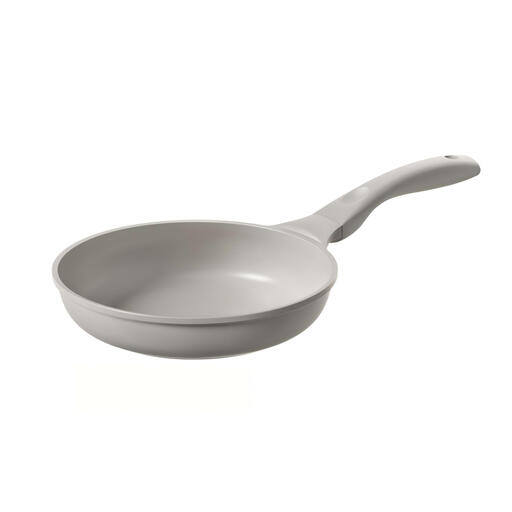
Why it suits this profile: A compact 24 cm pan for everyday cooking, with compatibility with induction, gas and electric hobs according to the product description.
The product specifications explicitly state that the ceramic coating is free from PTFE, PFOA and PFAS. According to the care information, hand washing is still advisable despite the stated dishwasher compatibility.
24 cm size, ergonomic handle and stated suitability for induction, gas and electric cooking.

Why it suits this profile: For anyone who pays attention to material choice, oven use and a sturdy handle for everyday cooking.
The manufacturer states that the pan has a PFAS-free ceramic coating, an RCS-certified construction made from recycled aluminium, and compatibility with all the listed heat sources. The oven limit of 200 °C is clearly stated.
Riveted stainless steel handle, oven use up to 200 °C and dishwasher-safe design according to the product information.
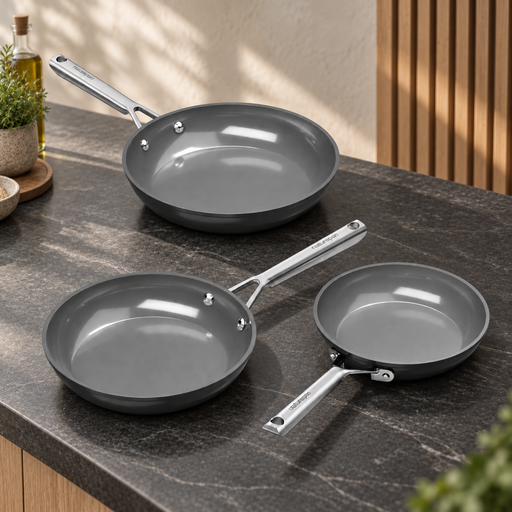
Why it suits this profile: A set for households that regularly prepare different portion sizes and want to move a pan from the hob to the oven.
The set includes three clearly stated sizes: 20, 24 and 28 cm. Induction, gas, electric and ceramic cooking are also listed. According to the product information, the coating is free from PTFE, PFAS and PFOA.
Three sizes, oven resistance up to 260 °C and dishwasher-safe design according to the product details.
We have put together a complete, up-to-date list of products that fully meet these strict selection criteria and the applicable European safety regulations.
Follow these tips to keep a ceramic frying pan in good working order for longer:
A dishwasher-safe frying pan can go in the dishwasher, but hand washing with a soft sponge is often the gentler option. If the coating is damaged or coming away, replacing the pan is wiser than continuing to use it.
That depends on the base. Only choose a model that explicitly lists induction as a suitable heat source. Also check that the base makes good contact with the cooking zone.
There is no fixed lifespan. Cooking temperature, utensils, cleaning and frequency of use all play an important role. Hand washing, moderate heat and avoiding metal spatulas can help protect the coating.
No. PFAS-free and dishwasher-safe are two different properties. Check both specifications separately and always follow the manufacturer’s care instructions for the coating.
