
Vandaag of morgen in huis

Kwaliteit gegarandeerd

Welkomstaanbiedingen ontgrendelen: GRATIS bezorging | Tot 80% korting | Gratis 30 dagen JoyPlus-proefperiode
Download de app
A driveway that is barely visible in the dark, a patio without any atmosphere or a façade where a lamp starts causing problems after a few showers: the wrong outdoor lighting can quickly become a disappointing purchase. Many products look similar, but differ in protection, power supply, light output and installation.
Pay particular attention to these three common pitfalls:
The IP code indicates how well a light fitting is protected against solid particles and water. The first digit refers to dust and contact; the second digit refers to water.
A higher IP rating does not automatically make a lamp suitable for every situation. Also check the installation instructions and make sure that connections are not left in standing water.
Lumens indicate the total light output. As a practical guide:
Colour temperature is measured in Kelvin. Warm white light of around 2700K to 3000K often works well on a patio or at an entrance. Cooler light can be more functional for a driveway or workspace, but may feel harsher.
Also consider the direction of the light. A path light with downward-facing light distribution helps to reduce glare. A wall light that shines in all directions creates more atmosphere. An outdoor lamp with a motion sensor is particularly practical in areas where you do not need continuous lighting.
An LED outdoor lamp with an integrated light source is usually compact and ready to use straight away. However, check whether the LED module can be replaced. With some integrated models, the entire lamp must be replaced when the light source reaches the end of its service life.
A GU10 outdoor lamp offers greater flexibility: you can choose a suitable GU10 LED bulb yourself and adjust the colour or light output later. Pay attention to the maximum wattage and whether the light source is included. The GU10 bulb is not included with several Brilliant and Philips Fylx models in this selection.
Solar outdoor lighting works without a fixed mains connection. Performance depends on positioning, the number of hours of direct sunlight, the weather and battery capacity. Do not place the solar panel beneath a roof edge or in the shade of a tree if you expect a longer operating time.
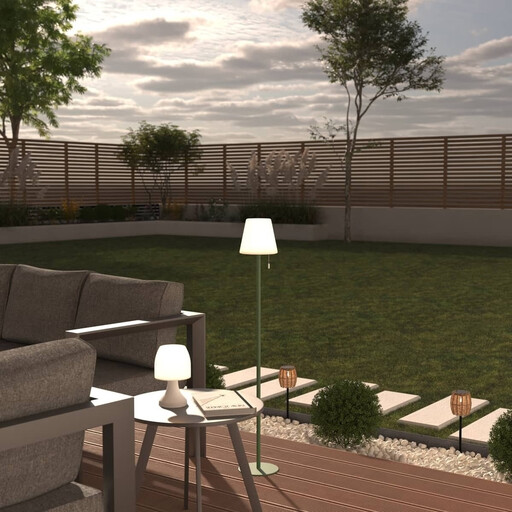
Why it suits this profile: This portable floor lamp is suitable for a balcony, patio or garden where you do not want to install wiring. Battery power and manual controls keep it simple to use.
The IP44 rating makes it clear that this lamp is designed for splashing water, not immersion. You can therefore choose its location accordingly.
108 cm tall, three light modes and a stated operating time of up to ten hours.
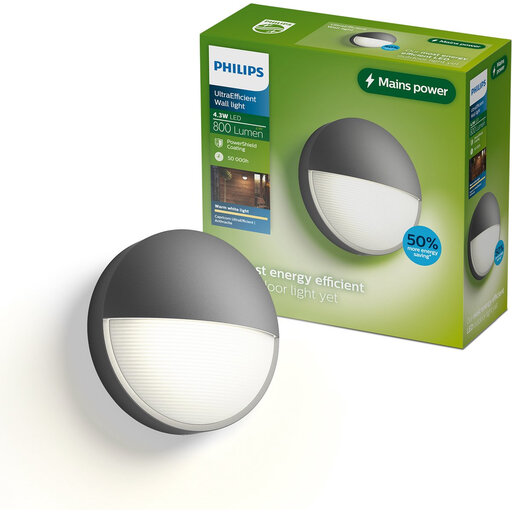
Why it suits this profile: For fixed, warm lighting by an entrance, façade or balcony, this model offers an integrated LED light source and a stated colour temperature of 2700K.
The specifications state IP44 and professional installation. This prevents you from mistaking a splash-resistant fitting for a lamp designed to withstand direct water jets.
800 lumens, 2700K and a stated power consumption of 4,3W; the LED light source is integrated.

Why it suits this profile: This solar outdoor light is designed for a driveway, garage, garden or larger outdoor area where automatic lighting and broad coverage are desirable.
The product details state IP65, three light modes and a motion sensor. However, check beforehand that the solar panel receives sufficient direct sunlight.
302 LEDs, a stated light output of 3000 lumens, three adjustable heads and installation without fixed wiring.
A fixed outdoor wall light must be secured to a stable surface. Have a 220–240V model connected by a qualified electrician. Switch off the power before carrying out maintenance or installation.
With solar lamps, positioning is more important than many buyers expect. Clean the panel and sensor window regularly with a soft, damp cloth. With an LED string light for outdoor use, keep plugs and connections away from standing water. The VIVREAL G40 string light is 30 metres long, has replaceable bulbs and a plug for continuous use; follow the stated maximum connection length.
For patio lighting, you can combine several light sources: a wall light for orientation, a path light for walkways and a string light for atmosphere. This prevents one bright lamp from casting harsh, uneven light across the entire garden.
We have put together a complete, up-to-date list of products that fully meet these strict selection criteria and the applicable European safety regulations.
For a sheltered façade or balcony, IP44 may be suitable. For a location exposed to more dust and weather, IP54 is a more sensible choice. Choose IP65 outdoor lighting when protection against dust and water jets is important. Always check the installation location and the manufacturer’s instructions.
It can be, provided the panel receives several hours of direct sunlight. Cloudy days, shade and dirt on the panel can limit its charging capacity. A solar outdoor lamp with a motion sensor generally only uses light when movement is detected, which can help limit energy consumption per night.
Consumption depends on the wattage and the number of hours it is lit. A 4W lamp that is switched on for five hours a day uses approximately 7,3 kWh per year. Solar lighting does not use electricity from the mains, but you should factor in battery wear and the need to replace the complete fitting if the integrated light source cannot be replaced.
