Who is this choice relevant to?

Shoppers with a strict sugar-free requirement

You don’t want to rely on a name such as Zero Sugar; you want to check the total sugar content. Both chocolate options discussed contain more than 0.5 g of sugars per 100 g. If you have a strict requirement, compare the ‘of which sugars’ figure on the label.

Brunch shoppers who also want to avoid sweeteners

You’re looking for chocolate granola with no added sugars and no sweeteners. Quaker states that its product meets both criteria, but it does contain naturally occurring sugars. If you’re serving guests, also check the information on milk, wheat, oats and possible traces of nuts.

Shoppers comparing nutritional values

You want to serve chocolate breakfast cereal with yoghurt or quark, for example, and compare not just sugars but also fibre, ingredients and allergens. The Netherlands Nutrition Centre recommends comparing nutritional values per 100 g, so different serving sizes don’t affect the comparison.

What should you look for when choosing?

For your Easter brunch, first decide whether ‘sugar-free’ is a strict requirement or whether you mainly want to avoid added sugars or sweeteners. Then compare the nutritional information per 100 g and check the ingredients and allergens for everyone who’ll be eating.

What to consider What to check before buying Who it’s most relevant to
Literally sugar-free Compare ‘of which sugars’ per 100 g with the EU nutrition claim threshold of 0.5 g per 100 g for ‘sugar-free’. A statement about no added sugars doesn’t answer this question. If sugar-free is a strict requirement for me, I want to know the total sugar content before putting a chocolate product on the table. An estimated 50% of consumers make this their priority.
Added sugars and sweeteners Read both the product claim and the ingredients list, and check whether sweeteners, including polyols, are listed. I want to serve chocolate granola with no added sugars and no sweeteners, even if it contains naturally occurring sugars. This is the main consideration for an estimated 30% of consumers.
Fibre and your brunch bowl Compare fibre and other nutritional values per 100 g, then check the ingredients and allergens for your chosen combination. When putting together a bowl with yoghurt or quark, I pay particular attention to fibre and what my guests can eat, as well as the chocolate flavour. This is the most important consideration for an estimated 20% of consumers.

Common mistakes

  • Assuming ‘no added sugars’ means ‘sugar-free’

    Under EU rules on nutrition claims, ‘sugar-free’ can only be used when a product contains no more than 0.5 g of sugar per 100 g or 100 ml. Albert Heijn states that its chocolate muesli discussed here contains 0.6 g of sugars per 100 g; Quaker states 3.4 g per 100 g.

    If you have a strict sugar-free requirement, use the nutrition table per 100 g rather than relying only on the wording on the front of the pack.

  • Overlooking sweeteners because the sugar content is low

    According to Albert Heijn, AH Krokante muesli chocolade 0% suiker contains maltitol and 23 g of polyols per 100 g. The product information warns that excessive consumption may have a laxative effect.

    Read the ingredients and information about polyols if you want to avoid sweeteners.

  • Comparing nutritional values per serving only

    Serving sizes can differ between packs, so the figures may not describe the same amount of product.

    Compare sugars, fibre, energy and salt per 100 g, as recommended by the Netherlands Nutrition Centre. Then decide how much you’ll actually serve in each brunch bowl.

  • Checking for allergens only after you’ve bought it

    The Quaker granola discussed contains milk, wheat and oats, and may contain nuts. The Albert Heijn muesli discussed lists, among other things, cereals containing gluten and pecan nuts.

    Check the current packaging before buying or serving the product to guests.

Relevant brands to consider

Quaker

Quaker Cruesli Zero Sugar Chocolade is worth considering if you’re looking for chocolate granola with no added sugars and no sweeteners for Easter brunch.

  • The product information states that it contains 21 g of fibre and 3.4 g of sugars per 100 g, as well as naturally occurring sugars.
  • At 3.4 g of sugars per 100 g, this product isn’t literally sugar-free. It contains milk, wheat and oats, and may contain nuts.

Albert Heijn

AH Krokante muesli chocolade 0% suiker is another option if you’re looking for a product with a low stated sugar content and don’t mind sweeteners.

  • Albert Heijn states that this product contains 0.6 g of sugars and 7.8 g of fibre per 100 g.
  • It contains maltitol and lists 23 g of polyols per 100 g. The product information warns that excessive consumption may have a laxative effect; it also lists cereals containing gluten and pecan nuts.

Kellogg's

Special K Pure Chocolade is a chocolate flake cereal from Kellogg's, but it isn’t an option if you’re looking for this particular product to be sugar-free or have no added sugars.

  • Kellogg's lists a sugar content for Special K Pure Chocolade, so you can compare it with your buying criteria.
  • The manufacturer states that it contains 17 g of sugars per 100 g and lists sugar among the ingredients. This assessment applies to Special K Pure Chocolade, not the entire range.

Chocolate granola on Joybuy

This chocolate granola could suit an Easter brunch if you’re looking for a product with no added sugars and no sweeteners. If you need something that is literally sugar-free, you’ll need to look elsewhere: this product contains 3.4 g of sugars per 100 g.
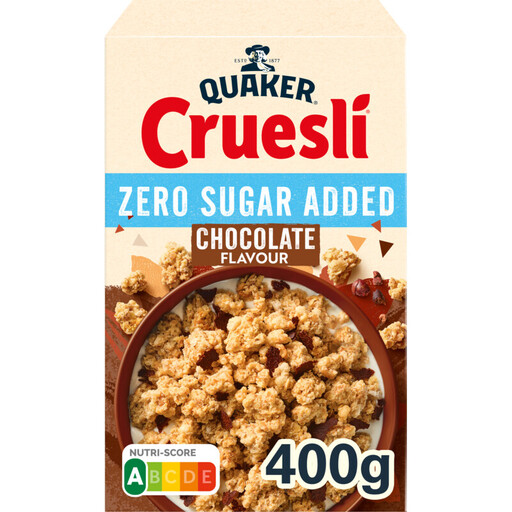
Quaker Cruesli Choco Zero Sugar, 400 g pack

Quaker Cruesli Choco Zero Sugar – 400 g

For a brunch bowl when you’re looking for chocolate granola with no added sugars and no sweeteners.

The product information states that it contains 21 g of fibre and 3.4 g of sugars per 100 g. This means it isn’t literally sugar-free. It contains milk, wheat and oats, and may contain nuts; check the current packaging if you’re serving it to guests with allergies.

View on Joybuy

Frequently asked questions

Does ‘no added sugars’ mean the same as sugar-free?

No. Under EU rules on nutrition claims, ‘sugar-free’ means a product contains no more than 0.5 g of sugar per 100 g or 100 ml. A product with no added sugars may still contain naturally occurring sugars, so check the ‘of which sugars’ figure in the nutrition table too.

Which chocolate granola should I choose if I also want to avoid sweeteners?

According to the product information, Quaker Cruesli Zero Sugar Chocolade contains no added sugars and no sweeteners. It isn’t literally sugar-free: the stated amount is 3.4 g of sugars per 100 g. Also check the allergens if you’re serving it to guests.

Why do polyols matter in AH Krokante muesli chocolade 0% suiker?

According to Albert Heijn, this product contains maltitol and lists 23 g of polyols per 100 g. The product information warns that excessive consumption may have a laxative effect. So if you want to avoid sweeteners, this product isn’t right for you.

How should I compare chocolate breakfast cereals for an Easter brunch?

Compare the nutritional values of similar products per 100 g, rather than per serving only. Check sugars and fibre, and read the ingredients and allergen information too. The Netherlands Nutrition Centre recommends comparing products per 100 g, so different serving sizes don’t skew the comparison.

Can I serve the chocolate options discussed as gluten-free or nut-free?

Don’t assume they’re suitable. The Quaker granola discussed contains wheat and oats and may contain nuts; the Albert Heijn muesli discussed lists cereals containing gluten and pecan nuts. Check the current packaging for relevant allergens for each guest.
