When choosing chocolate sprinkles for home baking, compare the amount of ‘of which sugars’ per 100 g, rather than relying on ‘dark’ in the name. Albert Heijn’s nutritional information lists 40 g of sugars per 100 g for De Ruijter Special vlokken intens puur and 63 g per 100 g for De Ruijter Chocoladevlokken puur. The extra-dark variant was listed as discontinued; when buying, also check the current label, allergens and whether you want to use the sprinkles as a topping or in the bake itself.
Who is this relevant to?
Home bakers comparing sugar content
You want to choose a variety for biscuits or cupcakes that contains less sugar per 100 g than the sprinkles you’re comparing it with. Check the nutritional information for the exact variety: the figures for De Ruijter products on Albert Heijn’s product pages vary.
Home bakers who need to check allergens
If milk, lactose or soya is a concern for the person eating your bake, ‘dark’ is no substitute for checking the allergen information. The declarations differ between De Ruijter varieties on Albert Heijn’s product pages.
Home bakers using sprinkles as a finishing touch
You’re looking for sprinkles to decorate the top of a cake, cupcake or biscuit. PLUS suggests using De Ruijter sprinkles on bakes like these; check your recipe to decide whether to add them after baking or use them as an ingredient.
What should you look for when choosing?
First compare chocolate sprinkles per 100 g, then check the ingredients and allergens, and finally decide how you’ll use the sprinkles in your bake.
| What to consider |
What should you check? |
Who is this most important for? |
| Sugars per 100 g |
For the same type of product, compare ‘of which sugars’ per 100 g and check the ingredients list. |
If I want less sugar in the sprinkles I choose, I need to be able to compare the figure for the exact variety. This is the top priority for around 40% of consumers. |
| Allergens |
Check the ingredients and allergen information on the packaging for milk, lactose and soya. |
If I’m baking for someone who needs to avoid these ingredients, the packaging determines whether I can use the sprinkles. Around 40% of consumers give this check top priority. |
| Using them as a topping |
Check when the recipe says to add the sprinkles and decide how many to use for decoration. |
For cupcakes or biscuits, I want to know in advance whether the sprinkles go on top or are baked in. For around 20% of consumers, how the sprinkles will be used is the first thing to consider. |
Common mistakes
-
Assuming ‘dark’ means less sugar
The product name doesn’t tell you how much sugar the sprinkles contain. Albert Heijn lists 63 g per 100 g for De Ruijter Chocoladevlokken puur, 40 g for De Ruijter Special vlokken intens puur and 65 g for AH Pure chocoladevlokken.
Compare the ‘of which sugars’ figure per 100 g for the varieties you’re actually considering.
-
Assuming a product you looked at before is still available
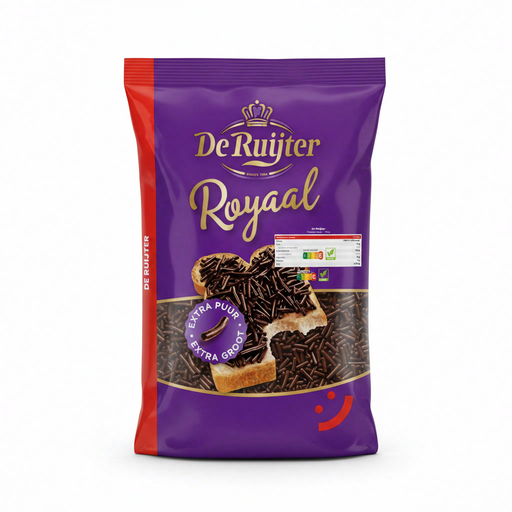
De Ruijter Royaal extra puur and Special intens puur were listed as discontinued at Albert Heijn. Their nutritional values can be used for comparison, but they don’t tell you what you can buy now.
Check current availability and read the nutritional information for an alternative before choosing it for your recipe.
-
Treating a vegan claim or ‘dark’ as an allergen guarantee
PLUS describes its dark chocolate sprinkles as vegan, but also says they may contain milk and lactose. Other dark varieties carry warnings about milk, lactose or soya.
For allergen decisions, use the ingredients and allergen information on the packaging you buy.
-
Comparing serving sizes across brands
A serving can be defined differently for each product, so serving sizes don’t provide a like-for-like basis for comparing packs.
First compare the nutritional information per 100 g, as the Netherlands Nutrition Centre recommends, then work out how many grams of sprinkles you’ll use in your bake.
Brands compared
De Ruijter
De Ruijter’s dark and extra-dark chocolate sprinkles offer specific varieties to compare for home baking.
- Albert Heijn lists 63 g of sugars per 100 g for the standard dark variety, 56 g for Royaal extra puur and 40 g for Special intens puur.
- Royaal extra puur and Special intens puur were listed as discontinued there. Check the allergens for each variety too, as they differ.
Albert Heijn
AH Pure chocoladevlokken are a supermarket own-brand option whose nutritional information you can compare with other dark sprinkles.
- Albert Heijn’s product information lists 65 g of sugars per 100 g and at least 32% cocoa solids.
- The product page warns that the sprinkles may contain milk and lactose, and listed them as discontinued. Check the packaging and current availability.
PLUS
PLUS Chocoladevlokken puur comes with product information you can use to assess the sugar content and ingredients for your recipe.
- PLUS lists 63.8 g of sugars and 63.6 g of added sugars per 100 g.
- The product page describes the sprinkles as vegan but also warns that they may contain milk and lactose. Check the pack itself for allergen information.
Kiekeboe
ALDI lists Kiekeboe chocolate sprinkles in milk and dark varieties, in 300 g packs.
- You can compare the dark variety with other chocolate sprinkles in store.
- Before deciding whether this variety suits your recipe, check ‘of which sugars’ per 100 g and the allergen information on the pack.
Products at Joybuy for a chocolate finishing touch
These two De Ruijter products are worth considering if you’re looking for chocolate to finish your bakes. If your main priority is less sugar, compare the nutritional information per 100 g on the exact pack; don’t rely on the product name instead of checking.
 No image available
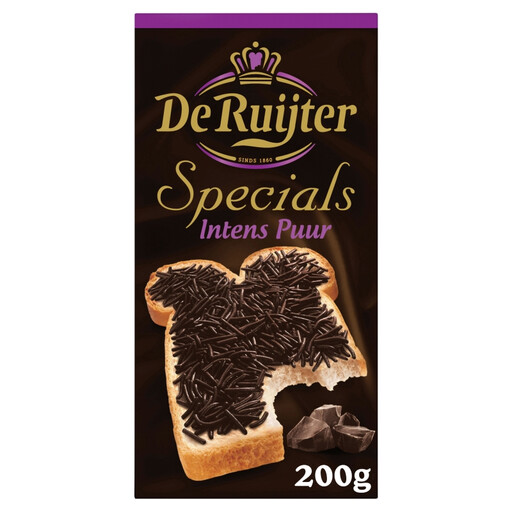
De Ruijter Intense Pure Chocolate Sprinkles, 200 g
An option to consider if you’re looking for chocolate sprinkles to finish cupcakes.
Pack size: 200 g. Compare ‘of which sugars’ per 100 g and check the pack for allergen information. If you want to bake the sprinkles in, follow your recipe’s instructions.
View at Joybuy
 No image available
De Ruijter Chocolate Chunks, 390 g
An option to consider if you’re looking for Chocolate Chunks rather than regular chocolate sprinkles to finish cupcakes.
Pack size: 390 g. Compare the sugars per 100 g and the allergen information on the pack before choosing. Check your recipe if you want to bake the chunks in.
View at Joybuy
Frequently asked questions
Are dark chocolate sprinkles automatically the lowest-sugar option?
No, ‘dark’ alone doesn’t tell you which variety contains less sugar. Albert Heijn lists 63 g of sugars per 100 g for De Ruijter Chocoladevlokken puur, 40 g for De Ruijter Special vlokken intens puur and 65 g for AH Pure chocoladevlokken. So compare the exact products you plan to use.
How do I compare packs with different serving sizes?
Compare the nutritional information for chocolate sprinkles per 100 g. This gives you a consistent basis for comparing the sugar content of similar products, even when their stated serving sizes differ. The Netherlands Nutrition Centre also recommends comparing similar products per 100 g.
What should I check on dark sprinkles if milk or soya is a concern?
Read the ingredients and allergen information on the exact pack. According to Albert Heijn’s product information, De Ruijter Chocoladevlokken puur contains soya and may contain milk; De Ruijter Special vlokken intens puur contains milk and soya and may contain lactose.
Can I call sprinkles with a lower sugar content ‘low sugar’?
Having less sugar than another product doesn’t automatically make the ‘low sugar’ claim accurate. According to the European Commission, nutrition claims may only be used if they are authorised and meet the applicable conditions. To compare sprinkles for your recipe, you can use the specific ‘of which sugars’ figure per 100 g.


