If you’re looking for a strong cocoa flavour, start with the stated minimum cocoa solids: Albert Heijn lists at least 52% for De Ruijter Specials Intens Puur and at least 43% for De Ruijter Royaal extra puur. These figures don’t predict which one you’ll prefer. When shopping on a budget, choose a pack size that suits how much you use, and check the ingredients and allergens on the packaging.
Who is this for?
Fans of a strong cocoa flavour
If you want to compare varieties by cocoa content, check the minimum percentage on the exact product. Albert Heijn lists at least 52% cocoa solids for De Ruijter Specials Intens Puur and at least 43% for De Ruijter Royaal extra puur; these figures don’t guarantee a particular taste.
People who use chocolate sprinkles regularly
If you often add chocolate sprinkles to bread, yoghurt or porridge, the net weight can help you choose the right size. The dark varieties reviewed include packs of 200 g, 400 g and 600 g; a larger pack won’t automatically suit how much you use.
People who need to check ingredients
If you need to avoid milk or soya, or want to eat a plant-based diet, don’t assume a product is suitable just because it says ‘dark’. Check the ingredients, allergen information and any warnings on the packaging of the variety you’re buying.
What should you look for in dark chocolate sprinkles?
First decide whether cocoa content, pack size or ingredients matter most to you. Then compare information only for the exact varieties you’re considering.
| What to consider |
What should you check? |
Who is it important for? |
| Cocoa content |
Look for the minimum percentage of cocoa solids on the exact packaging; don’t rely on words such as ‘dark’ or ‘intense’ alone. |
I’m looking for a strong cocoa flavour, so I want a specific percentage to compare varieties. Cocoa content is the top priority for roughly 46% of consumers. |
| Pack size |
Check the net weight and choose a size that suits how often you use chocolate sprinkles. |
If I use chocolate sprinkles regularly, I want to have enough in the cupboard without choosing a pack that stays open for too long. Pack size comes first for around 36% of consumers. |
| Ingredients and allergens |
Check the ingredients, allergen information and any warnings for the exact variety. |
If I need to avoid certain ingredients or want to eat a plant-based diet, the label needs to give me a clear answer before I choose based on taste or size. This check comes first for roughly 18% of consumers. |
Common mistakes when choosing
-
Assuming ‘dark’ tells you the cocoa percentage
Product names alone don’t tell you the minimum cocoa solids in a specific variety. Albert Heijn lists at least 52% for De Ruijter Specials Intens Puur and at least 43% for De Ruijter Royaal extra puur.
Compare the information on the pack and use the percentage to narrow down your options, not as a guarantee that you’ll like the taste.
-
Assuming dark chocolate sprinkles are free from milk or soya
The word ‘dark’ doesn’t tell you whether a product is suitable if you need to avoid milk or soya.
Before buying, check the current ingredients, allergen information and warnings for the variety you’ve chosen.
-
Confusing cocoa content with nutritional value
The percentage of cocoa solids alone doesn’t give you the full picture of the sugar and fat content of chocolate sprinkles.
Use the percentage for the product comparison you want to make, and check the nutritional information per 100 g and per serving separately.
Brands to consider
De Ruijter
Albert Heijn lists the minimum cocoa solids for two dark varieties: 52% for Specials Intens Puur and 43% for Royaal extra puur.
- The stated percentages make it possible to compare these two varieties.
- Check the ingredients and allergens on each pack; the percentage won’t tell you which variety you’ll prefer.
Venz
Jumbo lists Venz Puur Chocolade Hagelslag in a 400 g pack.
- This pack size gives you a useful reference when comparing pack weights.
- Check the cocoa content of this exact variety on the packaging before comparing it on that basis.
Jumbo
Jumbo’s own brand is another option to compare when looking at dark chocolate sprinkles.
- Compare the product information for the own-brand variety you’ve chosen with that of other dark varieties.
- For cocoa content and suitability for a plant-based diet, rely on the label for the exact product, not the brand name.
Kiekeboe
ALDI Netherlands describes Kiekeboe Hagelslag Puur as a 600 g pack made with Rainforest Alliance cocoa.
- The stated pack size gives you a useful point of comparison if you use chocolate sprinkles often.
- Check the cocoa content of this variety separately if it’s an important factor in your choice.
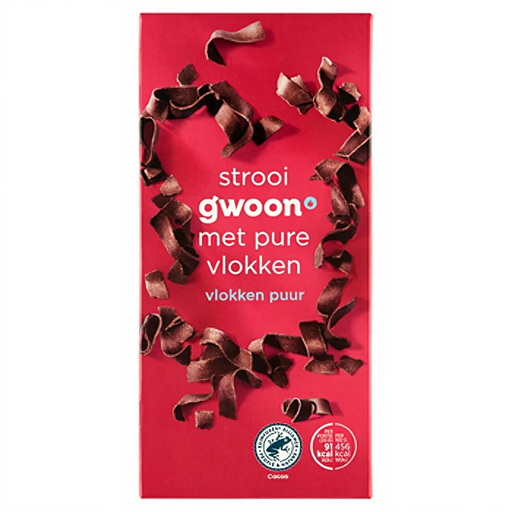
Joybuy products: dark chocolate flakes
This product is an option if you’re also considering dark chocolate flakes as well as chocolate sprinkles. Flakes are a different type of product, so check the cocoa content stated on the pack before choosing based on cocoa flavour.
 No image available
g'woon Flakes Pure 300 g
An option if you’re considering dark chocolate flakes instead of chocolate sprinkles. If you’re looking for a strong cocoa flavour, check the cocoa content on the packaging. If you have allergies, check the current ingredients and allergen information.
View at Joybuy
Frequently asked questions
Does ‘dark’ mean chocolate sprinkles always have the same cocoa content?
No. Check the stated minimum on the exact packaging. Albert Heijn lists at least 52% cocoa solids for De Ruijter Specials Intens Puur and at least 43% for De Ruijter Royaal extra puur; that doesn’t tell you which one you’ll prefer.
What pack size is right for regular use?
Choose a pack size that suits how often you use chocolate sprinkles. De Ruijter Specials Intens Puur is listed in a 200 g pack, Jumbo lists Venz Puur Chocolade Hagelslag in 400 g, and ALDI Netherlands lists Kiekeboe Hagelslag Puur in 600 g.
Are dark chocolate sprinkles automatically plant-based or lactose-free?
No. The word ‘dark’ doesn’t confirm either of these. Check the ingredients and allergen information on the packaging for the exact variety, even if you’re buying a product you’ve had before.
Do Dutch food labels have to list allergens?
Yes. The Netherlands Food and Consumer Product Safety Authority requires 14 specified allergens to be listed on food labels. Check the information on the pack of chocolate sprinkles you’re buying.


