
Office manager looking to reduce mess
Looking for a way to serve dry, loose chocolate flakes in the shared kitchen or alongside the biscuit tin, without using packaging designed for liquid sauce as a starting point.


For loose chocolate flakes to share alongside the office biscuit tin, a shaker with a wide opening or the original packaging is a better choice than a squeezy bottle. Van Beekum Specerijen describes a shaker with an opening for dry flakes, while the HANOS squeezy bottle contains a smooth sauce. If you decant the flakes, choose a container intended for food contact, let it dry completely after cleaning and keep the product information to hand.
Looking for a way to serve dry, loose chocolate flakes in the shared kitchen or alongside the biscuit tin, without using packaging designed for liquid sauce as a starting point.
Wants colleagues to be able to check the ingredients and allergens for the exact variety, even when the flakes are transferred to another container.
Weighs up the amount of flakes in each pack against the space and upkeep needed for a separate shaker.
Choose this option: if colleagues need to be able to sprinkle dry chocolate flakes from a separate container. Van Beekum Specerijen describes its shaker as having a wider opening for flakes.
Bear in mind: you’ll need to refill and clean it, then let it dry completely. According to Van Beekum Specerijen, the shaker reviewed is not dishwasher-safe.
Choose this option: if you want to keep the product information with the flakes and don’t need a separate dispenser.
Bear in mind: the opening varies from pack to pack. Check whether colleagues can sprinkle the flakes from your chosen pack without making too much mess.
Choose this option: only if you want to serve a smooth, liquid topping designed for a squeezy bottle instead of loose flakes.
Bear in mind: the squeezy bottle described by HANOS contains sauce; that doesn’t mean it’s suitable for dispensing dry chocolate flakes.
| What to consider | What to check before buying | Who it matters to |
|---|---|---|
| Dispensing dry flakes | Check that the dispensing opening is suitable for flakes. An opening designed for smooth sauce tells you nothing about this. | If I want colleagues to help themselves to flakes without reaching into the stock each time, I look for an opening that dry flakes can pass through. Around 50% of consumers prioritise this type of dispenser. |
| Keeping the flakes clean and dry | If you decant the flakes, use a container intended for food contact; follow the cleaning instructions and let both the container and lid dry completely. | When a container is refilled regularly, I want to be able to clean it without any moisture getting into the next batch. For around 30% of consumers, this is their main concern. |
| Variety and product information | Check the packaging for the exact variety for ingredients, allergens, contents and storage advice. Keep the label available if you decant the flakes. | When colleagues are choosing from the same stock, I want to know which flakes are inside and which allergens are listed on the packaging. This is the priority for around 20% of consumers. |
A smart-looking bottle isn’t necessarily a suitable dispenser for dry chocolate flakes. The squeezy bottle described by HANOS contains a smooth speculoos topping, while the shaker from Van Beekum Specerijen has an opening designed for flakes.
For loose flakes, check what the container is designed to hold and the size of its dispensing opening. Keep a squeezy bottle for a liquid topping intended for that type of packaging.
The net weight of a pack of chocolate flakes doesn’t tell you how much space the contents will take up in a container. So a capacity in ml doesn’t guarantee that a pack of a particular weight will fit.
Try filling your chosen container with one pack first, and leave enough room to sprinkle the flakes without compressing them.
Allergens vary by product and variety. For example, PLUS lists milk, lactose and soya in De Ruijter Milk Chocolate Flakes, 200 g.
Keep the original packaging with your stock so colleagues can check the product name, ingredients, allergens and best-before date.
Dry flakes need to be stored somewhere dry. The Van Beekum Specerijen shaker reviewed must be completely dry after cleaning before it’s refilled.
Clean the container outside serving times, and only refill it when both the container and lid are dry.
The milk and dark chocolate flakes reviewed are available in different pack sizes.
Jumbo lists its own-brand dark and milk chocolate flakes in 300 g packs.
PLUS describes its 300 g dark chocolate flakes as Fairtrade.
ALDI lists Kiekeboe chocolate flakes in milk and dark varieties, both in 300 g packs.
PLUS describes the 200 g Choca Flakes reviewed as cocoa-based fantasy flakes.
This selection features chocolate flakes that you can serve in their original packaging. Check the opening of the pack before using it for self-service alongside the office biscuit tin.
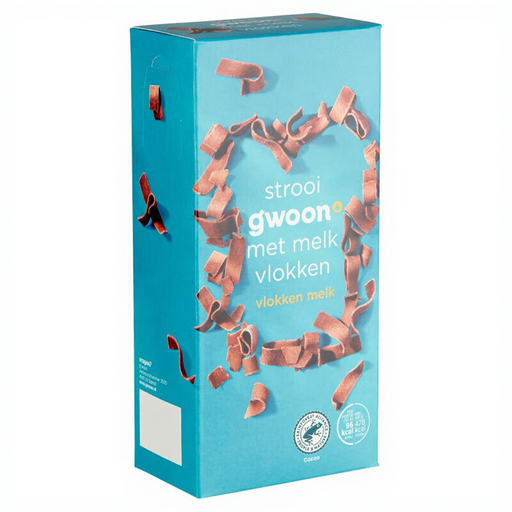 Image unavailable
A good choice if you want to serve milk chocolate flakes in their original packaging, without a separate shaker. The pack contains 300 g. Before serving, check the dispensing opening and the allergen information on the packaging.
Don’t use just any squeezy bottle for loose chocolate flakes: the HANOS bottle reviewed contains a smooth sauce and doesn’t show that dry flakes can be dispensed from it. If you decant the flakes, choose packaging intended for food contact; the Netherlands Food and Consumer Product Safety Authority classifies this type of packaging as food contact material.
You can’t work this out from the number of millilitres and the pack weight alone: volume and net weight are different measurements. Try one pack in your chosen container first, and check that both the filling and dispensing openings are wide enough for flakes.
Follow the cleaning instructions for your chosen container and only refill it once the container and lid are completely dry. For the shaker reviewed, Van Beekum Specerijen recommends washing it by hand; keep the product label with your stock too.
No. Check the packaging for the exact variety. PLUS lists milk, lactose and soya in De Ruijter Milk Chocolate Flakes, 200 g; don’t apply that information to dark flakes or another brand without checking the label.