Start with the allergens: the standard chocolate digestives reviewed contain wheat or gluten, milk and soya, while gluten-free varieties may contain other allergens too. If those ingredients aren’t a concern, choose a pack that suits the occasion and check the portion size. The name ‘digestive’ doesn’t, by itself, mean the biscuit aids digestion.
Who is this choice relevant to?
Parents keeping an eye on allergens
If your child needs to avoid certain ingredients, check the full packaging before choosing a chocolate digestive. The standard varieties reviewed contain wheat or gluten, milk and soya. With a gluten-free variety, the other ingredients and any ‘may contain’ statements still matter. If you want to send a biscuit in with your child, check the school’s policy too.
Parents looking to keep treats in check
For an after-school biscuit, the stated serving size and packaging make it easier to compare options. For everyday snacks, the Netherlands Nutrition Centre recommends options including vegetables and fruit for children aged 4 to 12.
Families looking for a store-cupboard option
If you’re buying a pack to share at home, consider how many biscuits or stated servings it contains, and whether you want to portion them out yourself. Compare the ingredients and allergens in branded and own-brand varieties too; a similar pack size doesn’t mean the labels are the same.
What should you look for when choosing?
First, check that the label meets your needs for relevant allergens and any school policies. Then compare the serving size, nutritional information and packaging for the occasion.
| What to consider |
What to check when buying |
Who it matters to |
| Allergens and school policies |
Read the allergen information and any ‘may contain’ statements on the pack; check the school’s policy before packing a biscuit. |
If my child needs to avoid certain ingredients or I want to send a biscuit in with them, I need to know whether this particular pack is suitable. For around 33% of consumers, this check comes first. |
| Portion size and taking it with you |
Compare the stated serving size and check whether you’ll need to portion out the biscuits yourself. |
I want to be able to offer a set amount after school, at home or on the go. Around 25% of consumers prioritise this practical choice of portion size. |
| Its place as a snack |
Read the nutritional information per 100 g and per stated serving, including sugars, saturates and fibre. |
When I offer a chocolate biscuit, I want to be able to consider the portion alongside the other snacks my child has that day. This is the most important factor for around 25% of consumers. |
| Packaging and keeping a supply |
Compare the pack weight, the number of stated servings and current availability. |
For home, I want to know whether a pack suits how often we share biscuits, without having to open more than we need. Around 17% of consumers put this choice of how much to keep in the cupboard first. |
Common mistakes
-
Assuming ‘digestive’ means it aids digestion
McVitie's product information at Jumbo states that the ingredients in the biscuit don’t contain substances that aid digestion. So the product name isn’t a reason to assume it has this effect.
Choose based on the ingredients, allergens, nutritional information and portion size you want, rather than the name.
-
Assuming gluten-free means allergen-free
The gluten-free chocolate digestives reviewed from Jumbo and Schär still contain milk and soya. Jumbo states that the variety in question may contain nuts; Schär lists eggs and lupin as possible allergens.
Check every pack for all the allergens relevant to your child, even if it says ‘gluten-free’.
-
Confusing a large pack with a set portion
A family pack to share at home calls for a different approach from a pack that’s already divided into smaller portions. The packaging format alone doesn’t tell you the nutritional value of a serving.
Check the stated serving size and decide how much you want to offer for the occasion.
-
Checking only the online ingredients list
Albert Heijn warns that product information can change when products are updated. This is particularly important when buying for a child with a relevant allergy.
Read the physical packaging before use, and check the school’s current policy if you’re sending a biscuit in with your child.
Brands compared
McVitie's
The range reviewed includes wheat biscuits with milk chocolate and with dark chocolate.
- The varieties reviewed come in 266 g packs and contain 30% chocolate, according to the product information.
- The varieties reviewed contain wheat, milk and soya. Jumbo’s McVitie's product information states that the biscuit contains no ingredients that aid digestion.
Verkade
The Verkade Verk digestive milk variety reviewed is a wheat biscuit with milk chocolate in a 400 g pack.
- According to Albert Heijn’s product information, this variety contains 30% milk chocolate.
- The listed ingredients include wheat, milk and soya; if you need to avoid any of these, always check the latest label.
Jumbo
The own-brand range reviewed includes standard 300 g milk and dark chocolate digestives, as well as a separate gluten-free milk chocolate variety.
- The varieties reviewed include options for those who prefer milk or dark chocolate, as well as a separate variety labelled gluten-free.
- The standard varieties contain gluten, milk, soya and wheat. The gluten-free variety contains milk, oats and soya, and may contain nuts.
AH
The AH digestive milk variety reviewed is a 300 g own-brand pack with milk chocolate.
- According to Albert Heijn’s product information, the variety reviewed contains 30% milk chocolate.
- The listed allergens include milk, cereals containing gluten, soya and wheat. Albert Heijn recommends checking the packaging, as product information can change.
Schär
The Digestive Choc variety reviewed is a chocolate digestive described by Albert Heijn as gluten- and wheat-free, packaged as 3 × 50 g.
- The three individually wrapped portions may be handy if you don’t want to open the whole pack at once.
- The variety reviewed contains milk and soya, and may contain eggs and lupin. So make sure you check the full label for this variety too.
Chocolate digestives at Joybuy
This selection features a standard milk chocolate digestive for an after-school treat, if wheat, milk and soya aren’t a concern.
 No image available
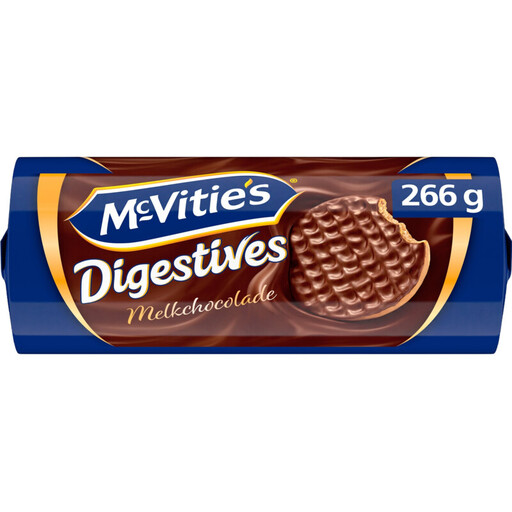
McVitie's Digestives Milk Chocolate 266 g
A milk chocolate digestive to share as a treat at home or portion out yourself. The pack contains 266 g; according to the product information reviewed, the variety contains 30% milk chocolate. The biscuit contains wheat, milk and soya. Check the latest label before use, and check the school’s policy if you want to send a portion in with your child.
View at Joybuy
Frequently asked questions
Are standard chocolate digestives gluten-free?
The standard varieties reviewed from Verkade, McVitie's, Jumbo and AH contain wheat or cereals containing gluten. For a gluten-free option, look for a product explicitly labelled as gluten-free, and check the packaging for other allergens too.
Does ‘digestive’ mean the biscuit aids digestion?
No, you can’t infer that effect from the name. Jumbo’s information for the McVitie's digestives reviewed states that the ingredients in the biscuit don’t contain substances that aid digestion.
Can I rely on the online product page for allergen information?
Check the packaging of the product you’re actually buying too. Albert Heijn warns that product information can change; the Netherlands Food and Consumer Product Safety Authority explains which allergens must be listed on the labels of prepacked foods.
Is a chocolate digestive an everyday choice for after school?
You can think of a chocolate digestive as a treat, but don’t let the product name dictate what you offer every day. For children aged 4 to 12, the Netherlands Nutrition Centre recommends options including vegetables and fruit for snacks; if you choose a biscuit, check the portion size and nutritional information.


