Consider chocolate-coated toast only as a sweet addition to your child’s school lunch, and only after checking the exact product’s label and the school or class rules. For an everyday lunch, wholemeal bread or wholemeal crackers, served with vegetables and fruit, are more in line with the recommendations from the Netherlands Nutrition Centre. Plain Melba toast can be a crunchy option, but it is not the same as chocolate-coated toast and is not necessarily a wholemeal staple.
Who is this choice for?
Parents of children in allergy-aware classes
You want to know whether an item in your child’s lunch fits the class rules and takes their allergies into account. So check the label of the exact product and, if your child has a known food allergy, discuss it with the school. The Dutch Food Allergy Foundation points out that mealtimes at school may require extra coordination for children with food allergies.
Parents considering a sweet addition
You’re looking for a little variety without letting sweet toast replace the usual lunch staples. The Netherlands Nutrition Centre recommends wholegrain products, vegetables and fruit as part of a school lunch, so treat a chocolate-coated option as a separate addition.
Parents looking for something crunchy to pack
You want something that’s easy to portion out in a lunchbox. Some plain Melba toast comes in small packets: Albert Heijn lists AH Melba toast naturel as containing twelve packets of six toasts. This tells you nothing about the packaging or allergens of a chocolate-coated version.
What should you look for when choosing?
First decide whether you’re looking for an everyday lunch staple or a sweet addition. Then check the allergens for each specific product, along with the school or class rules.
Wholemeal bread or crackers
A good choice when: you’re looking for an everyday school-lunch staple; the Netherlands Nutrition Centre recommends wholemeal bread and crackers, as well as vegetables and fruit.
Things to consider: choose your topping separately, and check the label of your chosen crackers too.
Plain Melba toast
A good choice when: you want crunchy toast that you can pack separately.
Things to consider: plain Melba toast has no chocolate coating and is not automatically a wholemeal lunch staple.
Chocolate-coated toast
A good choice when: you want to pack a sweet addition and the packaging of the specific product meets the school rules.
Things to consider: check the ingredients, allergens and portion size of that particular version; don’t assume they’re the same as those of plain toast or a recipe made with chocolate.
| What to consider |
What to check before buying |
Who it matters to |
| Allergens and class rules |
Read the allergen information and any warnings on the packaging. Ask what rules apply in the class. |
If my child has a food allergy, I want to know before packing whether this product is suitable under the class rules. This is the top priority for around 42% of consumers. |
| Its place in the everyday lunch |
Decide whether the toast is an addition or a replacement for the usual lunch staples; for a sweet version, check the nutritional information per portion. |
For an ordinary school day, I want to pack a lunch that follows the Netherlands Nutrition Centre’s advice on wholegrain products, vegetables and fruit. This is the main consideration for around 33% of consumers. |
| Taste and practicality |
Check the portion size, packaging and storage instructions for the version you’ve chosen. |
Every now and then, I’m looking for something crunchy and sweet that’s easy to pack neatly. Around 25% of consumers put this practical consideration first. |
Common mistakes
-
Confusing a recipe with a packaged toast product
A recipe made with chocolate or plain Melba toast won’t tell you which ingredients and allergens are in a specific chocolate-coated product.
Before buying, check the full product name and the ingredients and allergen information on the packaging of the exact product.
-
Assuming there’s a general school rule
Rules about food can vary from one school or class to another. A product label doesn’t replace those rules.
Ask the school or teacher what applies to the class. If your child has a known food allergy, check what they can bring with them.
-
Letting sweet toast replace the whole lunch
For school lunches, the Netherlands Nutrition Centre highlights wholegrain products, vegetables and fruit, among other things. A sweet chocolate version doesn’t automatically replace those staples.
Choose the usual lunch staples first, then consider a sweet option separately as an addition.
Brands and shops to consider
Albert Heijn
AH Melba toast naturel is a specific example of plain Melba toast, not chocolate-coated toast.
- Albert Heijn lists twelve packets of six toasts and provides ingredients, allergen information, nutritional information and storage advice for this product.
- According to the product page, this version contains cereals containing gluten, soya, barley and wheat; sesame, oats, spelt and rye may also be present.
Jumbo
The toast range includes various types of plain toast and crackers.
- The category includes products such as Jumbo Knapperige Toast and Van der Meulen Melba Toast Naturel.
- Check the product page or packaging of the item you choose; a category overview doesn’t provide an allergen assessment for every product.
Lidl
Lidl lists plain Melba toast as a product available in store.
- The product listing gives a pack size of 240 g.
- Check the ingredients and allergens on the packaging before choosing this toast for school.
Bolletje
Bolletje offers wholegrain light crackers, which could be a crunchy base for lunch.
- Bolletje says its light crackers are made from wholegrain cereals.
- The ingredients list for these crackers includes wholemeal wheat flour, barley malt extract and sesame seeds, among other things; check the label of the version you choose.
Plain Melba toast on Joybuy
This plain Melba toast is a crunchy option to consider alongside a school lunch. It isn’t chocolate-coated toast, so check the label and class rules before packing it.
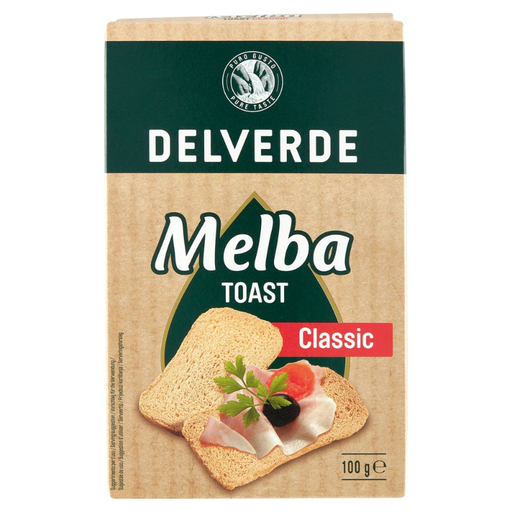 Image unavailable
Delverde Classic Melba Toast, 100 g
Plain Melba toast for anyone looking to pack something crunchy alongside lunch, without a chocolate coating.
100 g pack. Check the current packaging for allergen information, portion size and storage advice; if your child has a food allergy, discuss it with the school too.
View on Joybuy
Frequently asked questions
Can I pack chocolate-coated toast for school every day?
Don’t treat chocolate-coated toast as an everyday lunch staple by default. The Netherlands Nutrition Centre recommends wholegrain products, vegetables and fruit, among other things, for a school lunch. Consider any chocolate version as a separate sweet addition and check the label.
Do I need to check allergens in plain Melba toast too?
Yes, check the label of the pack you’ve chosen. The Netherlands Food and Consumer Product Safety Authority says that allergens must be clearly listed on pre-packed foods. For example, Albert Heijn lists cereals containing gluten, soya, barley and wheat in AH Melba toast naturel.
Can my child take chocolate-coated toast to school if there’s a child with a food allergy in the class?
That depends on the school or class rules and the exact product. Ask the teacher what rules apply, then check the allergen information on the packaging. Don’t assume it’s generally allowed or banned.
How should I store plain Melba toast after opening?
According to Albert Heijn, AH Melba toast naturel should be kept in a sealed container after opening. For another brand or a chocolate-coated version, follow the storage instructions on its packaging.


