
Buyer stocking a shared office cupboard
Wants to offer crispbread that’s practical to share and store. The pack format and storage advice help determine whether a product is right for the biscuit tin you have in mind.


Choose a pre-coated product only if the packaging confirms that the base really is crispbread. If you mainly want to offer crispbread in the shared office biscuit tin, regular crispbread with chocolate served separately is another option, but it isn’t the same product. In either case, check the allergens, nutritional information per 100 g and storage advice before sharing it.
Wants to offer crispbread that’s practical to share and store. The pack format and storage advice help determine whether a product is right for the biscuit tin you have in mind.
Wants to check the ingredients and allergens for the specific product before sharing it. The Netherlands Nutrition Centre points out that relevant allergens must be listed on the label.
Is looking for a crispbread base with chocolate, not just any chocolate-coated snack. Sonko lists chocolate-coated crispbread alongside other product types in its international range, so the exact product name and ingredients matter.
Choose this if: the chocolate coating needs to be part of the crispbread and the product packaging confirms this combination.
Bear in mind: the ingredients, allergens and storage advice apply to the whole product, so check them on the label.
Choose this if: regular crispbread is fine for the office and you’d like to offer the chocolate separately.
Bear in mind: this isn’t a pre-coated product; you’ll need to choose and serve both items separately.
| What to consider | What to check when buying | Most relevant to |
|---|---|---|
| Product type | Check that the name and ingredients confirm crispbread as the base and, if that’s what you’re looking for, a chocolate coating. | If I’m specifically looking for crispbread with chocolate, I don’t want to accidentally choose a chocolate-coated rice or corn cake. Around 42% of consumers put the exact product type first. |
| Serving and storage | Check the portion size and inner packaging, and follow the use-by and storage instructions on the label. | For a shared tin, I want to know how to serve and store the product once it’s opened. For around 33% of consumers, practical use is the top priority. |
| Ingredients | Read the ingredients and allergen information; compare the nutritional values of different products per 100 g. | If colleagues need to take ingredients or allergens into account, I want to be able to check the information on the current packaging. Around 25% of consumers put this check first. |
Rice and corn cakes have a different base. Sonko lists chocolate-coated crispbread and chocolate-coated cakes as separate product types.
If crispbread is a must, check the product name and ingredients.
A category for regular crispbread doesn’t confirm that a particular product is pre-coated with chocolate.
Check the individual product listing or the physical packaging to confirm whether it has a coating.
A picture or short description doesn’t provide the same information as the ingredients list, allergen information and nutrition table.
Read the current label and compare nutritional values per 100 g, as recommended by the Netherlands Nutrition Centre.
Albert Heijn lists products including Wasa Lichtgewicht and Wasa Protein+ wheat crispbread as regular crispbread options.
On its UK brand page, Ryvita presents crispbread, Thins and crackerbread as separate product ranges.
Albert Heijn lists AH wholegrain crispbread and has a separate crispbread category.
ALDI lists wholegrain and robust crispbread from Goud Gebakken as separate varieties.
Lidl Netherlands has product listings for regular and wholegrain crispbread.
These products are regular crispbread for the option where you serve the chocolate separately. They aren’t pre-coated varieties; always check the current packaging before putting them in a shared tin.
 No image available
A regular crispbread base if you want to serve chocolate separately, rather than a chocolate-coated variety.
Check the portion format, allergens and storage advice on the packaging before putting it in a shared tin.
 No image available
Regular crispbread for anyone who wants to serve chocolate separately; this product isn’t pre-coated.
Check the current packaging for how the contents are divided, and for the relevant ingredients, allergens and storage instructions.
 No image available
Regular crispbread for an office cupboard where chocolate is served separately, with no chocolate coating.
Check the packaging for how the contents are divided, as well as the ingredients, allergens and storage advice.
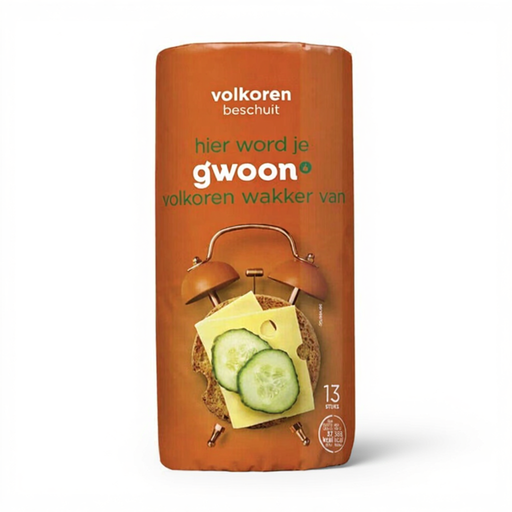 No image available
Regular crispbread for serving with chocolate separately; it isn’t a chocolate-coated product.
Check the packaging for the portion format, ingredients and allergens. To compare nutritional values, use the figures per 100 g on the label.
Read the allergen information on the current packaging for the complete product. The Netherlands Nutrition Centre lists allergens that may be relevant to a product, including cereals containing gluten, milk, soya, peanuts, nuts and sesame. Also check for any warning about possible traces.
Compare the nutritional values per 100 g, and read the ingredients list for both products too. The Netherlands Nutrition Centre recommends comparing products per 100 g so that differences in portion size don’t skew the comparison.
First, follow the storage advice on the packaging for the product you’ve chosen. Also check the use-by information and inner packaging before transferring the crispbread for everyone to share.
No. The general rule about adding iodine through baker’s salt doesn’t mean that every crispbread product contains iodine. Check the product packaging if iodine content is important to your choice.