What should you look for when choosing?
If you have coeliac disease, a clear gluten-free label is essential, even if fibre, sugar or other allergens are what ultimately influence your choice. Compare nutritional values on the same basis, preferably per 100 g, and then consider your usual portion size.
| What to check |
What to look for when buying |
Who is this most important for? |
| Gluten-free label |
Check the current packaging for a ‘gluten-free’ label or the Crossed Grain symbol. Also check the ingredients, especially if the product contains oats. |
If I have coeliac disease, I don’t want to assume a product is suitable based on the type of grain or a fibre claim. An estimated 42% of consumers put this certainty first. |
| Fibre content |
Compare fibre per 100 g. To make the EU ‘high fibre’ claim, a product must contain at least 6 g per 100 g or 3 g per 100 kcal. |
For a regular breakfast, I want to be able to see whether the gluten-free chocolate variety really does contain a lot of fibre. Around 33% of consumers give this the highest priority. |
| Sugars and other allergens |
Compare sugars, any added sugars, energy and fat per 100 g; check the ingredients and warnings about possible traces. |
I want to know whether the breakfast cereal contains ingredients I need to avoid as well as gluten, and how its nutritional values add up for my portion. This matters most to around 25% of consumers. |
Chocolate granola on Joybuy
These two pack options of Holie’s chocolate granola may suit you if you’re looking for gluten-free breakfast cereals with a stated fibre content of 14 g per 100 g. When buying, check the current packaging for the gluten-free label and allergens, especially oats and peanuts.
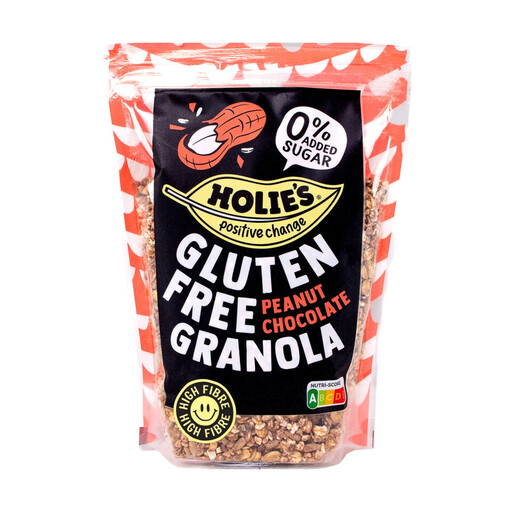 Image unavailable
Holie’s Granola Glutenfree Peanut Chocolate, 330 g
For anyone looking for chocolate granola with a clear gluten-free label and a high stated fibre content.
The product information states that it contains 14 g of fibre and 4 g of sugars per 100 g. Contains oats and peanuts; may also contain nuts and soya. For your usual portion, also consider the stated 438 kcal and 22 g of fat per 100 g.
View on Joybuy
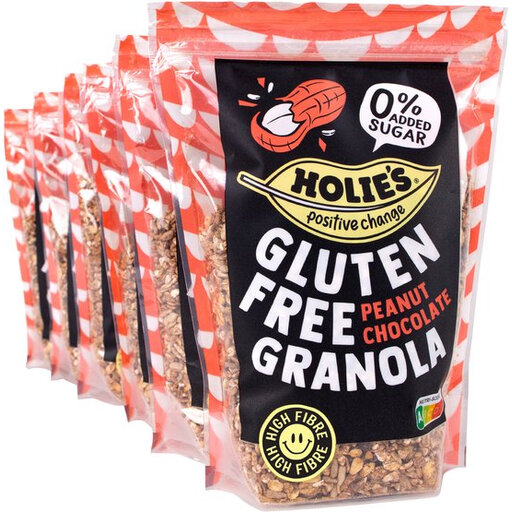 Image unavailable
Holie’s Granola Glutenfree Peanut Chocolate, 6 × 330 g
The six-pack is a good option if you plan to enjoy this particular chocolate granola regularly and the quantity suits your needs.
This granola variety is stated to contain 14 g of fibre per 100 g. It contains oats and peanuts and may contain traces of other nuts and soya. Check the gluten-free label and allergen information on the packs you receive.
View on Joybuy
Frequently asked questions
How can I tell whether chocolate breakfast cereals are suitable for coeliac disease?
Look for a clear ‘gluten-free’ label or the Crossed Grain symbol on the current packaging. Check the ingredients too: according to the Voedingscentrum, the type of grain alone isn’t enough to determine whether a product is gluten-free.
Are oats in chocolate granola automatically suitable for coeliac disease?
No. Oats on the ingredients list aren’t confirmation on their own. The Voedingscentrum warns that oats may be contaminated with gluten, so choose a product containing oats that has a clear ‘gluten-free’ label or the Crossed Grain symbol on the current packaging.
When can a breakfast cereal be called ‘high fibre’?
Under EU rules on nutrition claims, a product must contain at least 6 g of fibre per 100 g or at least 3 g of fibre per 100 kcal. If you compare chocolate breakfast cereals per 100 g, you can compare the stated fibre value directly with the first threshold; ‘source of fibre’ is a different claim.
What should I check in chocolate granola besides fibre?
Check the sugars, fat, energy and allergen information for each variety. For example, Albert Heijn states that Holie’s Peanut Chocolate contains peanuts and 22 g of fat per 100 g; a high-fibre label doesn’t replace these checks.
Should I check the packaging again if I buy the same product regularly?
Yes. Check the current gluten-free label, ingredients and allergen information every time you buy it. That way, you can base your choice on the packaging of the product you’re actually using, especially if you also need to avoid other allergens.


