
If you keep a close eye on sugar
You want to know what a claim on the front of the pack means, so you check total sugars per 100 g in the nutrition information.


Start by checking total sugars per 100 g: ‘no added sugars’ doesn’t mean a chocolate breakfast cereal contains no sugars. Then choose according to what matters most to you: keeping total sugars as low as possible, avoiding sweeteners, or getting a certain amount of protein and fibre. Check the ingredients, allergens and the portion you actually eat, too.
You want to know what a claim on the front of the pack means, so you check total sugars per 100 g in the nutrition information.
You want a sweet breakfast, but you also compare recipes with no added sugar for sweeteners, polyols and allergens.
You don’t choose based on the sugar claim alone: you also check the protein and fibre per 100 g, and what you add to your bowl.
First, compare chocolate breakfast cereals per 100 g for total sugars and ingredients. Then use the nutrition information per portion to assess your own breakfast; portion sizes on packs aren’t always the same.
| What to consider | What to check when buying | Who is it important for? |
|---|---|---|
| Sugar claim | Check ‘of which sugars’ per 100 g alongside the claim about added sugars. | I don’t want to rely on ‘zero’ or ‘0%’ if my breakfast still contains sugars. For around 36% of consumers, this check comes first. |
| Sweeteners | Check the ingredients for sweeteners and polyols; AH chocolate muesli lists maltitol. | A sweet chocolate flavour with no added sugar suits my preference, but I want to choose for myself whether to have sweeteners. Around 29% of consumers give this choice top priority. |
| Protein and fibre | Compare both values per 100 g, then consider your own portion. | If I eat chocolate cereal with yoghurt or quark, I want to know how much protein and fibre the cereal itself provides. This matters most to around 21% of consumers. |
| Portion size and availability | Compare nutrition values on the same basis, and check the portion size on the pack and current availability. | I want to know how much I actually serve and whether I can buy the same variety again. This is the main consideration for around 14% of consumers. |
According to Albert Heijn’s nutrition information, AH Krokante muesli chocolade 0% suiker still contains 0.6 g sugars per 100 g. So a claim about added sugars doesn’t tell you how much total sugar the product contains.
If you’re being strict about sugar, always check the ‘of which sugars’ figure per 100 g.
Albert Heijn’s chocolate muesli lists maltitol and 23 g polyols per 100 g. The product information also warns of a possible laxative effect if consumed in excess.
If you want to avoid sweeteners or polyols, check the current ingredients list rather than relying on the nutrition table alone.
The stated portions vary by product: Albert Heijn gives 40 g for its chocolate muesli, Jumbo gives 45 g for Quaker cruesli, and Nestlé gives 30 g for Fitness Pure Chocolade.
Compare per 100 g first, then calculate based on the amount you actually eat.
Two products with no added sugars can differ in protein, fibre, ingredients and allergens. One figure doesn’t tell you everything about a product.
As well as sugars, check the nutrition information and, if relevant to you, the allergens on the current packaging.
These brands show just how much chocolate breakfast cereals can vary. The values and points to note below apply to the specific varieties listed, not every product from each brand.
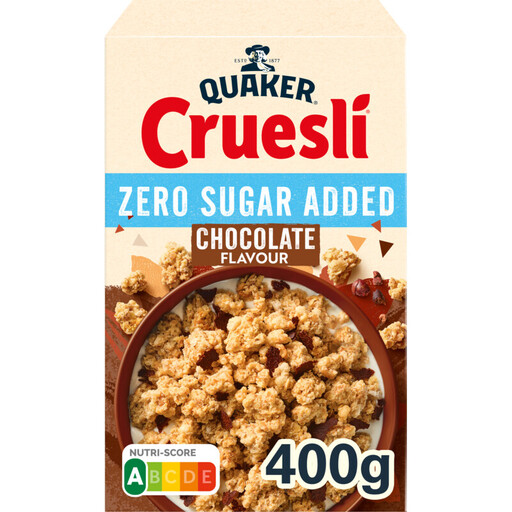
According to Jumbo’s product information, Cruesli Zero Sugar Added Chocolade is a crunchy chocolate cruesli with no added sugars or sweeteners.
AH Krokante muesli chocolade 0% suiker combines a claim about added sugar with a recipe that contains maltitol.
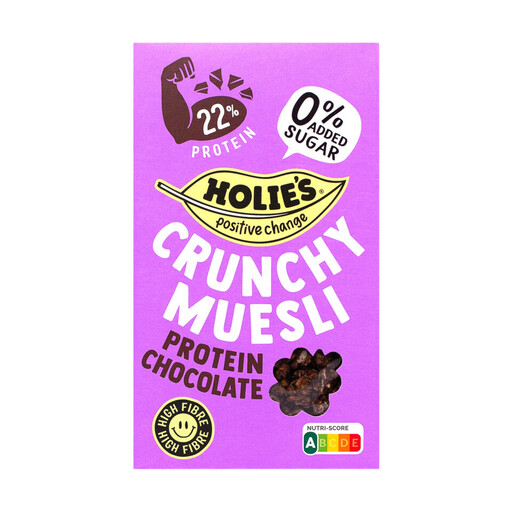
Crunchy Muesli Protein Chocolate is a chocolate muesli for anyone who wants to compare protein and fibre as well as added sugar.
Coco Pops Chocos is included here as a comparison with regular chocolate breakfast cereal, not as a no-added-sugar option.
Fitness Pure Chocolade is included here only as a product-specific comparison; the product information consulted is Belgian.
These two products suit anyone looking for a chocolate breakfast with no added sugar: Holie's muesli focuses on protein and fibre, while Quaker cruesli is an option with no added sweeteners. Check the total sugars and allergens for both before choosing.
 No image available
A chocolate muesli for anyone who wants to include protein and fibre in their choice of a breakfast with no added sugar.
The product information lists 2.1 g sugars, 22 g protein and 21 g fibre per 100 g. This variety contains oats and wheat, and may also contain nuts, peanuts and milk; if you have an allergy, check the current packaging.
 No image available
A crunchy chocolate cruesli for anyone who wants to avoid both added sugars and sweeteners.
The product information lists 3.4 g sugars and 21 g fibre per 100 g. This variety contains oats, wheat and milk, and may contain nuts; if you have an allergy, check the current packaging.
No: a product with no added sugars can still contain sugars. The Netherlands Nutrition Centre points out that this claim doesn’t mean the same as sugar-free, so check ‘of which sugars’ in the nutrition information per 100 g as well.
No, Albert Heijn lists 0.6 g sugars per 100 g for this variety. The claim about added sugar doesn’t replace the figure for total sugars; check both when you buy it.
For the chocolate varieties discussed here, Albert Heijn lists 22 g protein and 21 g fibre per 100 g for Holie's; Jumbo lists 8.7 g protein and the same 21 g fibre per 100 g for Quaker. Then compare this with the amount you actually eat.
Per 100 g, you can compare the nutrition values of different products on the same basis; your own portion shows how much you’re having. Packs use different portion sizes, so don’t assume a smaller stated portion means the product has a different composition.
Check the current ingredients and allergen information for the exact variety. The Quaker cruesli discussed here contains oats, wheat and milk, and may contain nuts; Holie's muesli contains oats and wheat, and may also contain nuts, peanuts and milk.