
If you want to compare fibre
You’re looking for a chocolate digestive and want to compare the fibre per 100 g with the rest of the nutritional information, rather than relying on the name ‘digestive’ alone.


Choose a chocolate digestive if you want to share a crunchy biscuit with chocolate this Valentine’s Day. Choose chocolate speculoos if you prefer that caramelised flavour. The name ‘digestive’ alone is no proof that a biscuit has any effect on digestion. Before you decide, compare the nutritional information and portion size, and check the label of the exact product if you have a dietary requirement or need to avoid allergens.
You’re looking for a chocolate digestive and want to compare the fibre per 100 g with the rest of the nutritional information, rather than relying on the name ‘digestive’ alone.
You’re looking for something to enjoy with coffee or tea and are choosing between a digestive base and the caramelised flavour of speculoos, with your favourite type of chocolate.
You have a specific dietary requirement or need to avoid certain allergens. Check the ingredients and allergen information on the exact pack; the product name or chocolate variety alone won’t give you enough certainty.
First decide whether you’re looking for a digestive, speculoos or a product explicitly labelled gluten-free. Then compare the information on the pack that matters most to you.
| What to consider | What to check when buying | Who it matters to |
|---|---|---|
| Fibre and ‘digestive’ | Compare fibre per 100 g, and check sugars and saturated fat on the same basis. Jumbo lists 4,1 g of fibre per 100 g for its Digestive Biscuit Pure Chocolade. | If I choose a digestive, I want to know how much fibre it contains without assuming anything from the name. For around 40% of consumers, this is the most important consideration. |
| Flavour and sharing | Check the biscuit base, type of chocolate and pack size. Lotus Biscoff with chocolate is speculoos, not a digestive. | For a Valentine’s Day treat to share, I mainly want to choose a flavour we’ll both enjoy; this preference comes first for around 30% of consumers. |
| Gluten and allergens | Check for an explicit dietary claim and the full allergen information for the exact product, including any relevant ‘may contain’ warnings. | If I need to avoid gluten or an allergen, the label determines which product I can consider. Around 20% of consumers put this requirement first. |
| Pack size and shop | Check the pack size and where the product you want is available. Lidl lists Sondey Digestives pure chocolade as available in store only. | I want to be able to pick up a suitable pack at the shop where I do my grocery shopping; for around 10% of consumers, this is the most important consideration. |
The product name doesn’t mean that a chocolate digestive aids digestion. For McVitie's Digestives Pure Chocolade, Jumbo states that the ingredients don’t contain substances that aid digestion.
Use the nutritional information to compare biscuits, rather than treating the name as a health claim.
For its Digestive Biscuit Pure Chocolade, Jumbo lists 4,1 g of fibre, as well as 27,4 g of sugars and 12,9 g of saturated fatty acids per 100 g.
Compare fibre, sugars and saturated fat on the same basis, and consider what counts as a portion for you.
Albert Heijn labels Schär Digestive choc as gluten-free and wheat-free, but also says it contains milk and soya and may contain eggs and lupin.
As well as checking the gluten information, check all the allergens that are relevant to you.
Albert Heijn points out that ingredients, nutritional values and allergen information can change.
Read the label on the pack you buy before relying on any dietary or allergen information.
Jumbo lists Verkade Digestive Chocolade Cream in a 205 g pack.
Lotus Biscoff with chocolate has a speculoos base rather than a traditional digestive base.
Albert Heijn lists a standard AH Digestive and also offers Schär Digestive choc.
Jumbo lists an own-label digestive with dark chocolate.
Lidl lists Sondey Digestives pure chocolade in a 300 g pack.
ALDI describes Biscotto Digestive Biscuits as crunchy wheat biscuits.
If you’re looking for a milk chocolate digestive to share, you could consider this variety. Check the current pack separately if nutritional values or allergens will affect your choice.
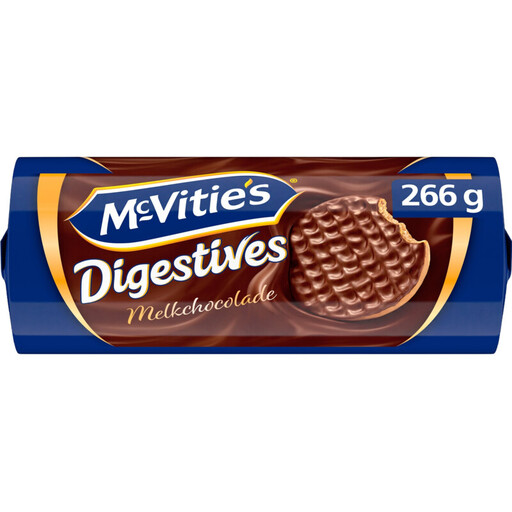 Image unavailable
An option if you’re looking for a milk chocolate digestive to share. The pack contains 266 g.
You can’t tell from the name ‘digestive’. For McVitie's Digestives Pure Chocolade, Jumbo states that the ingredients don’t contain substances that aid digestion. So compare biscuits using their nutritional information rather than assuming they have a particular effect.
Compare the fibre per 100 g and check the sugars, saturated fat and portion size at the same time. Jumbo lists 4,1 g of fibre per 100 g for its Digestive Biscuit Pure Chocolade; Lotus Bakeries lists 2,0 g per 100 g for Lotus Biscoff with chocolate. These are different types of biscuits, so don’t choose based on just one nutritional value.
No, don’t assume it is. Albert Heijn explicitly labels Schär Digestive choc as gluten-free and wheat-free, but also says that this variety contains milk and soya and may contain eggs and lupin. Check all the information on the pack you buy.
Follow the storage instructions on the pack for your chosen variety. Jumbo advises sealing its Digestive Biscuit Pure Chocolade well after opening and storing it in a dark place; instructions may differ for other biscuits.