
Vandaag of morgen in huis

Kwaliteit gegarandeerd

Welkomstaanbiedingen ontgrendelen: GRATIS bezorging | Tot 80% korting | Gratis 30 dagen JoyPlus-proefperiode
Download de app
A children’s RC car may seem straightforward to choose at first glance. However, a toy car with remote control, an RC stunt car and a 4WD RC car can differ considerably in terms of handling, speed, performance on different surfaces and maintenance. A model with lots of lights and sound effects is not automatically suitable for a young child. And a fast remote-controlled off-road vehicle can quickly prove too powerful or difficult to control indoors.
So before you place your order, pay particular attention to the following pitfalls.
High speed sounds appealing, but younger drivers usually benefit more from a low-speed setting and proportional steering. Also check where the car can be driven. An RC drift car often performs better on a flat surface, while an RC monster truck with treaded tyres may be more suitable for grass or gravel.
A rechargeable RC car means you do not need to keep buying separate batteries for the car, but the remote control often still uses AA or AAA batteries. So check:
Play time depends on speed, surface, temperature and driving style. Treat any stated usage time as a product specification under particular conditions, rather than a guarantee.
Product pages may state that a model is suitable from 3 years. This does not mean that independent play is always appropriate. Small parts, batteries, cables and accessories may pose risks. Check the warnings on the packaging and supervise young children closely. Also consider the noise level, speed and the space in which the car will be used.
A 4WD RC car is powered by all four wheels. This can help it get moving on grass, carpet or a slightly uneven surface. With a stunt car featuring independent wheel drive, the focus is also on manoeuvres such as moving sideways, tipping over and turning 360°.
A 6WD model has six driven wheels or a similar swivelling construction. This may be appealing for intensive off-road driving, but these models are often larger, heavier and more complex. For a child who mainly drives around the living room, a simple 2WD or compact 4WD car is often more practical.
Do not just look at the size of the car, but also consider:
Interpret a claim such as “all-terrain” in practical terms. Check whether the product description specifically mentions grass, sand, gravel or shallow water. Water resistance does not necessarily mean that the car is suitable for submersion.
A 2.4GHz remote control is commonly used with a radio-controlled car. According to the product descriptions of the models below, this frequency is intended to allow several cars to be driven at the same time without signal interference between them. The actual range depends on obstacles and the surrounding environment.
For beginners, simple buttons and a low-speed setting are useful. More experienced drivers may benefit from a gyro, adjustable steering sensitivity, two speed settings or a wrist strap with motion control.
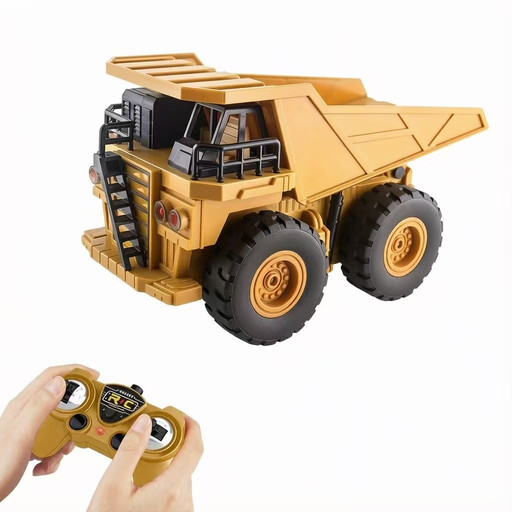
Why it suits this profile: This remote-controlled lorry has forward, reverse and turning functions, plus a tipping bed that can be raised using the remote control. This makes it suitable for calm imaginative play from the stated age of 3 years, with adult supervision.
The product description states that a 3.7V 500mAh battery and USB cable are included. The two AA batteries for the remote control are not included.
1:24 scale, LED headlights and rear lights, horn sound and a controllable tipping bed.
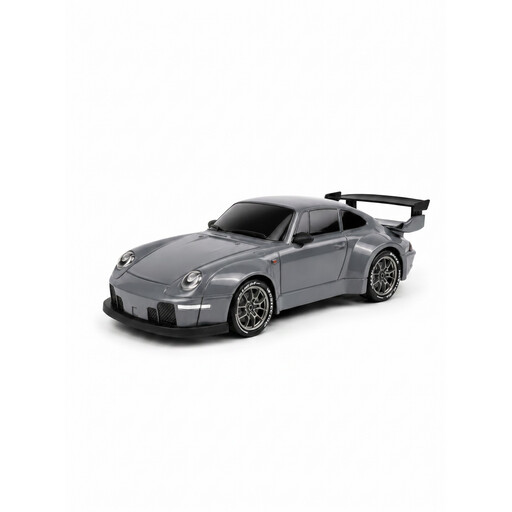
Why it suits this profile: This model is aimed at older children, teenagers and RC enthusiasts who want to learn to drift and eventually drive more precisely. The combination of a gyro, suspension and two sets of tyres offers more adjustment options than a basic toy car.
The low- and high-speed settings allow you to progress from beginner-level driving to faster speeds. However, check the age recommendation and use the model on a suitable surface.
4WD drive, adjustable gyro, LED lighting, independent suspension and interchangeable drift and racing tyres.
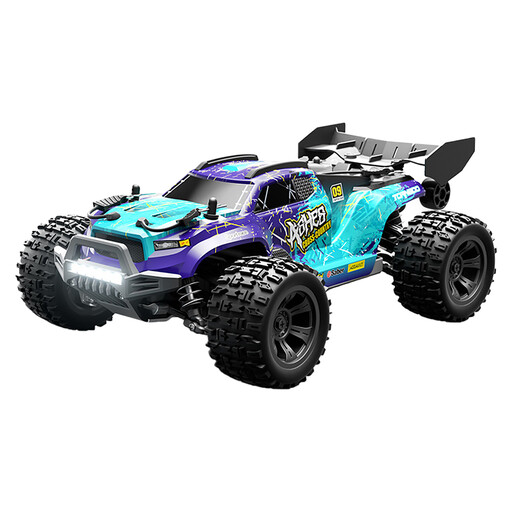
Why it suits this profile: According to the product information, this model is intended for teenagers aged 14 and over and adults who want to drive outdoors on grass, sand or gravel. It is less suitable for young children because of its higher speed and more powerful drive system.
The age limit and intended use are more clearly defined than with general toys. However, the included 7.4V 1500mAh battery and professional transmitter require careful use.
4WD, 7.4V battery, aluminium chassis plate, adjustable steering and deep-tread tyres for outdoor use.
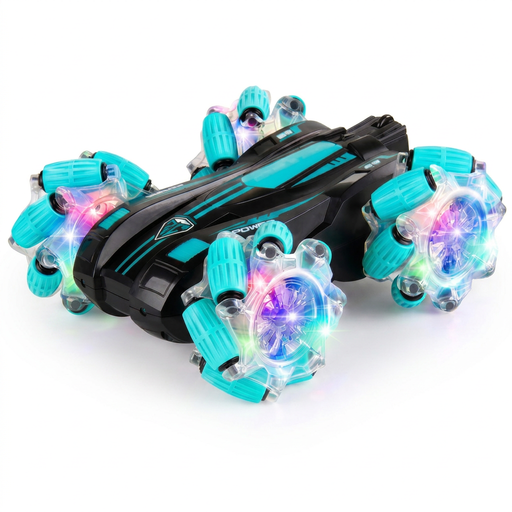
Why it suits this profile: For children who mainly want to spin, tip the car over and drive sideways, the Mecanum wheels and double-sided design are a great match. According to the product description, the car can be used indoors and outdoors on various flat or slightly uneven surfaces.
The car keeps moving after turning over and features an automatic demonstration mode. This reduces frustration for beginners, but supervision is still required when driving outdoors and in the event of collisions.
4WD, double-sided driving, sideways drifting, 360° turns and colourful LED lighting in the wheels.
We have put together a complete, up-to-date list of products that fully meet these strict selection criteria and the applicable European safety regulations.
Before using the car for the first time, check that the battery is connected correctly and that the remote control is paired according to the instructions. Never leave a battery charging unattended and store the car in a dry place. Remove sand and dirt from the wheels, and allow the model to dry completely after driving on wet grass.
For products with a spray or mist function, use only the specified water. According to the product description of some models, the spray is intended as a visual effect; do not add any other liquids. Also always check the CE marking, warnings, manufacturer details and EU responsible person on the product packaging or product page.
Choose a model with limited speed, simple controls and a clear minimum-age warning. A remote-controlled lorry or compact toy car is often easier to manage than a fast RC drift car. Direct supervision remains important, especially where small parts and batteries are involved.
This varies depending on the battery, motor, speed and surface. Product descriptions sometimes state a play time, but this will not be the same in all conditions. An additional compatible battery can be useful, provided that its voltage, connection and charging method match the instructions.
This depends on the tyres, ground clearance and protection of the electronics. Grass, paving and dry gravel are manageable for many off-road models, while mud, puddles and rain are only suitable when the manufacturer clearly states this. After outdoor use, always check the wheels, body and battery.
