
Vandaag of morgen in huis

Kwaliteit gegarandeerd

Welkomstaanbiedingen ontgrendelen: GRATIS bezorging | Tot 80% korting | Gratis 30 dagen JoyPlus-proefperiode
Download de app
Buying a children’s bike seems simple until you have to choose between a balance bike, tricycle, bike with stabilisers, BMX model or conventional bike. Age indications can help, but they are not enough. Your child’s height, the wheel size and how the bike will be used all determine whether it rides comfortably and safely.
Pay attention to marketing claims too. A low price may seem appealing, but a heavy frame or poorly adjustable saddle can quickly make a bike impractical. Conversely, a long list of features does not automatically mean that a model is right for your child.
A 2-year-old’s bike, 3-year-old’s bike or 4-year-old’s bike is often categorised by age. However, children of the same age can differ considerably in height and motor development. Use age as a guideline, then always check the recommended height, saddle height and stand-over height.
A 20-inch children’s bike or 24-inch children’s bike may seem appealing because your child could use it for longer. However, if the frame is too large, mounting, braking and steering can be difficult. A well-fitting bike that your child can control now is usually more practical than a model they still need to grow into.
A basket, bell or striking colour can make a bike more appealing, but says little about how easy it is to use. Focus mainly on the brakes, chain guard, steering limiter, tyres and frame strength. According to the product descriptions of some models, several braking systems are included; check on arrival that they have been fitted and adjusted correctly.
Wheel sizes provide an initial indication. The right choice also depends on your child’s height, inside leg measurement and experience.
A boys’ bike and a girls’ bike do not necessarily differ technically. Choose based on size, riding position, brake operation and intended use. Colour and accessories are a matter of personal preference.
For a first bike, your child’s feet do not necessarily need to rest completely flat on the ground, but they should be able to mount and dismount in a controlled manner. With a balance bike, sufficient contact with the ground is important for learning balance. Check whether the saddle can be set to the correct height without tools or with a simple adjustment.
A heavy bike can be difficult for a small child to steer and lift. According to product descriptions, an aluminium frame is often lighter than a steel frame, while steel generally offers a robust construction. Look at the total weight, not just the frame material.
For young beginners, wide tyres and a simple drivetrain are easier to understand. An enclosed chain guard helps limit contact with the chain. Hand brakes can become more important for older children. A BMX bike often has a U-brake, rotor and stunt pegs; these components require additional checks and are not intended to replace protective clothing.
Check before every ride:
Always use a suitable helmet and supervise young children. A manufacturer may provide specific safety advice; according to the product information for the models mentioned, use on public roads is discouraged for some toddler and balance bikes.
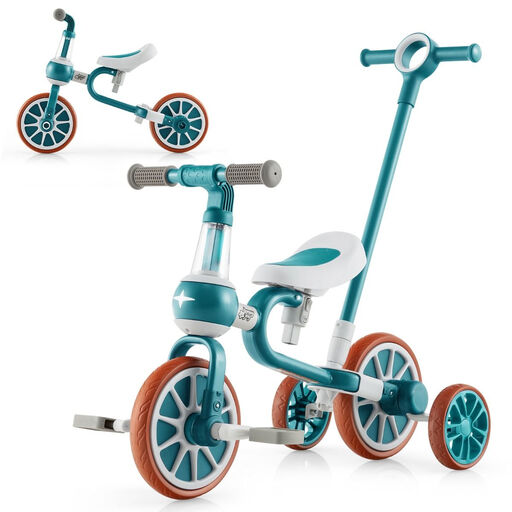
Why it suits this profile: According to the product description, this children’s tricycle is intended for children aged 2 to 4 and can be used in several modes. The parent push bar is useful on walks when your child is not yet able to steer independently.
According to the specifications, the saddle height can be adjusted from 33 to 37 cm. The pedals and training wheels can also be removed, allowing you to adapt the configuration.
Four modes according to the product information, EVA wheels and a maximum load capacity of 30 kg.
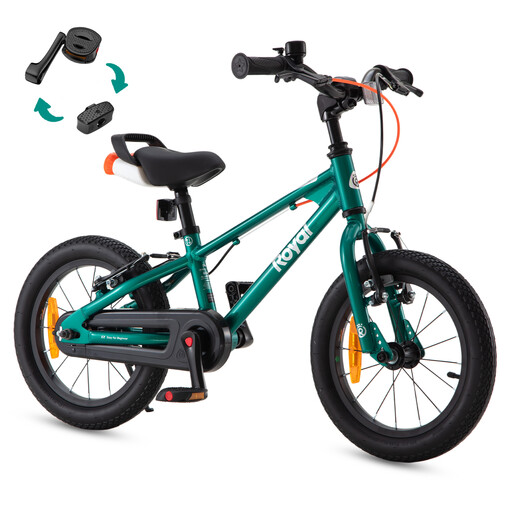
Why it suits this profile: According to the product specifications, this 14-inch children’s bike is aimed at children aged 3 to 5. The aluminium frame weighs 7.4 kg according to the stated specifications, and the low step-through design can make mounting easier.
The model has an adjustable saddle and handlebars. The manufacturer also describes a system that allows you to switch between balance and pedal modes.
Aluminium frame, low step-through design and two hand brakes according to the product information.
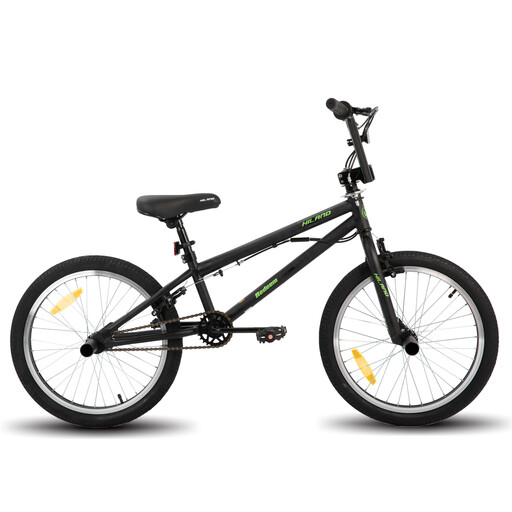
Why it suits this profile: This model is aimed at children and teenagers considering freestyle riding, tricks or riding on unpaved terrain. It is not a conventional school bike for young beginners.
The product description lists a 360° rotor, U-brakes and wide 20 × 2.35-inch tyres. Check the rotor, brake pads and bolts before every ride.
Steel freestyle frame, wide tyres and stunt pegs included according to the product information.
For older children, a 24-inch or 26-inch children’s bike may make more sense than a children’s mountain bike. Look for mudguards, lights, storage space, brake type and adjustable handlebars. According to the product description, the RoyalBaby XCOOL 24-inch comes with disc brakes, wide tyres, mudguards, a dynamo light and a luggage box with a stated maximum load of 25 kg. According to the same information, the 26-inch version is intended for a height of 150 to 178 cm.
Claims such as “weatherproof”, “puncture-resistant” or “extra safe” should be read as information provided by the manufacturer. Check the specific details and usage limitations before placing your order.
We have put together a complete, up-to-date list of products that fully meet these strict selection criteria and the applicable European safety regulations.
A balance bike or children’s tricycle is often a sensible starting point. Choose a model that allows your child to place both feet firmly on the ground. A 12-inch bike with stabilisers may also be suitable, but always check the minimum saddle height and recommended height.
It varies from child to child. Once your child can balance independently, ride in a straight line and brake in a controlled manner, the stabilisers can be removed. A bike with adjustable components or a model that switches from balance mode to pedal mode can make this transition easier.
Its lifespan depends on use, storage and maintenance. Check the brakes, tyres, chain, handlebars and fixing bolts regularly. Ideally, store the bike somewhere dry and wipe away mud or rainwater. A bike that is still mechanically sound but has become too small can be replaced before its components wear out.
