
Vandaag of morgen in huis

Kwaliteit gegarandeerd

Welkomstaanbiedingen ontgrendelen: GRATIS bezorging | Tot 80% korting | Gratis 30 dagen JoyPlus-proefperiode
Download de app
Buying a children’s bike seems straightforward until you have to choose between 12, 14 or 16 inches, a girls’ or boys’ bike, stabilisers or a kickstand. A striking colour tells you little about how easy the bike is to use. A low price may also be less appealing if the bike is outgrown quickly or difficult to assemble.
Focus instead on wheel size, your child’s height, brakes, adjustability and included accessories. Below, you’ll find the main things to consider, along with some suitable models for different family situations.
Age is a guide, not a fixed rule. Children of the same age can vary considerably in height and inside leg length. According to the product information, a 12-inch children’s bike may be suitable for a height of around 80 to 105 cm, while a 16-inch children’s bike is listed for children around 105 to 135 cm tall.
Always check:
A bike that’s too big can feel intimidating. One that’s too small leaves little room to grow and may need replacing before long.
A basket, bell or eye-catching frame can make a bike more appealing, but doesn’t automatically tell you anything about its braking performance or stability. Check whether the bike has a full chain guard, protected handlebar ends and a suitable braking system.
The Hiland Starry models listed feature a combination of a front V-brake and a rear coaster brake. According to the product information, the 12- and 14-inch versions come with stabilisers, while the 16-inch models include a kickstand. Before every ride, check that the brakes work properly and all fixings are secure.
A bike delivered mostly assembled isn’t necessarily ready to ride. The handlebars, pedals, saddle, brakes and accessories all need to be fitted and adjusted correctly. According to the product description, the Hiland models arrive around 90% assembled. The remaining assembly takes approximately 20 minutes using the tools provided.
After assembly, check:
Wheel size is a useful starting point, but your child’s height is the deciding factor.
Don’t look at diameter alone. A bike weighing around 9 kg for a 12-inch model and around 11.5 kg for a 16-inch model may feel heavy to a young child. An adjustable saddle helps you get a better fit, but can’t make the bike grow indefinitely.
For a bike for children aged 2 to 7, easy operation and predictable handling are important. A single-speed drivetrain means your child won’t have to change gear while learning to ride. Wide tyres, such as the listed 1.95-inch size, can feel stable on paved paths. The actual riding experience also depends on tyre pressure, the surface and how well the bike is adjusted.
Also look out for:
The terms girls’ bike and boys’ bike mainly refer to the colour and design. The important technical factors are size, riding position, brakes and weight. So choose based on fit and how the bike will be used, not just its colour.
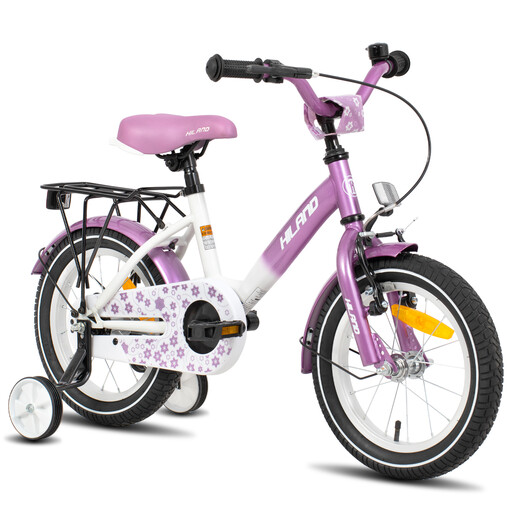
Why it suits this rider: According to the product specifications, this beginner’s bike is designed for children aged around 2 to 4 and measuring 80 to 105 cm. Stabilisers, a basket and single-speed operation are included.
The recommended height, adjustable saddle position and included stabilisers make it easier to assess the fit and suitability for a beginner in advance.
12-inch tyres, front V-brake, rear coaster brake, chain guard and product weight of around 9 kg.
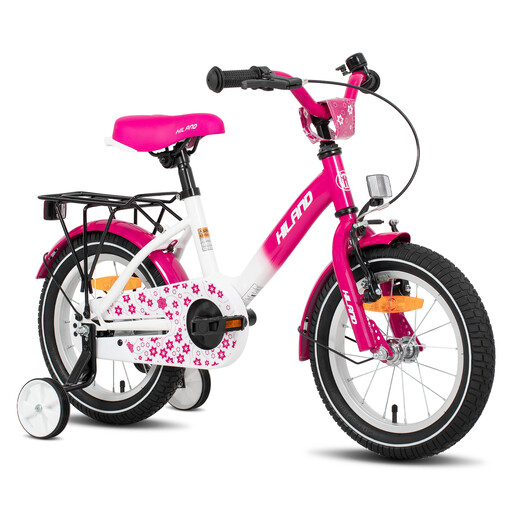
Why it suits this rider: The 14-inch size is a middle ground for children aged around 3 to 6 and measuring 90 to 125 cm. This model combines adjustability with a low step-through frame and accessories for everyday use.
The product specifications list an adjustable saddle, two braking systems and an assembly level of around 90%, so you can check the key features in advance.
14-inch tyres, basket, stabilisers, Hi-ten steel frame and a combination of V-brake and coaster brake.
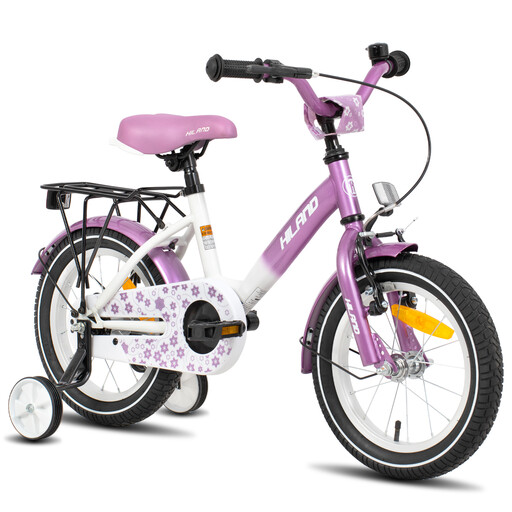
Why it suits this rider: According to the product description, this model is designed for children aged around 4 to 7 and measuring 105 to 135 cm. The included kickstand is suited to children who ride without stabilisers.
The size and recommended height range are clearly stated. This lets you check whether the larger bike is a good fit in advance, rather than choosing based on age or appearance alone.
16-inch tyres, single-speed drivetrain, front V-brake, rear coaster brake, basket and kickstand.
We’ve put together a complete, up-to-date list of products that meet these strict selection criteria and the applicable European safety regulations.
If your family has several bikes, a compact bike rack for 2 bikes can save space in a storage area, garage or garden. Check the available floor space and how the rack is secured.
The vidaXL rack for two bikes measures 43,5 × 33 × 26 cm, is made from galvanised steel and weighs around 2,06 kg according to the product specifications. Its design keeps both bikes on the ground. Screws and plugs are listed as included for anchoring. Check in advance that your floor is suitable and that the tyres fit the holders.
You can view the vidaXL bike rack for 2 bikes as an addition to a children’s bike or family bikes.
Start by checking your child’s height. A 12-inch bike is often recommended for children measuring around 80 to 105 cm, while a 14-inch model may be suitable for around 90 to 125 cm according to the specifications listed. Also check the lowest saddle position and whether your child can get on and off safely.
Stabilisers can offer support during the early stages, but they’re no substitute for supervision or correct adjustment. Check regularly that both stabilisers are level, and remove them once your child has developed enough balance.
Clean the frame with a damp cloth, check the tyre pressure and test the brakes regularly. Also look for loose bolts, worn tyres and secure fittings on the basket, kickstand or stabilisers. Have any damaged parts checked before using the bike again.
