
Vandaag of morgen in huis

Kwaliteit gegarandeerd

Welkomstaanbiedingen ontgrendelen: GRATIS bezorging | Tot 80% korting | Gratis 30 dagen JoyPlus-proefperiode
Download de app
Buying a children's bike helmet may seem straightforward, until you realise how similar so many models look. A helmet with an attractive design, ventilation holes or a light is not automatically suitable for every child or activity. Fit, intended use and verifiable safety information matter more than attention-grabbing marketing claims.
For children aged around 5 to 13, these are the main pitfalls to avoid:
Use a soft tape measure around the head, approximately 1 to 2 centimetres above the eyebrows and across the widest part of the back of the head. Keep the tape measure close to the head, but do not pull it tight. Note the measurement in centimetres and compare it with the manufacturer's stated range.
A children's helmet size S is often intended for smaller head circumferences, while a children's helmet size M offers more room for older children. However, the letters S and M are not standardised. The stated range, such as 48–52 cm or 52–56 cm, is therefore more important than the letter on the label.
An adjustable children's bike helmet should remain firmly in place when the dial is adjusted. The helmet should sit horizontally and must not tilt backwards. You should be able to fit approximately one finger between the chin and the strap.
For bike helmets in Europe, EN 1078 is a relevant standard for helmets for cyclists, skateboarders and roller skaters. Look for the CE marking, reference to the standard, manufacturer details and warnings on the packaging or product page. A reference to an American standard, such as CPSC, is not the same as a European standard.
According to the product description, the DKONI HS-001 complies with CPSC1203, ASTM1447 and CE1078. This is verifiable information from the product specifications provided. The materials and intended uses are listed for other models in this overview, but the information supplied does not include a European standard for every model. Always check the current product page before ordering.
Also note the warning that no helmet can protect against every impact. Replace the helmet after a hard fall, visible damage or a deep dent, even if the outside appears to be in good condition at first glance.
For everyday cycling around town, ventilation, low weight and a simple fastening system are practical features. A removable liner is useful if a child wears the helmet frequently. Check whether the liner can be hand-washed and allow it to air-dry.
For BMX, dirt biking or intensive use, a full-face children's helmet can offer extra coverage around the chin and face. It is usually heavier and warmer than an open model. Choose this type of helmet only if the child can wear it comfortably and the product description supports the intended use.
An integrated rear light or a light on the adjustment dial may help improve visibility in low-light conditions. According to RoyalBaby's product description, the light has three modes and six red LEDs. This is a product specification, not a guarantee that other road users will always notice the child.
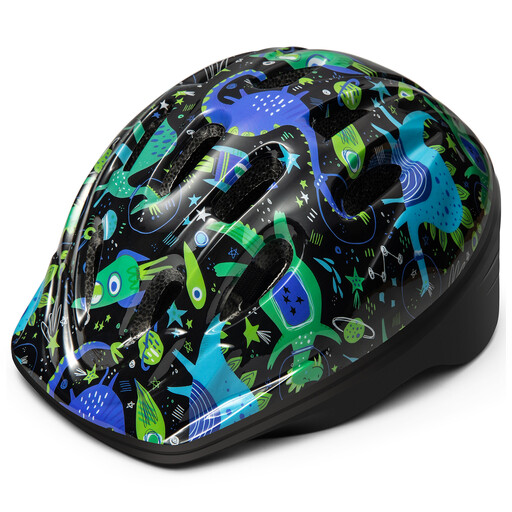
Why it suits this profile: This model is designed for children aged 5 and over and is suitable for cycling, skateboarding and scooting. Size S is practical for a smaller head, provided the size range matches the measurement.
The adjustment dial, chin strap and two removable liners provide more ways to fine-tune the fit than a helmet with a fixed internal size.
ABS outer shell, EPS inner layer, adjustable fit and washable liners. CPSC is mentioned in the product description; check the European standard before buying.
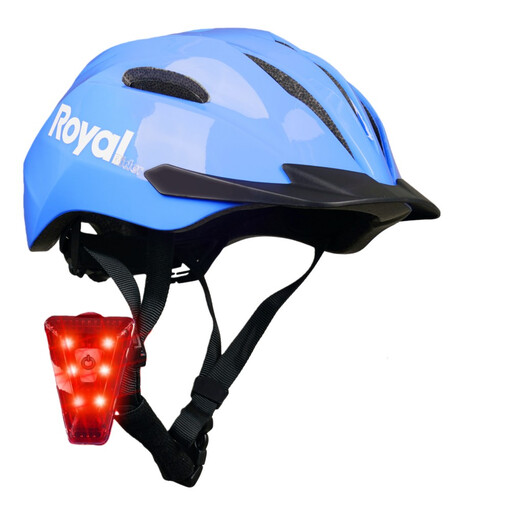
Why it suits this profile: Suitable for families looking for one lightweight helmet for cycling, scooting, skateboarding, roller skating and balance bikes.
The adjustable fastening system and breathable, removable liner help prevent the helmet from sitting too loosely or becoming uncomfortable quickly.
PC shell with EPS foam, a weight of 250 grams, ventilation openings and a rear light with three modes according to the product description.
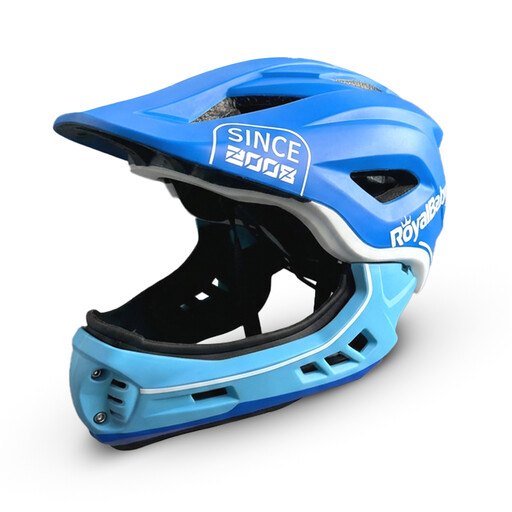
Why it suits this profile: An option for BMX, dirt biking and other activities where extra coverage around the face may be desirable.
The removable chin guard makes the intended use clearer than with a standard children's helmet. Use the full-face configuration only when it fits properly and the child can move comfortably while wearing it.
2-in-1 design, adjustment range of 20–23 inches, removable liner, ventilation openings and a light on the adjustment dial according to the product specifications.

Why it suits this profile: The available S, M and L sizes make this model an interesting choice for families comparing different head circumferences.
The size ranges of 48–52, 52–56 and 57–61 cm prevent you from relying solely on age or the letter indicating the size.
ABS shell, EPS foam, adjustment dial, removable inner pads and, according to the product information, CE1078 alongside CPSC1203 and ASTM1447.
We've compiled a complete, up-to-date list of products that fully meet these strict selection criteria and the applicable European safety regulations.
A children's helmet should fit firmly and securely without creating pressure points. When you move the head gently, the helmet should not shift noticeably from side to side. The chin strap should sit close to the skin, but must not feel tight. Let the child wear the helmet for a few minutes and check that it does not cause any irritation.
There is no fixed lifespan that applies to every helmet. Replace the helmet after a fall or collision, if there is visible damage, or when the fastening system or adjustment dial no longer works properly. A new helmet is also needed once the child has outgrown the size range. In addition, check the manufacturer's care and replacement information.
Only if the manufacturer lists these activities as suitable. According to their product descriptions, several models in this overview are suitable for cycling, scooting and skateboarding. A children's multisport helmet is therefore practical, but always check the standards, fit and usage warnings for the specific sport.
