
Vandaag of morgen in huis

Kwaliteit gegarandeerd

Welkomstaanbiedingen ontgrendelen: GRATIS bezorging | Tot 80% korting | Gratis 30 dagen JoyPlus-proefperiode
Download de app
A children’s night light can help with night-time feeds, nappy changes, checking on your child during the night or creating a regular bedtime routine. However, many models look similar, even though they can differ considerably in use. A bright light can illuminate a baby’s room unnecessarily, a model with a small battery may run out quickly, and a decorative lamp isn’t always suitable for young children.
This guide helps you compare a baby night light, a portable night light and an LED night light based on the features that matter in everyday use.
Animal designs, soft silicone and colour-changing lights can make a lamp an attractive gift. Also check how it’s operated, whether it has a timer and how stable it is on a bedside table. A pretty night light that’s difficult to switch on during a night-time feed often ends up unused.
A brand may describe a lamp as soft or soothing, but that isn’t a fixed technical standard. Instead, look for specific details such as dimmable settings, colour temperature, lumens or a separate warm-white mode. According to the product information for various models, some have three brightness levels, five dimming settings or stepless dimming. You’ll notice the difference most when using the light both at bedtime and during nappy changes.
The stated maximum battery life often applies to the lowest brightness setting. For example, the VAVA VA-CL009 is listed as lasting up to 100 hours at its lowest brightness; at maximum brightness, the stated battery life is around 7 hours. So always compare battery capacity, charging time and how you plan to use the light. A rechargeable night light is handy, but only if you can charge it in time.
For a night light in a baby’s room, a warm, low-light setting is often more practical than a bright ceiling light. Look out for:
RGB colours are mainly decorative. They aren’t essential for night-time feeds or nappy changes. If practical lighting is your priority, choose a model with warm white light.
A night light with a timer switches off automatically, so it won’t stay on all night. Timer lengths vary by product: some models offer 30 minutes, others 1 hour, or 30, 60 and 90 minutes.
A night light with a motion sensor can be useful on the landing, in the hallway or by the changing table. Check the detection distance and light threshold. According to the product specifications, one available model activates at a maximum of 20 lux and has a detection range of 3 to 5 metres. In a baby’s room, however, the sensor may also be triggered when someone walks past. A continuous low-light setting may be more predictable.
Before buying, check:
A CE mark isn’t an independent quality certification. Also check the safety warnings, age guidance and care instructions. A product description may mention materials such as BPA-free or food-grade silicone; treat this as information from the manufacturer and check the full product page.
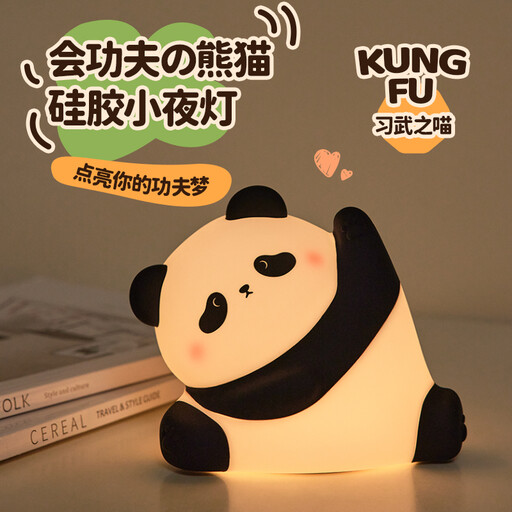
Why it suits this profile: This compact baby night light has a familiar panda design, touch controls and three brightness levels. According to the product information, it comes with a 1200 mAh rechargeable battery.
You don’t have to rely solely on a decorative design: the dimming settings and USB charging function are clearly specified. Before use, check the warnings and keep the device out of a baby’s reach.
Three dimming settings, touch controls and a 1200 mAh rechargeable battery.
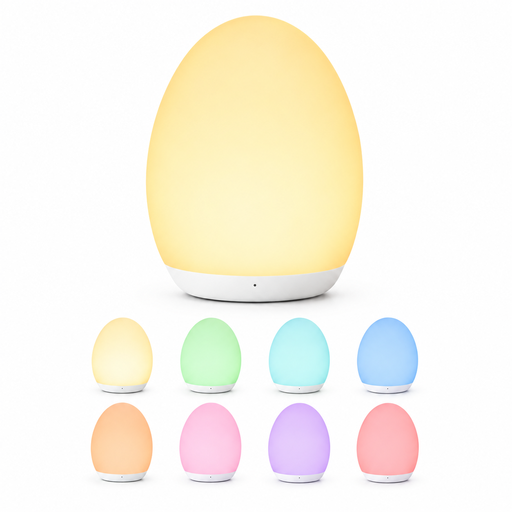
Why it suits this profile: This rechargeable night light combines warm white light, eight colour modes, touch controls, a memory function and a one-hour timer. According to the product information, it weighs around 155 grams.
The stated battery life is broken down by brightness level. This makes it easier to assess the claim realistically than when only a maximum battery life is given.
Dimmable warm white light, eight colours, a memory function and a 2000 mAh battery.

Why it suits this profile: These two compact lights are designed for situations where you need automatic lighting, such as in the hallway, on the landing or by a changing table.
The product specifications give more than just the presence of a sensor: they also state a detection range of 3–5 metres, a threshold of up to 20 lux, and both a sensor mode and a standard lighting mode.
Two lights, three colour temperatures, five dimming settings and USB-rechargeable 500 mAh batteries.
We’ve put together a complete, up-to-date list of products that meet these strict selection criteria and the applicable European safety requirements.
That depends on its design, controls and safety information. Choose a model intended for indoor use, with no small parts within reach, and that can be placed outside the cot or bed. Never put a lamp with a cable within a baby’s reach.
Battery life varies depending on the battery, brightness and light mode selected. A lamp may last considerably longer on its lowest setting than at maximum brightness. So check both the battery capacity and the stated battery life for each setting. If you use it every day, set a regular time to recharge it.
A low-wattage LED light generally uses little electricity. A 0.5 or 1 watt model uses a different amount of power from a lamp left on for hours at a higher setting. With a battery-powered model, you mainly pay for recharging; with a plug-in model, its wattage and how long it’s left on determine its consumption. A timer can prevent it from staying on unnecessarily long.
