
Workshop host using several oven dishes
You want to bake dishes so they’re ready to serve at the same time. So, first check whether the dishes will actually fit, rather than relying solely on the oven’s stated capacity.


First, choose based on how many oven dishes you need, their external dimensions, and the available space and connection. Then compare the heating settings and cleaning options. A spacious built-in oven may suit several dishes being cooked at the same time, while a freestanding oven may be an option if there is no suitable built-in space—provided your dishes fit. Neither option replaces a separate check that the chicken is safely cooked through; the Voedingscentrum advises heating chicken thoroughly.
You want to bake dishes so they’re ready to serve at the same time. So, first check whether the dishes will actually fit, rather than relying solely on the oven’s stated capacity.
If there’s no suitable built-in space, a freestanding oven may be an option. Also check where it can be positioned, the dimensions of your dishes and the instructions for safe use.
You want to plan repeated baking and cleaning practically. A cleaning function does not replace hygienic cleaning of the oven, dishes and workspace.
Start with your dishes and the available space, then work out how many batches you’ll need and what cleaning routine will suit the workshop.
| What to consider | What should you check? | Who is this important for? |
|---|---|---|
| Oven space at the right time | Measure the external dimensions of your dishes and compare them with the usable interior space and permitted shelf positions. The stated capacity in litres doesn’t prove that the dishes will fit at the same time. | If I want to bake several dishes so they’re ready to serve at the same time, I’d rather check the measurements than just the capacity. Around 33% of consumers prioritise being able to bake several dishes at once. |
| Checking that chicken is cooked through | Keep raw chicken separate from cooked food and check that it is cooked through independently. For applicable professional food preparation, the NVWA recommends cooking chicken to 75 °C or above, checked with a digital probe thermometer. | If you want to check that chicken is safe while cooking, a method you can verify is more useful than relying on a timer alone. Around 27% of consumers make cooking chicken their top priority. |
| A suitable set-up | For a built-in oven, compare the specified niche dimensions with your kitchen. For a freestanding model, follow that model’s positioning and safety instructions. | If there’s no suitable built-in space or the workspace is temporary, I want to know where a freestanding oven can be positioned safely. Around 20% of consumers choose mainly based on the available set-up. |
| Cleaning after use | Compare each model’s specific cleaning method with how often you bake, and follow the instructions for using a cleaning cycle. | For regular workshops, I want to be able to organise cleaning practically after each session. Around 13% of consumers give cleaning top priority. |
| Energy use for the right size | Compare energy use on a like-for-like basis, and don’t choose a larger oven based on its energy label alone. Milieu Centraal points out that a smaller A+ oven may use less energy than a larger A+++ oven. | If the dishes I need to use already fit, I also want to factor in energy use without overlooking capacity. Around 7% of consumers put energy consumption first. |
The number of litres doesn’t tell you how much space your dishes take up or how much room will be left between them. If they don’t fit together, you may need to plan more batches.
Measure your dishes and the available oven space, then plan serving times around the batches that will actually fit.
A timer records how much time has passed, not whether the chicken is safely cooked through. A browned top doesn’t guarantee this either.
Keep raw and cooked ingredients separate, and check the chicken using the applicable food safety method.
Milieu Centraal notes that a smaller A+ oven may use less energy than a larger A+++ oven. So, a better energy label alone doesn’t automatically make a larger oven the right choice.
Compare ovens that can accommodate the dishes you need, and assess their energy use on a like-for-like basis.
The built-in models listed differ in their heating settings and cleaning methods, among other features.
The freestanding OV457B is an option to compare if there’s no suitable built-in space.
The NBU5P40SM built-in oven is a model to compare if capacity and pyrolytic cleaning are important to you.
The HB457G0B3F built-in oven is an alternative to compare if you’re looking for fan-assisted cooking and telescopic rails.
This selection includes built-in ovens and a mini oven. Before the workshop, check the available space, the dimensions of your dishes and the installation requirements for your chosen model.
 No image available
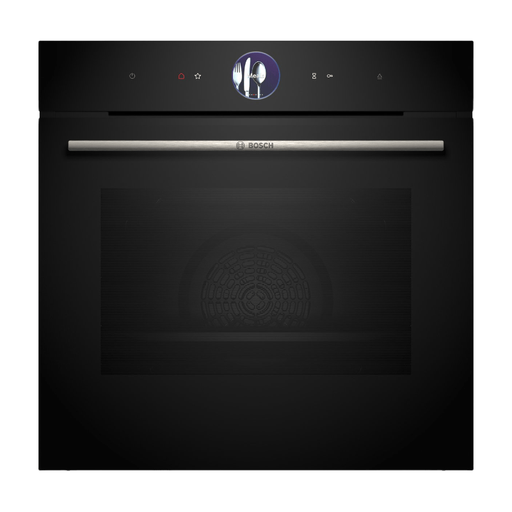
A built-in option to compare if you’re looking for a fixed oven set-up with fan-assisted cooking; check the niche and the dimensions of your dishes.
The product name lists 3 kW, grill and pizza functions, AquaClean steam cleaning, a timer and energy label A.
 No image available
A model to compare if you’re looking for a built-in steam oven; check that the niche and your preferred cooking method are suitable for your workshop.
The product name lists a size of 60 × 60 cm and an Air Fry function.
 No image available
A compact mini oven to compare if you’re looking for a smaller set-up; check whether your dishes will fit and whether the capacity is sufficient.
The product name lists two zones and 15 programmes.
 No image available
A built-in model to compare if 3D hot air and pyrolytic cleaning suit your needs; check the niche and the dimensions of your dishes.
The product name lists 3D hot air, pyrolytic cleaning and Home Connect.
 No image available
A built-in model to compare if you want to weigh up 3D hot air and the stated baking levels; check whether your own dishes will fit.
The product name lists 3D hot air and a stainless steel finish.
Count the dishes and measure their external dimensions before comparing ovens by capacity or shelf positions. Stated capacity in litres and claims about multiple levels don’t replace checking whether your dishes will fit.
No. The Voedingscentrum advises heating chicken thoroughly and keeping raw chicken separate from cooked food. For applicable professional food preparation, the NVWA recommends cooking chicken to 75 °C or above, checked with a digital probe thermometer; so don’t rely on the oven setting or cooking time alone.
For a built-in oven, compare the specified niche dimensions with your kitchen. For a freestanding model, follow the model-specific instructions. Before running a cleaning cycle, check which cleaning method your chosen model uses and follow the instructions for use.
It depends on the organisation and the food-related activities; the word ‘workshop’ alone doesn’t determine which rules apply. The NVWA requires businesses that produce, process, sell or distribute food to work according to a HACCP-based food safety plan or a recognised hygiene code. The NVWA also requires registration for businesses that sell or supply food directly to consumers. Check what applies to your specific workshop; this is not a general registration requirement for everyone who cooks at home.
For a consumer purchase in the Netherlands, the Dutch government says the seller must provide a solution if a product is faulty. An optional extended warranty is only relevant if it provides additional rights. Check separately which terms apply if the oven is bought or used for business workshops.