Who is this choice relevant to?

Cook with limited floor space

You’re looking for extra space for soup, but need to check that both the chest freezer and its open lid will fit. The Consumers’ Association explains that an upright freezer with drawers can be easier to access; also check the dimensions of the model you choose.

Batch-cooking soup maker

You regularly freeze several portions at once after they’ve cooled, and want to match the capacity to your tubs and the appliance’s freezing capacity. The Netherlands Nutrition Centre advises against leaving cooked food out of the fridge for longer than two hours.

User of individual portions

You often take one tub out of the freezer at a time and want to find it easily. The Consumers’ Association highlights the accessibility of drawers; the layout and any baskets vary from model to model.

What should you look for when choosing?

Existing freezer compartment

Choose this if: you freeze soup occasionally and have enough room for sealed portions.

Trade-off: you won’t need an extra appliance or floor space, but there may not be enough room when you cook larger batches.

Compact chest freezer

Choose this if: you regularly store several portions at once, the lid can open freely and the freezing capacity suits the amount you cook.

Trade-off: portions at the bottom are less easy to reach than those in drawers. Also compare the external dimensions and annual energy consumption of each model.

Table-top upright freezer

Choose this if: you often take out individual tubs and prefer drawers to an open chest layout.

Trade-off: check that the capacity and drawer dimensions suit your tubs; an upright freezer isn’t automatically more or less energy-efficient than a chest freezer.

Point to consider What should you check? Who is this important for?
Will the appliance fit? Measure the width, depth and height, and check the clearance above the lid and the installation requirements in the manual. I want to know first whether the chest freezer will fit in the available space with its lid open. For around 36% of consumers, the space needed for installation comes first.
How much soup at a time? Compare the capacity and layout with your sealed tubs. Separately compare the amount of fresh soup you make per batch with the stated freezing capacity in kg/24 hours. When I make a large amount of soup in one batch, I want to know whether both the tubs and the quantity will suit the appliance. Around 29% of consumers prioritise the amount they make per batch.
Energy consumption Compare the annual consumption in kWh of models that will fit; the energy rating and annual consumption tell you different things. I want to avoid an extra appliance using electricity unnecessarily and compare suitable models by their annual consumption. For around 21% of consumers, energy consumption is the first consideration.
Access to portions Check whether the model has a removable basket or drawers, whether your tubs will fit and what maintenance the manufacturer recommends. When I usually take out one tub, I want to find it without searching and know what maintenance the layout requires. Easy access to portions is the top priority for around 14% of consumers.

Common buying mistakes

  • Measuring only the width of the chest freezer

    A chest freezer has a lid that opens upwards, and its depth varies by model. The appliance may fit on the floor but still not have enough room for the lid to open properly.

    Measure the entire space where you plan to put it and check the manual for the clearance needed to open the lid.

  • Confusing capacity in litres with freezing capacity

    Capacity describes the storage space; freezing capacity tells you how much fresh food the model can freeze in 24 hours, according to the manufacturer. A large batch of soup may exceed that stated amount.

    Compare the capacity with the tubs you want to store, then separately compare the freezing capacity with the amount of soup you’ll add at once.

  • Assuming Low Frost means you never need to defrost

    Inventum describes Low Frost on the VK562W as a feature that reduces ice build-up, not one that removes the need to defrost.

    Check the defrosting system and maintenance instructions for the exact model you’re considering.

  • Choosing an extra freezer without checking annual energy consumption

    An extra appliance uses electricity whenever it’s switched on. The European Commission describes the EU energy label as a scale from A to G; the stated consumption in kWh per year helps you compare models.

    First check the space in your existing freezer, then compare the annual consumption of models that will fit in the available space.

Brands and models to consider

Inventum

The Inventum VK562W is a 99-litre chest freezer for anyone with room for a top-opening lid who wants to store portions.

  • Inventum lists a basket, temperature alarm, Low Frost, energy rating D and a freezing capacity of 4.5 kg/24 hours for the VK562W.
  • According to Inventum, Low Frost means you need to defrost less often, not that defrosting is never necessary. These features don’t automatically apply to other models.

Beko

The Beko CF100EWN is a 98-litre chest freezer; its external dimensions may matter if space is tight.

  • Beko lists external dimensions of 84.5 × 54.5 × 54.5 cm and energy rating E for this model.
  • Check the dimensions of the space and the clearance needed to open the top lid.

Everglades

The Everglades EVFR5201 is a 95-litre chest freezer with a stated depth of 47.9 cm.

  • Everglades lists energy rating E, annual consumption of 167 kWh and a freezing capacity of 4.8 kg/24 hours for this model.
  • Everglades specifies a minimum ambient temperature of 10 °C. Don’t assume this model is suitable for a cold shed without checking first.

Liebherr

The Liebherr Fe 1003 Pure is a table-top upright freezer, offering an alternative if drawers and individual portions are important to you.

  • Liebherr lists a capacity of 75 litres and external dimensions of 68 × 55 × 60.7 cm for this model.
  • It’s an upright freezer, not a chest freezer; check that its capacity and depth suit your tubs and the space available.

Chest freezers at Joybuy

These product picks are compact chest freezers for extra freezer space and storing several portions.
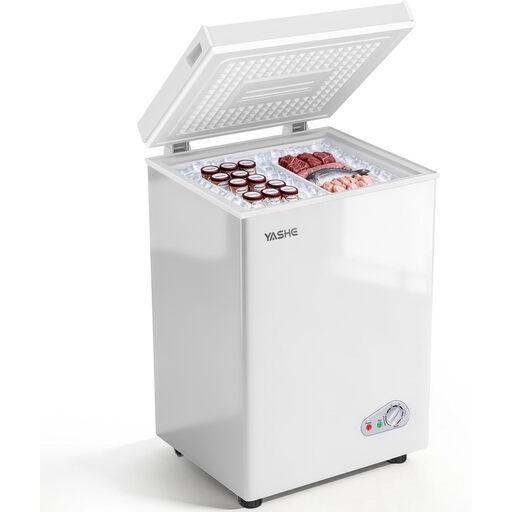
YASHE BC-100Q-EU 100-litre chest freezer

YASHE BC-100Q-EU chest freezer, 100 l

An option if you want to store several portions and keep smaller items organised separately.

Capacity: 100 l; two removable baskets; six temperature settings.

View at Joybuy
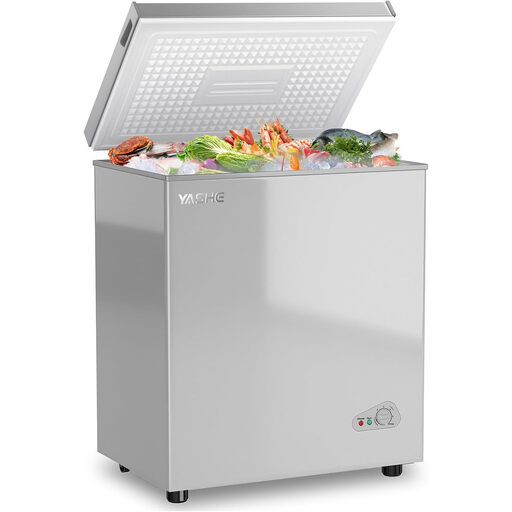
YASHE BC-150Q-EU 150-litre chest freezer

YASHE BC-150Q-EU chest freezer, 150 l

An option if you need more storage space for several portions and want to organise them using baskets.

Capacity: 150 l; two removable baskets; six temperature settings.

View at Joybuy

AUCMA 95-litre convertible chest freezer

AUCMA convertible chest freezer, 95 l

An option if you’re looking for a model that, according to its product name, can switch between fridge and freezer modes.

Capacity: 95 l; seven-position thermostat; removable basket; defrost drain.

View at Joybuy

TCL CF126EWE0NL 98-litre chest freezer

TCL CF126EWE0NL chest freezer, 98 l

An option if you’re looking for a chest freezer with a storage basket and counterbalanced lid.

Capacity: 98 l; adjustable temperature control; storage basket; counterbalanced lid.

View at Joybuy

TCL CF182EWE0NL 140-litre chest freezer

TCL CF182EWE0NL chest freezer, 140 l

An option if you’re looking for a larger stated capacity and want to organise portions in a basket.

Capacity: 140 l; adjustable temperature control; storage basket; counterbalanced lid.

View at Joybuy

Frequently asked questions

How should you cool and store homemade vegetable soup before freezing it?

Let the soup cool briefly, portion it into airtight tubs and don’t leave it out of the fridge for longer than two hours. The Netherlands Nutrition Centre recommends keeping clear vegetable soup in the freezer for up to three months; after that, its quality may deteriorate.

What temperature should you set for frozen soup?

Set the freezer to −18 °C and follow the manual for the model you choose. The Consumers’ Association gives −18 °C as a suitable temperature for a freezer.

Can you keep a chest freezer in an unheated storage room?

It depends on the minimum ambient temperature specified for the particular model. Inventum says the VK562W can be used in a room down to −15 °C; Everglades gives a minimum ambient temperature of 10 °C for the EVFR5201. These figures don’t automatically apply to other models.

What can you do if your new chest freezer turns out to be faulty?

According to the Dutch government, you should contact the retailer if a product is faulty. If your complaint is upheld, the retailer must resolve the issue or involve the manufacturer; any repair or replacement should be free of charge.

Does a new chest freezer sold in the Netherlands need an energy label?

Yes. New domestic freezers sold in the Netherlands must have an EU energy label. The European Commission uses a scale from A to G; also check the stated annual consumption in kWh to compare suitable models.
