
Student with a small kitchen
Wants to freeze sauce without an extra appliance taking up useful kitchen space. Milieu Centraal recommends choosing a suitable size, so measure the space where you plan to put the appliance too.


A chest freezer makes sense if your existing freezer space isn’t enough and you have room for the appliance, including space to open the lid fully. Then compare the amount of sauce you freeze at a time with the stated freezing capacity, and weigh the extra storage space against the electricity consumption and how easy it is to find individual portions.
Wants to freeze sauce without an extra appliance taking up useful kitchen space. Milieu Centraal recommends choosing a suitable size, so measure the space where you plan to put the appliance too.
Makes several portions of sauce at once and compares the amount per cooking session with the freezing capacity in kg per 24 hours. Inventum and Tomado list this figure for their VK562W and TCF0991W models.
Wants to identify and find their own portions easily, while bearing in mind the electricity consumption of an extra appliance. The Voedingscentrum recommends storing cooled leftovers in sealed containers.
Choose this if: you only store a few tubs of sauce and already have room for them.
Bear in mind: you won’t have extra capacity for larger batches.
Choose this if: you regularly freeze more portions than will fit in your existing freezer and have enough floor space and room to open the lid.
Bear in mind: a chest freezer has one open storage compartment, and the lid needs room to open upwards. Small tubs need to be organised so you can find them easily.
Choose this if: you often take out individual tubs and easy access matters to you. According to the Consumentenbond, food is easier to reach in an upright freezer with drawers.
Bear in mind: compare its usable capacity and space requirements with those of a chest freezer.
| What to consider | What should you check? | Who is this relevant to? |
|---|---|---|
| Will the appliance fit? | Measure the available space and check the appliance’s external dimensions, as well as the clearance needed to open the lid. | If I have limited floor space, I want to know whether an extra appliance will fit at all before I buy one. Around 33% of consumers give available space top priority. |
| How much sauce do you freeze at a time? | Weigh a typical batch and compare it with the freezing capacity of the exact model, given in kg per 24 hours. | If I make several portions at once, I want to know whether the amount is within the stated freezing capacity. Around 27% of consumers prioritise the amount they make per cooking session. |
| Electricity consumption | For models with a suitable capacity, compare the annual consumption in kWh shown on the energy label. | I don’t want to run an extra appliance unnecessarily, so I consider its consumption as well as the capacity I need. Around 20% of consumers give ongoing electricity consumption top priority. |
| Finding individual portions | Compare a basket with drawers if you often take out individual tubs; use well-sealed containers and label them with the date. | In a shared kitchen, I want to find my small portions easily. Around 20% of consumers give keeping individual portions organised top priority. |
Capacity in litres tells you how much food you can store; freezing capacity in kg per 24 hours tells you how much new food the manufacturer says the model can freeze in that time.
Compare the weight of your sauce portions with the figure for the exact model, and freeze the sauce in small portions.
An extra freezer uses electricity even when you’re not freezing sauce.
First check how much space is available in your current freezer. If you’re considering a new chest freezer, compare the size that suits your needs and its annual consumption in kWh.
Inventum states that the VK562W still needs to be defrosted periodically, even with Low Frost.
Read the care instructions for your chosen model and think about where you can store your portions while defrosting it.
Allow time for defrosting and make temporary space for the contents.
These models illustrate the features to look out for; the specifications apply to the models listed.
The VK562W is a freestanding chest freezer with a 99-litre capacity, for anyone looking for extra space without going straight for a large freezer.
The TCF0991W is a chest freezer with a 99-litre capacity.
The CF100EWN is a freestanding chest freezer with a 98-litre capacity.
The CFd 2085 Plus has a 248-litre capacity and is designed for people who want to store more food with housemates and have the space for it.
This selection includes chest freezers with capacities from 98 to 140 litres, as well as an 87-litre under-counter upright freezer for anyone looking for extra space for portions. Measure the available space and compare the layout with how you want to find your small tubs.
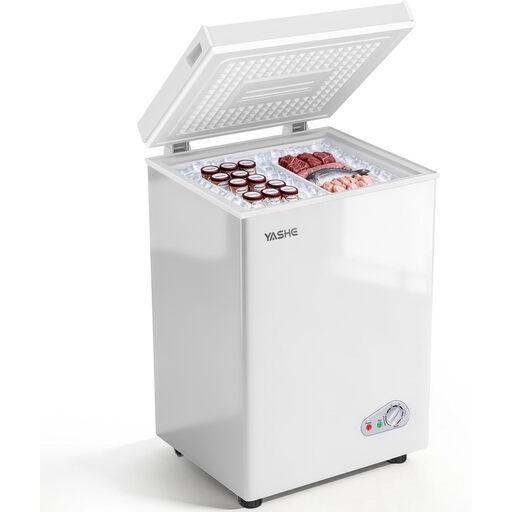 No image available
A good choice if you’re looking for extra freezer space and want to organise smaller portions separately.
The product listing gives a capacity of 100 litres, two removable baskets, six temperature settings and a noise level of 45 dB.
 No image available
An option to consider if you’re looking for a chest freezer with extra storage space and a basket.
The product listing gives a capacity of 98 litres, energy rating E, a storage basket, a counterbalanced lid, adjustable temperature control and adjustable feet.
 No image available
A good choice if you need more space for portions and have room for a larger chest freezer.
The product listing gives a capacity of 140 litres, energy rating E, a storage basket, a counterbalanced lid, adjustable temperature control and adjustable feet.
 No image available
A chest freezer to consider if you need extra space and want to organise portions on a rack.
The product listing gives a capacity of 99 litres, energy rating E, a wire shelf and thermostat control.
 No image available
An alternative if you’re considering an under-counter upright freezer as well as a chest freezer; compare the layout and access for small tubs.
The product listing gives a capacity of 87 litres and energy label B.
Cool cooked sauce promptly and divide large amounts into smaller portions. The Voedingscentrum recommends cooling leftovers within two hours, then putting them in sealed containers in the fridge or freezer.
The Voedingscentrum recommends a freezer temperature of −18 °C and gives three months as the storage time for cooked leftovers; after that, the quality may deteriorate. Write the date on each sealed container.
No. Follow the installation instructions for the exact model and check the space and electrical connection. For example, the Tomado TCF0991W manual specifies an earthed wall socket and warns against using adaptors or extension leads behind the appliance. This is a manufacturer requirement for that model.
According to the Rijksoverheid, purchases made in the Netherlands are covered by statutory consumer rights: if a product is faulty, the seller must provide a solution. There is no fixed statutory guarantee period of two years; any manufacturer’s guarantee is in addition to your statutory rights.
Yes. The Rijksoverheid lists freezers among the appliances that must have an energy label. The European Union requires the label to be clearly visible when the products concerned are sold, including online. Compare both the energy rating and the stated consumption.