
For cooks who freeze several portions at once
You prepare several containers of sauce after a day's cooking and want to match the batch size to the stated freezing capacity. The Voedingscentrum recommends freezing food in small portions.


A separate chest freezer makes most sense if your existing freezer is running out of space and you regularly freeze several portions of sauce at once. Choose a capacity that suits your stock and the space available, but if you plan to freeze a batch after a cooking day, check the stated freezing capacity of the exact model too. A compact appliance may be a more sensible choice than extra capacity you won't use. According to the Voedingscentrum, leftovers should be cooled within two hours, packed into small portions and stored at −18 °C or below.
You prepare several containers of sauce after a day's cooking and want to match the batch size to the stated freezing capacity. The Voedingscentrum recommends freezing food in small portions.
You need more freezer space, but have to weigh the appliance's external dimensions and the room needed to open the lid against its usable capacity.
You store sauce alongside other frozen food and want to find portions easily without taking up more freezer space than necessary. The Consumentenbond points out that food can be easier to access in an upright freezer with drawers than in a chest freezer.
Choose this if: your portions and the amount you add each day already fit in your current freezer.
The trade-off: you won't gain extra storage space, but you'll avoid the electricity use of a second appliance. The Voedingscentrum recommends setting the freezer to −18 °C or below and not adding too much at once.
Choose this if: you need extra space for small portions and have a suitable spot with enough clearance above the lid.
The trade-off: two 99-litre models have different stated freezing capacities: Inventum lists 4.5 kg/24 hours for the VK562W, while Tomado lists 2.25 kg/24 hours for the TCF0991W. These are manufacturer figures, not the results of a comparative practical test.
Choose this if: you regularly store other frozen food as well as sauce and need more storage space.
The trade-off: more capacity takes up more floor space and doesn't automatically make small containers easier to reach. Milieu Centraal recommends choosing a suitable size and comparing annual electricity consumption.
Choose this if: you store lots of individual portions and an upright model is a better fit for the space available.
The trade-off: according to the Consumentenbond, the contents of an upright freezer with drawers are easier to access; this doesn't mean that sauce freezes better in one.
| What matters | What to check before buying | Who is this important for? |
|---|---|---|
| Freezing capacity | Compare the largest amount of sauce you make in one day with the stated kg/24 hours for the exact model. The Voedingscentrum recommends small portions and a freezer temperature of −18 °C or below. | If you want to add several containers after a day of cooking without confusing storage capacity with freezing capacity; around 36% of consumers prioritise the peak amount that can be frozen at one time. |
| Available space | Measure the external dimensions, the access route and the space needed to open the lid. If you plan to keep the freezer somewhere unheated, check the minimum temperature specified for the exact model. | If space is limited, you'll want to know whether the freezer will fit with its lid open and with the required ventilation clearance; around 29% of consumers prioritise suitable dimensions and placement. |
| Finding your portions | Check how many storage baskets the model has. The Consumentenbond says an upright freezer with drawers is easier to access than a chest freezer. | If you want to take out small containers without having to move the rest of your stock each time; around 21% of consumers prioritise being able to find portions easily. |
| Energy use and maintenance | Compare annual consumption in kWh and read the maintenance instructions for the exact model. Milieu Centraal recommends choosing a suitable size and considering annual energy consumption. | If you're adding another appliance, you'll also want to factor in its electricity use and the defrosting it requires; around 14% of consumers prioritise these practical considerations. |
Two 99-litre chest freezers can have different manufacturer-stated freezing capacities. If you add too much at once, food that is already frozen may warm up.
Compare the largest batch you add after a day of cooking with the stated kg/24 hours for the exact model, and divide the sauce into small portions.
An extra appliance uses electricity even when it contains very little sauce. Milieu Centraal recommends choosing a suitable size and comparing annual energy consumption.
First check whether your current freezer has enough room, then compare the models you're considering by their annual consumption in kWh.
Despite its Low Frost feature, Inventum recommends defrosting the VK562W two or three times a year.
Read the maintenance instructions for the model you choose and consider where you'll temporarily store the food while defrosting.
Defrosting takes time and you'll need somewhere to keep your frozen food temporarily.
A stated suitability for low ambient temperatures applies to that particular model, not automatically to other chest freezers.
Compare the minimum temperature of the space with the product specifications and manual for the exact model you're considering.
Inventum offers chest freezers in a range of capacities; the VK562W is a compact model to consider for smaller stocks.
Tomado offers chest freezers in capacities including 99 and 198 litres; the TCF0991W is a compact model to compare by its stated freezing capacity.
According to Liebherr, the CFd 2085 Plus is a 248-litre chest freezer for anyone looking for more storage space.
According to Beko, the HSM22340 is a 230-litre chest freezer for anyone looking for more storage space.
This selection includes compact and larger chest freezers for anyone looking for extra storage space for portions of sauce alongside other frozen food. Capacity and layout vary by model.
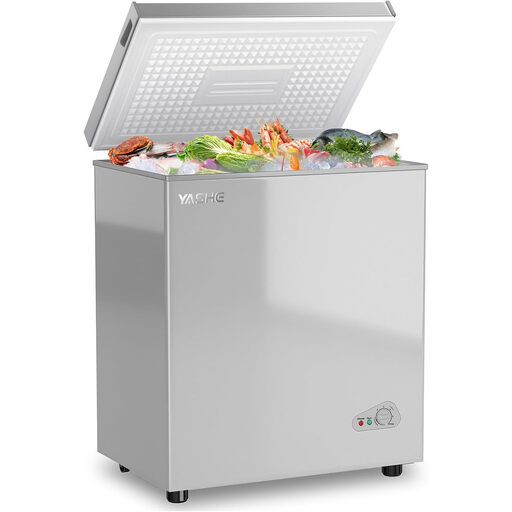 Image unavailable
An option if you're looking for extra freezer space with separate baskets for smaller items or products you use frequently.
150 litres; two removable baskets; six temperature settings; freestanding model.
 Image unavailable
A compact option if you're looking for extra freezer space and want to use a removable basket to keep food separate.
95 litres; seven-position thermostat; removable basket; defrost water drain; energy class E.
 Image unavailable
This larger capacity suits anyone who wants to store sauce alongside a bigger stock of other frozen food.
291 litres; removable basket; built-in LED lighting; five-setting digital temperature control; energy class E.
 Image unavailable
A compact option if you want to keep smaller frozen items separate in a basket.
98 litres; storage basket; counterbalanced lid; adjustable temperature control; energy class E.
 Image unavailable
A larger option if you want to store other frozen food as well as portions of sauce.
140 litres; storage basket; counterbalanced lid; adjustable temperature control; energy class E.
According to the Voedingscentrum, cooked leftovers should be cooled within two hours. Then divide the sauce between airtight containers, label them with the date and freeze in small portions at −18 °C or below; don't add too much at once. The Voedingscentrum says tomato sauce can be kept in the freezer for three months, after which its quality may deteriorate.
No. Check the stated ambient temperature range for the exact model. Inventum specifies that the VK562W can be used down to −15 °C, as does Liebherr for the CFd 2085 Plus; these manufacturer figures don't automatically apply to other models.
No. Inventum recommends defrosting the Low Frost VK562W two or three times a year. Follow the manual for any other model.
An energy label is compulsory for household appliances; also compare the stated annual consumption in kWh. According to ACM ConsuWijzer, your statutory guarantee is separate from any manufacturer's guarantee. If a product doesn't meet the standard you could reasonably expect when used normally, the retailer is responsible for providing an appropriate solution. There is no single fixed statutory guarantee period in the Netherlands that applies to every chest freezer.
When a private individual buys a new, similar appliance, the retailer is required by the Dutch government to take the old one free of charge. This also applies to online purchases; if it can't be collected when your new appliance is delivered, the government explains other free collection or return options.