A separate chest freezer is worth considering if you regularly freeze more cooled soup than your existing freezer space can hold. First, measure the available floor space, ventilation clearance and room for the lid to open. Then compare capacity, the stated freezing capacity and annual electricity consumption. For just a few portions, your existing freezer may be more practical, while an extra appliance will also continue to use electricity.
Who might find a chest freezer for soup useful?
Student short on floor space
You want to freeze soup, but first need to check whether the chest freezer will fit with the required ventilation clearance and whether its lid can open fully. The Consumers' Association discusses access through the lid, while the Tomado manual specifies clearance around the appliance.
Student who batch cooks
You regularly make several portions of soup and want to know whether both the available capacity and stated freezing capacity will suit your batch. The Netherlands Nutrition Centre advises on cooling cooked food, while Inventum and Tomado publish specifications for their chest freezers.
Student who shares electricity costs
You want to know how much electricity an extra freezer uses and whether your existing freezer space is enough. Milieu Centraal recommends taking annual consumption in kWh into account when comparing models.
What should you look for in a chest freezer for soup?
Use your existing freezer space
Suitable if: there is room for the sealed portions of soup without having to move other food.
Trade-off: larger batches may exceed the available space.
A compact chest freezer
Suitable if: you regularly make several portions at once and have enough floor space, ventilation clearance and room for the lid.
Trade-off: it takes up floor space and uses electricity while switched on.
An upright or under-counter freezer
Suitable if: you would rather take portions from drawers or through a door, or you don't have room to open a lid on top.
Trade-off: compare usable capacity, dimensions and electricity consumption for each model.
| What to consider |
What should you check? |
Who should consider this? |
| Space and positioning |
Measure the space with the lid open and allow for the clearance specified in the manual. The Tomado TCF0991W manual specifies 10 cm around the appliance. |
If you have limited floor space, you'll want to know whether the freezer will fit with enough ventilation clearance. Around 36% of consumers say positioning is their main concern when buying. |
| Capacity and freezing capacity |
Compare the capacity in litres and the stated freezing capacity in kg/24 hours; these are different specifications. The Inventum VK562W lists 99 litres and 4,5 kg/24 hours; the Tomado TCF0991W lists 99 litres and 2,25 kg/24 hours. |
If you're freezing several portions from one batch, you'll want to know whether both the storage space and freezing capacity are right for you. Around 29% of consumers say portion sizes and freezing are their main concern when buying. |
| Electricity consumption |
Compare the stated annual consumption in kWh and the energy label. Use your own electricity tariff if you want to estimate the cost. |
If you share electricity costs, you'll want to know how much an extra appliance uses each year. Around 21% of consumers say electricity consumption is their main concern when buying. |
| Access and maintenance |
Check whether a basket or drawer layout suits your portions, and read the maintenance and defrosting instructions. The Consumers' Association says drawers make the contents easier to reach. |
If you often take out small portions, you'll want to find them easily and keep maintenance straightforward. Around 14% of consumers say access and maintenance are their main concern when buying. |
Common buying mistakes
-
Choosing based on capacity alone
The external dimensions and capacity don't automatically tell you whether there's enough clearance around the appliance or whether the lid will open.
Measure the floor space, check the room needed for the lid and follow the positioning instructions for the exact model.
-
Confusing capacity with freezing capacity
Capacity tells you how much you can store; the stated freezing capacity describes how much the appliance can freeze in 24 hours, according to the manufacturer. Inventum lists 4,5 kg/24 hours for the VK562W, while Tomado lists 2,25 kg/24 hours for the TCF0991W. These are manufacturer specifications, not independent performance test results.
For larger batches, compare both the capacity and the stated freezing capacity of the exact model.
-
Ignoring electricity consumption
An extra freezer uses electricity while switched on, and annual consumption varies by model.
Compare consumption in kWh per year and use your own electricity tariff if you want to estimate running costs. The Dutch Government explains that the energy label for household appliances provides mandatory information about energy consumption.
-
Taking claims about use in a cold shed at face value
The product information and manual for the Tomado TCF0991W give different limits for the ambient temperature.
If you plan to place it somewhere other than a heated kitchen, ask the manufacturer to confirm that the exact model is suitable for the intended temperature.
Brands to compare as a reference
Inventum
For the freestanding VK562W, Inventum lists a capacity of 99 litres, a width of 54,7 cm, energy class D and a freezing capacity of 4,5 kg/24 hours.
- Inventum lists a removable basket and temperature alarm for this model.
- These are manufacturer details, not independent test results; check the positioning instructions for the model you're considering.
Tomado
For the freestanding TCF0991W, Tomado lists a capacity of 99 litres, energy class E and a freezing capacity of 2,25 kg/24 hours.
- Tomado lists a removable basket, a defrost water drain and a noise level of 38 dB for this model.
- The product information and manual give different limits for use in an unheated room. Check the conditions for the exact model before considering this type of placement.
Beko
For the CF100EWN, Beko lists a capacity of 98 litres, energy class E and external dimensions of 84,5 × 54,5 × 54,5 cm.
- The published dimensions give you a useful starting point for checking the available space.
- This information applies to the CF100EWN and isn't a general statement about other Beko freezers.
Chest freezers on Joybuy
These Joybuy products are compact chest freezers for anyone looking for extra space for portions of soup. Compare the stated capacity and layout with the space available and the amount you freeze in each batch.
 No image available
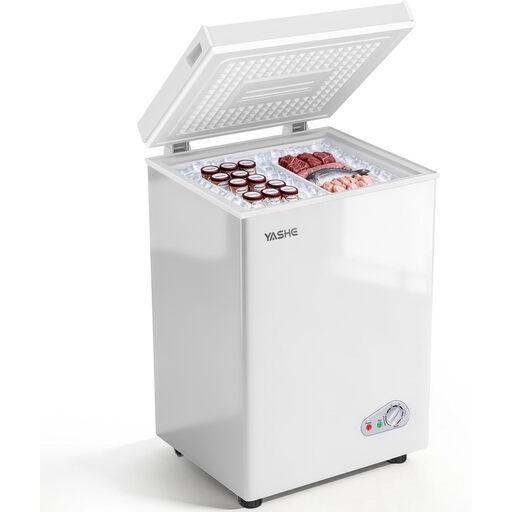
YASHE BC-100Q-EU chest freezer, 100 litres
An option to compare for extra freezer space for portions of soup, based on the room in your kitchen.
The product title lists a capacity of 100 litres, two removable baskets and six temperature settings.
Joybuy
 No image available
TCL CF126EWE0NL chest freezer, 98 litres
Compare its capacity and basket layout with the space you need for portions of soup.
The product title lists a storage basket, a counterbalanced lid, adjustable temperature control, adjustable feet and energy class E.
Joybuy
 No image available
TCL CF182EWE0NL chest freezer, 140 litres
The larger stated capacity may be worth considering if you want to store more portions, provided you have enough floor space.
The product title lists a capacity of 140 litres, a storage basket, a counterbalanced lid, adjustable temperature control, adjustable feet and energy class E.
Joybuy
 No image available
Comfee RCC143WH2EU(E) chest freezer, 99 litres
Compare the stated capacity and layout with the amount of soup you want to freeze at a time.
The product title lists an inverter compressor, a switchable fridge and freezer function, 38 dB, a removable basket, LED lighting and energy class E.
Joybuy
 No image available
CHiQ JR99DWE chest freezer, 99 litres
A compact capacity to compare with your portion sizes and available kitchen space.
The product title lists a four-star freezer compartment, energy class E, a wire shelf and a lid that can stay open. Bear in mind that this model needs to be defrosted manually.
Joybuy
Frequently asked questions
Does vegetable soup need to be completely cold before you freeze it?
Let cooked soup cool first, then put it into airtight containers. The Netherlands Nutrition Centre advises letting cooked food cool for about half an hour and not leaving it out of the fridge for more than two hours; then refrigerate or freeze it.
What temperature is suitable for soup in the freezer?
The Netherlands Nutrition Centre recommends −18 °C as the ideal freezer setting. Divide the soup into sealed portions and label them with the contents and freezing date; its general advice for prepared meals is to keep them in the freezer for at least three months.
How should you defrost and reheat a portion of soup?
Defrost a meal-sized portion in the fridge, or a small portion in the microwave. Don't leave soup out of the fridge all day or overnight. Then heat it thoroughly until piping hot, as advised by the Netherlands Nutrition Centre.
Can a chest freezer be placed tightly between kitchen cupboards?
Check the installation instructions for the exact model before positioning the freezer. The Tomado TCF0991W manual specifies 10 cm of clearance all around and unobstructed ventilation openings; also check that the lid can open fully.
What should you look for when checking the electricity consumption of an extra freezer?
Compare the stated annual consumption in kWh for models that suit your needs in terms of capacity and positioning. Use your own electricity tariff if you want to estimate running costs; Milieu Centraal recommends taking annual consumption into account when choosing.


