
Solo cook stocking up on soup
Cooks several portions at a time and wants to be able to find small containers easily, without buying more freezer space than necessary.


If your usual portions of soup fit in your existing freezer compartment, you don’t need to buy a separate chest freezer just for soup. If you want to freeze extra food regularly, compare the capacity and annual energy consumption of suitable models; for larger batches, the stated freezing capacity also matters. Measure the space where you plan to put it, and check that your chosen model can be used there.
Cooks several portions at a time and wants to be able to find small containers easily, without buying more freezer space than necessary.
Weighs up the extra storage space against the electricity used by a second appliance that runs all the time.
Sometimes freezes a larger batch of food in one go and needs to check the freezing capacity and permitted ambient temperature for the exact model.
Choose this if: your sealed portions of soup fit and you don’t need extra storage space.
Bear in mind: the available space and layout determine how many portions you can store.
Choose this if: you regularly freeze more portions than will fit in your existing freezer compartment and have a suitable space for it.
Bear in mind: an open chest freezer gives you extra storage, but containers at the bottom are less accessible than items in drawers.
Choose this if: you want to find individual containers of soup quickly.
Bear in mind: compare the usable capacity and stated annual energy consumption with those of a suitable chest freezer.
First, compare what you want to store and where the appliance will go; then look at energy consumption and freezing capacity. Milieu Centraal points out that two refrigeration appliances use more energy together than one large appliance. Energielabel.nl lists details including annual energy consumption and capacity.
| What to consider | What should you check? | Who should pay particular attention? |
|---|---|---|
| Capacity and layout | Count your own containers and measure the space, including room to open the lid. Also check the layout and whether there’s a removable basket. | If I want to find small portions easily without paying for unused capacity, I’ll consider the size of my containers and the layout. Around 33% of consumers say accessible storage for portions is their main concern. |
| Electricity consumption | Compare the stated annual consumption in kWh and the capacity of appliances that suit your needs. | If I’m considering a second appliance for just a few portions, I’ll want to factor in the extra electricity consumption. Around 27% of consumers prioritise the energy use of extra freezer space. |
| Quantity per freezing cycle | Compare the amount you freeze at one time with the stated capacity in kg/24 hours for the full model code. | If I sometimes divide a large batch of food into portions, I’ll want to know whether the stated capacity is suitable. Around 20% of consumers say the quantity frozen at one time is their main concern. |
| Location | Measure the external dimensions and check the ventilation requirements and permitted ambient temperature for the exact model. | If I’m using a shed or another potentially unheated space, the appliance needs to be suitable for it. Around 20% of consumers therefore focus mainly on the installation requirements. |
For a few single portions, much of the extra capacity may go unused, while a second appliance still uses electricity.
First, count how many sealed containers of soup fit in your existing freezer compartment. Then compare suitable appliances by their stated annual consumption in kWh.
An extra appliance also means ongoing electricity use.
The Inventum VK562W and Tomado TCF0991W both have a stated capacity of 99 litres, but their manufacturers list different freezing capacities: 4.5 and 2.25 kg/24 hours respectively.
Compare the stated kg/24 hours for the full model code with the largest quantity you typically want to freeze at one time.
Inventum still recommends periodically defrosting the VK562W, so Low Frost doesn’t mean this model is maintenance-free.
Check the maintenance instructions for your chosen model and plan for somewhere else to store the contents temporarily.
Defrosting takes time and you’ll need somewhere else to keep your frozen food temporarily.
The space needs to fit the appliance, allow the lid to open and provide the required ventilation. Suitability for a cold space varies by model.
Measure the space and follow the installation instructions and temperature limits specified by the manufacturer for the exact model.
Offers compact chest freezers and under-counter models; the VK562W is one example to compare a chest freezer with a drawer model.
Offers compact chest freezers, including the white TCF0991W, which has a stated capacity of 99 litres.
Also offers larger chest freezers, such as the CFc 1875 Plus, for storage needs beyond a few portions of soup.
These models are compact chest freezers that provide extra space for frozen portions.
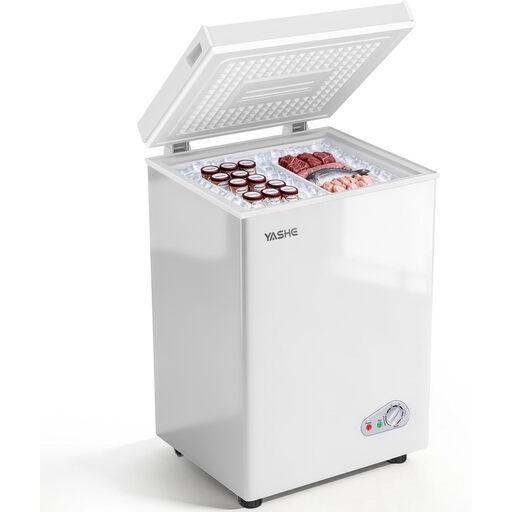 Image unavailable
The two removable baskets can help you keep frequently used items separate from food you’re storing for longer.
100-litre capacity; six temperature settings; stated annual energy consumption 185 kWh; stated noise level 45 dB.
Containers at the bottom of a chest freezer are less accessible than items in drawers.
 Image unavailable
The storage basket gives you somewhere to keep smaller items separate from food stored at the bottom.
98-litre capacity; energy class E; storage basket; adjustable temperature control.
Containers at the bottom of a chest freezer are less accessible than items in drawers.
 Image unavailable
The 140-litre capacity is worth considering if you need more storage space; measure first to make sure the freezer will fit where you want to put it.
140-litre capacity; energy class E; storage basket; adjustable temperature control.
Containers at the bottom of a chest freezer are less accessible than items in drawers.
 Image unavailable
The removable basket can help you keep smaller items separate; compare the freezing capacity with the amount you want to freeze at one time.
99-litre capacity; stated freezing capacity 4.5 kg/24 hours; stated annual energy consumption 169 kWh; removable basket.
Containers at the bottom of a chest freezer are less accessible than items in drawers.
 Image unavailable
The wire shelf gives you somewhere to keep smaller items separate; check that it works with the containers you use.
99-litre capacity; energy class E; stated freezing capacity 4.5 kg/24 hours; stated annual energy consumption 169 kWh; wire shelf.
Containers at the bottom of a chest freezer are less accessible than items in drawers.
Leave the soup to cool, but put it in the fridge or freezer within two hours of cooking, as advised by Voedingscentrum. Use airtight containers, label them with the contents and freezing date, and store frozen meals at −18 °C.
It’s best to defrost the soup covered in the fridge; a small portion can also be defrosted in the microwave. Then heat the soup until it’s piping hot, stirring it along the way if you’re using the microwave.
No, it depends on the permitted ambient temperature for the exact model. Inventum states that the VK562W is suitable for ambient temperatures down to −15 °C; check the manual separately for other models.
Compare the stated annual consumption in kWh of appliances with a capacity that suits your needs. Milieu Centraal notes that two refrigeration appliances use more energy together than one large appliance.
Household refrigeration appliances are covered by EU energy labelling rules. These requirements apply to businesses that place appliances on the EU market or sell them; as a buyer, you can use the label to check details including the energy class, annual consumption and capacity.