
Cook with limited space
You want to freeze portions of mash, but first need to check whether a narrow chest freezer will fit on the floor and whether the lid can open freely.


Measure the available floor space and the clearance above the appliance for the lid before choosing a chest freezer; a narrow model won’t automatically fit beneath a worktop. Then compare its capacity and freezing capacity with your portions, and check the annual energy consumption and how easy it is to find your containers in suitable models. The Netherlands Nutrition Centre advises cooling cooked mash quickly and not leaving it out of the fridge for more than two hours.
You want to freeze portions of mash, but first need to check whether a narrow chest freezer will fit on the floor and whether the lid can open freely.
You regularly make a larger batch of mash and want to match the capacity and freezing capacity to your containers and quantities, without assuming that a bigger freezer is always better.
You’re considering an appliance that uses electricity continuously, so you want to compare suitable sizes by energy label and stated consumption in kWh per year.
First measure the space and the clearance needed for the lid; then compare the capacity and annual energy consumption of models that will actually fit. The Consumers’ Association points out that chest freezers open from the top, while Milieu Centraal advises taking annual consumption in kWh into account.
| Point to consider | What should you check? | Who is this important for? |
|---|---|---|
| Positioning and access | Measure the width and depth of the floor space, and check the clearance needed above the open lid and the model’s installation instructions. | If the freezer is going near a kitchen unit or worktop, I want to be sure the lid can open and I can reach my portions; around 36% of consumers prioritise positioning and access. |
| Quantity per freezing session | Count your portion containers and compare their capacity in litres and the exact model’s freezing capacity in kg per 24 hours. | When I make several portions at once, I want to know whether my containers and the quantity will fit in one go; around 29% of consumers give the quantity per freezing session top priority. |
| Energy consumption | For models that fit, compare the energy label and stated annual consumption in kWh. | If I’m buying an extra freezer that will be on all the time, I want to factor in its annual consumption; around 21% of consumers prioritise energy consumption. |
| Finding portions and maintenance | Check whether it has a basket, how easy it is to reach the bottom and what the defrosting instructions are. | When I often take out small portions, I want to find them easily and know how much maintenance is needed; around 14% of consumers give access and maintenance top priority. |
A chest freezer opens from the top. So a suitable floor space doesn’t automatically mean the lid will open beneath a worktop.
Also measure the depth, the space needed to move around it and the clearance above with the lid open. Check the installation instructions for the model you choose.
Extra capacity is only useful if you use it; a larger appliance takes up more floor space.
Count your portion containers and compare the quantity you want to freeze in one day with the stated capacity and freezing capacity in kg per 24 hours.
Inventum states that Low Frost reduces frost build-up in the VK562W, but that it still needs to be defrosted periodically.
Check the defrosting procedure for the exact model and whether it has a defrost water drain.
Allow time for periodic manual defrosting.
Freezing it later doesn’t undo the effects of leaving it out of the fridge for too long.
Cool cooked portions quickly and put them in the fridge or freezer, well covered, within two hours, as advised by the Netherlands Nutrition Centre.
Offers chest freezers in a narrow size, such as the VK562W, as well as a larger model, the VK952W.
According to the manufacturer, the CF100EWN is a 98-litre chest freezer measuring 54,5 cm wide.
The CFe 1870 Pure is a larger chest freezer to consider if you have more floor space and clearance for the lid.
These product picks are chest freezers for storing portions and other frozen foods; check that the size and positioning work for you before buying.
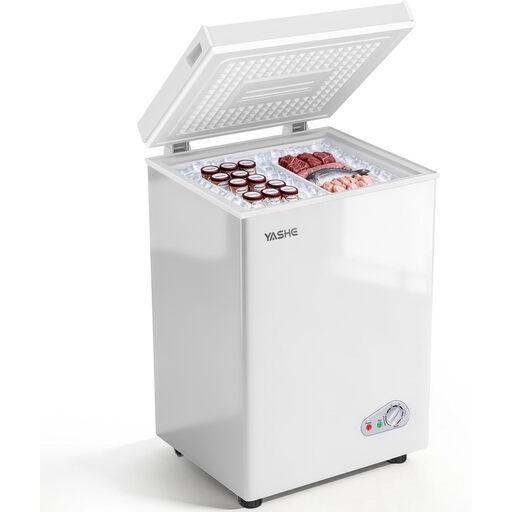 No image available
The removable baskets may come in handy if you want to keep your portions organised.
100-litre capacity, two removable baskets, six temperature settings, energy label E and 185 kWh per year.
 No image available
The basket can help you keep smaller portions separate.
98-litre capacity, storage basket, counterbalanced lid, adjustable temperature control and energy label E.
 No image available
The larger capacity could be a good fit if you have space and want to store a wider range of frozen food as well as mash.
140-litre capacity, storage basket, counterbalanced lid, adjustable temperature control and energy label E.
 No image available
The removable basket can help you store portions separately; check the installation requirements before choosing a spot.
99-litre capacity, removable basket, energy label E and 169 kWh per year. The product information specifies at least 10 cm of ventilation space and an earthed socket; also take note of the stated R600a refrigerant and the risk of trapping your fingers in the lid.
 No image available
The wire storage rack can help keep smaller containers separate and within easy reach.
99-litre capacity, freezing capacity of 4.5 kg per 24 hours, wire rack, energy label E and 169 kWh per year. The product data sheet states that it requires manual defrosting.
Yes. The Netherlands Nutrition Centre advises cooling leftovers quickly, storing them in a well-sealed container and not leaving them out of the fridge for more than two hours. For mashed potato made with potatoes and semi-skimmed milk, the Storage Guide recommends keeping it in the freezer for three months; after that, its quality may deteriorate. For other recipes or packaged products, follow the relevant storage advice.
Measure a clear space on the floor and allow for the clearance needed by the top-opening lid. Check the installation instructions and the full opening clearance for the exact model. If you want to put the freezer in an unheated shed or garage, also check the model’s permitted ambient temperature range.
Yes, the Inventum VK562W still needs to be defrosted periodically. Inventum says that Low Frost reduces frost build-up in this specific model; check the defrosting procedure for the version you’re considering.
Compare the stated consumption in kWh per year of models that suit your space and check for any delivery or installation costs. According to the Dutch government, there’s no fixed statutory warranty period in the Netherlands: you’re entitled to a product that works properly, and the seller is your point of contact if something goes wrong. An additional warranty doesn’t replace this right.
Household freezers use the EU energy scale from A to G, as stated by the European Commission. In the Netherlands, if a shop sells you a new, similar appliance, it must take your old one back under the old-for-new scheme, according to the Dutch government.