A separate chest freezer makes sense mainly if your usual portions of bread won’t fit neatly in your existing freezer space. Choose its capacity and freezing capacity based on the amount you store and how much bread you add at once. If you take out slices every day, layout and accessibility matter too. The Netherlands Nutrition Centre recommends freezing bread in portions and setting your freezer to at least −18 °C.
Who is a chest freezer suitable for?
Families with a stock of bread
If you freeze several loaves or meals at once, work out how much extra space and freezing capacity you need. The Netherlands Nutrition Centre recommends freezing bread in portions; Inventum and Liebherr list capacity and freezing or storage features for their models.
Those who take out portions every day
If you often take out a few slices, being able to find them easily may matter more than having the largest possible open storage space. A basket gives smaller portions their own place; according to the Consumers’ Association, drawers are easier to access than the contents of a chest freezer.
Households with space in a shed
If you’re considering putting a chest freezer outside a heated kitchen, check that the permitted ambient temperature for the exact model suits the location. For example, Liebherr states that the CFe 1870 Pure has FrostProtect down to −15 °C.
What should you look for when choosing one?
Use your existing freezer space
A good fit if: your preferred bread portions already fit neatly and you don’t need to store a large extra supply.
The trade-off: bread takes up space you could otherwise use for other food.
Compact chest freezer
A good fit if: you want extra space for bread and a modest mixed supply, but have limited floor space.
The trade-off: you’ll need to stack items under a basket; also check that the lid can open where you plan to put it.
Larger chest freezer
A good fit if: you regularly freeze larger family supplies as well as bread and have enough space.
The trade-off: having more capacity doesn’t automatically make slices easier to reach every day.
Upright freezer with drawers
A good fit if: you mainly want to find individual portions of bread and don’t need to store large or irregularly shaped items.
The trade-off: an upright freezer with drawers offers a different layout from the open space of a chest freezer; compare models based on their individual features.
First compare storage space and accessibility for your needs, then look at energy use, freezing capacity and where the appliance will go. The Consumers’ Association highlights how accessible drawers are, while Milieu Centraal also recommends checking the stated energy use in kWh per year.
| Concern |
What to look for when buying |
Who is this more important for? |
| Storage space and adding new batches |
Compare capacity in litres with freezing capacity in kg/24 hours; work out how much bread you add at once. |
If I want to store bread and other family supplies at the same time, I need both the total storage space and the ability to freeze a new batch to meet my needs. Around 33% of consumers mainly need storage space and freezing capacity. |
| Finding slices every day |
Check whether a basket helps organise smaller portions; compare drawer models if you often take out individual portions. |
If I want to take out a few slices every day, I don’t want to keep searching through larger items. Around 27% of consumers mainly want to find portions easily. |
| Energy use |
Compare kWh per year and capacity on the energy label of suitably sized models. |
If I leave an extra freezer running all the time, I want to take its stated annual energy use into account and avoid choosing more capacity than I need. Around 20% of consumers mainly look at energy use. |
| Location and ambient temperature |
Measure the space and room needed to open the lid; check the permitted ambient temperature for the exact model. |
If I’m considering putting the freezer in a shed, the space available and the temperature there need to suit the model. Around 20% of consumers mainly consider placing a freezer outside the kitchen. |
Common mistakes when choosing
-
Confusing capacity with freezing capacity
Capacity is stated in litres; the amount a model can freeze per day is a separate specification, measured in kg/24 hours.
Compare both with your storage needs and the amount of fresh bread you add at once.
-
Assuming Low Frost means No Frost
Inventum lists Low Frost for the VK562W, but states that it still needs to be defrosted periodically.
Choose a model based on the level of maintenance you’re happy with, and check the cooling technology of the exact model.
-
Choosing a model for a shed based only on its energy label
The energy class doesn’t tell you what ambient temperatures a chest freezer can handle.
For your intended location, check the minimum ambient temperature in the documentation for the exact model.
Brands to consider
Inventum
Inventum offers both compact and larger chest freezers, including the VK562W and VK980W.
- For the VK562W, Inventum lists a 99-litre capacity, a basket and a freezing capacity of 4,5 kg/24 hours.
- Low Frost on the VK562W doesn’t mean you can skip defrosting. According to Inventum, the VK980W has No Frost and is 98,6 cm wide.
Beko
The CF100EWN is a compact chest freezer with static cooling.
- Beko lists a capacity of 98 litres and a width of 54,5 cm for this model.
- The product specifications state energy class E; static cooling is not No Frost.
Liebherr
The CFe 1870 Pure is a larger chest freezer for a mixed supply of family food.
- Liebherr lists a capacity of 281 litres, a width of 104 cm and FrostProtect for ambient temperatures down to −15 °C.
- SmartFrost doesn’t mean defrosting is never necessary; the manufacturer states that it reduces frost build-up.
Chest freezers and an upright freezer at Joybuy
This selection includes compact and larger chest freezers for extra bread and frozen food storage, plus an upright freezer with separate compartments for keeping portions organised.
 No image available
TCL CF126EWE0NL, 98 litres
Suitable for a modest extra supply, with a storage basket to organise smaller items.
98-litre capacity; storage basket; adjustable temperature control; counterbalanced lid; energy class E.
View at Joybuy
 No image available
TCL CF182EWE0NL, 140 litres
A good choice if you want to store other frozen food as well as bread, and keep smaller items organised separately.
140-litre capacity; storage basket; adjustable temperature control; counterbalanced lid; energy class E.
View at Joybuy
 No image available
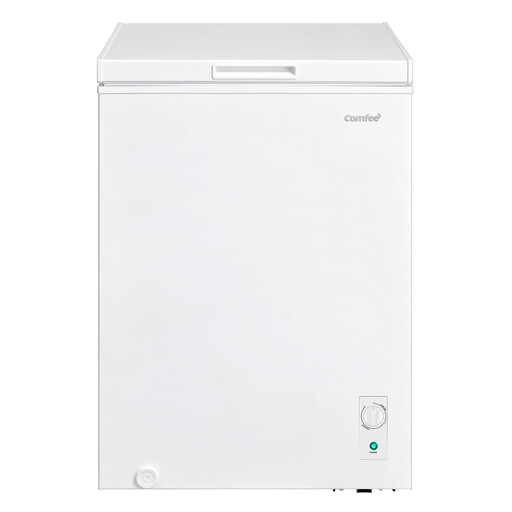
Comfee' RCC143WH2EU(E), 99 litres
Suitable for a compact supply with a removable basket. According to the product information, this model is not intended for outdoor use or damp, unprotected environments.
99-litre capacity; can be switched between fridge and freezer modes; removable basket; LED light; energy class E.
View at Joybuy
 No image available
CHiQ JR99DWE, 99 litres
Suitable for a compact supply, with a wire shelf to keep smaller items separate.
99-litre capacity; 4-star freezing; thermostat control; wire shelf; energy class E.
View at Joybuy
 No image available
Comfee' RCU60WH2(E), 60 litres
A good choice if you want to store portions of bread in separate compartments and find them more easily.
60-litre capacity; three storage compartments; adjustable temperature; reversible door.
View at Joybuy
Frequently asked questions
How should you freeze sliced bread for a family meal?
The Netherlands Nutrition Centre recommends setting your freezer to at least −18 °C and dividing the bread into portions you’ll actually use. That way, you can take out just the amount you need.
Does a Low Frost chest freezer still need defrosting?
Yes. The Inventum VK562W still needs to be defrosted periodically. Inventum lists Low Frost for this model, while the manufacturer lists No Frost for the VK980W. Check the technology used in the exact model.
What should you look at when comparing energy use?
Compare the stated energy use in kWh per year and the capacity on the energy label of suitably sized models. Your electricity costs will also depend on your own tariff.
Is an energy label required for a domestic freezer in the Netherlands?
Yes. The Dutch Government lists freezers among the appliances that must have an energy label. The European Union uses a scale from A to G for domestic fridges and freezers.


