
Households freezing large batches together
You blanch a large amount of broccoli on the same day and need a chest freezer with a stated freezing capacity that suits the quantity going into the freezer at once.


Choose a chest freezer based on how much broccoli you freeze at a time and the space needed to open the lid. Then compare the stated freezing capacity in kg per 24 hours, the layout and annual energy consumption. A compact freezer calls for careful planning when freezing larger batches, while a larger one takes up more floor space. In a shared kitchen, you’ll still need clear labels and agreed rules for portions.
You blanch a large amount of broccoli on the same day and need a chest freezer with a stated freezing capacity that suits the quantity going into the freezer at once.
You share freezer space but want to find your own dated portions easily. A practical basket layout and clear ground rules matter, as well as capacity.
You’re looking for extra freezer space without adding an overly wide chest freezer, and you also need to check how much room the lid needs when open.
Start with the quantity you want to freeze in each batch and the space available to open the lid fully. The European Commission states that the EU energy label shows information including the energy class, annual energy consumption and noise emissions. Compare these details alongside the layout and maintenance requirements.
| What to consider | What should you check? | Who does this matter most to? |
|---|---|---|
| Freezing capacity | Weigh a typical batch and compare its weight with the stated capacity in kg per 24 hours. Freeze the broccoli in small portions. | If we’re freezing a lot of blanched broccoli in one day, I want to know whether the freezer can handle that amount. Around 31% of consumers say capacity for large batches is their main buying concern. |
| Keeping portions organised | Check how many baskets there are and where they’re positioned; agree how you’ll label portions with a name, product and freezing date. | When sharing freezer space, I want to find my own dated portions quickly. Around 25% of consumers prioritise keeping things organised between housemates. |
| Positioning and lid clearance | Measure the space for the freezer and the clearance above it; compare these with the model’s external dimensions and installation instructions. | With limited floor space, I want to know whether the freezer will fit and whether the lid can open fully. Around 25% of consumers say available space is their main buying concern. |
| Energy use, noise and maintenance | Compare annual energy consumption and noise levels on the EU energy label. Also check the maintenance instructions for the model’s frost-reduction technology. | If the freezer is always on and used by housemates, I want to weigh up energy use, noise and maintenance. Around 19% of consumers say these are their main buying concerns. |
Capacity tells you how much storage space there is; the stated freezing capacity in kg per 24 hours is a separate specification. So a large chest freezer doesn’t, by itself, tell you how much broccoli you can freeze in a day.
Weigh a typical batch of broccoli and compare it with the specific model’s freezing capacity. Divide the broccoli into small portions.
A chest freezer opens from the top. The space may be wide enough, but still prove awkward if the lid can’t open properly or portions are hard to reach.
Check the external dimensions as well as the clearance needed to open the lid. Also decide where each housemate will keep their labelled portions.
Frost-reduction technology, maintenance instructions and energy information answer different questions. The EU energy label includes details such as annual energy consumption and noise levels; a model’s technology alone doesn’t tell you how much electricity it uses.
Compare the maintenance instructions and annual consumption in kWh for the exact models you’re considering.
The models listed offer useful points of comparison for capacity, layout and maintenance. Mentioning a brand doesn’t mean every model listed is available at Joybuy.
The chest freezers listed vary in capacity and maintenance requirements. The specifications below apply to individual models, not the entire range.
Beko offers a compact model and a larger chest freezer to compare in terms of capacity and features.
The CFd 2085 Plus is an example of a 248-litre chest freezer for a space that can accommodate a wider model.
This selection includes compact and larger chest freezers for storing shared supplies. Choose a capacity and layout to suit your portions, and check that the freezer will fit in the intended space with the lid open.
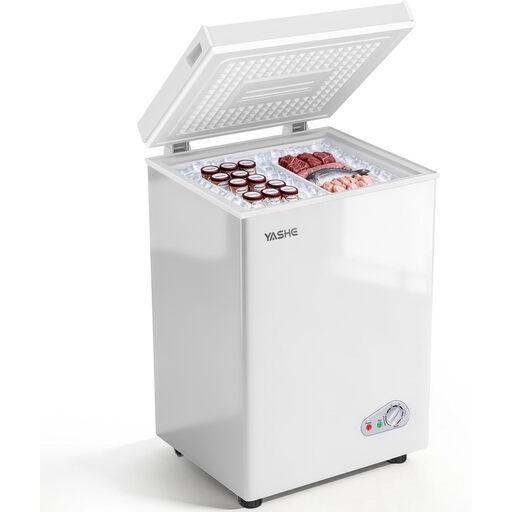 No image available
The two removable baskets can help you organise different portions in shared storage.
100 L capacity, two removable baskets and six temperature settings. The product name lists a noise level of 45 dB.
 No image available
The larger capacity is worth considering if housemates want to store more shared supplies; measure the available space first.
291 L capacity, convertible between fridge and freezer, with a top-opening lid and a removable basket. The product name lists energy class E.
 No image available
The capacity and included storage basket are useful to consider if you want to organise a smaller shared supply.
98 L capacity, one storage basket, counterbalanced lid, adjustable temperature control and adjustable feet. The product name lists energy class E.
 No image available
Its 140 L capacity offers a different amount of storage from the smaller chest freezers in this selection; check that its external dimensions suit your kitchen.
140 L capacity, one storage basket, counterbalanced lid, adjustable temperature control and adjustable feet. The product name lists energy class E.
 No image available
The storage basket and the interior light mentioned in the product name may be useful if housemates want to find smaller portions easily.
99 L capacity, removable basket, interior light and convertible fridge-freezer function. The product name lists an inverter compressor, 38 dB and energy class E.
The Netherlands Nutrition Centre recommends blanching broccoli briefly, cooling it straight away in iced water, then draining and drying it thoroughly. Divide the vegetable into small portions and don’t put warm portions in the freezer.
The Netherlands Nutrition Centre recommends setting your freezer to −18 °C or colder. Check the setting and the appliance’s user manual; the stated freezing capacity doesn’t replace this temperature check.
Don’t automatically use the storage period for raw or fully cooked broccoli as an exact guide for blanched broccoli. Date your portions and follow storage advice suitable for this preparation method.
Compare the annual energy consumption in kWh on the EU energy labels of the models you’re considering. Use the same basis for comparison and weigh energy use against capacity, layout and the space required.
Measure the space and check that the lid can open fully; also follow the model’s installation instructions. Inventum lists Low Frost for the VK562W and No Frost for the VK980W, but check the maintenance instructions for each model individually.