
Dough maker with batches of varying sizes
You sometimes make several portions of fresh dough at once after a visit to the market. Compare the weight of a batch like this with the freezing capacity of the exact model.


Choose a chest freezer based on the weight of the fresh dough you want to freeze in one day: its stated freezing capacity in kg per 24 hours tells you more than its capacity in litres alone. Then check that your wrapped portions will fit, that there’s enough room to open the lid, and what the energy label says. If you’re putting it in an unheated outbuilding, also check the minimum temperature the model is suitable for. If your current freezer can handle the batch, you may not need an extra appliance.
You sometimes make several portions of fresh dough at once after a visit to the market. Compare the weight of a batch like this with the freezing capacity of the exact model.
You’re looking for extra freezer space, but also need to consider the floor area, room for the lid to open and how easy it will be to find your portions.
You want to put the chest freezer in a garage or shed, so you’ll need to compare the lowest temperature there with the chosen model’s specifications.
Choose this when: there’s enough free space and freezing capacity for the wrapped portions and the fresh batch.
The trade-off: available storage space alone doesn’t tell you how much fresh dough the appliance can freeze at once.
Choose this when: you have a modest supply of dough or limited floor width. Inventum lists the VK562W as having a 99-litre capacity, a width of 54.7 cm and a freezing capacity of 4.5 kg per 24 hours.
The trade-off: a larger fresh batch may exceed its stated daily capacity; Low Frost doesn’t mean you’ll never need to defrost this model.
Choose this when: you regularly freeze larger batches of dough or store other food as well. Inventum lists the VK952W as having a 198-litre capacity and a freezing capacity of 9 kg per 24 hours.
The trade-off: Inventum says the VK952W is 77 cm wide; also compare the annual energy consumption in kWh of the models you’re considering.
| What to consider | What to look for | Who should consider this? |
|---|---|---|
| Freezing a fresh batch of dough | Weigh the largest batch you’d typically make and compare its weight with the stated freezing capacity in kg per 24 hours for the exact model. | If I want to freeze several fresh portions at once after a visit to the market, I need to know whether the capacity is up to the task. Around 36% of consumers prioritise having enough freezing capacity for a large fresh batch. |
| Storage and accessibility | Count the portions you want to store at once and measure the available floor space and clearance for opening the lid. Also check whether a basket would help keep smaller portions within easy reach. | If the chest freezer is going in a tight spot, I want enough room for my wrapped portions without the lid being blocked. Around 29% of consumers give top priority to suitable storage and accessibility. |
| Energy consumption | Check the energy label and compare the stated consumption in kWh per year for specific models; first, see whether your current freezer will do the job. | If I use the freezer all year round for the occasional batch of dough, I don’t want to choose more freezer space than I need. Around 21% of consumers prioritise annual energy consumption. |
| Positioning in a cold outbuilding | Measure the lowest temperature at the intended location and check the climate class and the model-specific temperature rating. | If my garage or shed is unheated, I want to know whether this particular model can be kept there at the lowest temperature. Around 14% of consumers prioritise suitability for a cold outbuilding. |
Litres describe storage space, not how much fresh dough the appliance can freeze in 24 hours. So even a spacious chest freezer may have a lower daily capacity than your batch requires.
Compare both the wrapped portions you plan to store and the weight of your largest fresh batch with the specifications for the exact model.
Inventum says that the VK562W, despite having Low Frost, still needs to be defrosted periodically.
Read the care instructions and think about where you can store the contents temporarily while you defrost it.
Allow time for defrosting and find somewhere temporary to store the contents.
Consumentenbond points out that the standard climate class and an additional rating for low ambient temperatures aren’t the same thing.
Measure the lowest temperature at the intended location and check the documentation for the specific model.
An extra appliance uses electricity even when you’re not freezing dough. Milieu Centraal recommends checking the annual consumption in kWh on the energy label.
First, check whether your existing freezer can handle the batch. Then compare the energy labels of models that suit your capacity and location requirements.
Inventum offers chest freezers in compact and larger sizes, including the VK562W and VK952W.
The TCF0991B is a compact chest freezer for which Tomado lists a 99-litre capacity and Low Frost.
The HSM22340 is a larger chest freezer to consider if you’re looking for extra storage space.
The CFc 1875 Plus is a Liebherr chest freezer with SmartFrost and FrostProtect.
This Joybuy range includes compact and larger chest freezers for storing extra wrapped portions of dough. For any model you’re considering, also check its freezing capacity for the fresh batch you want to freeze.
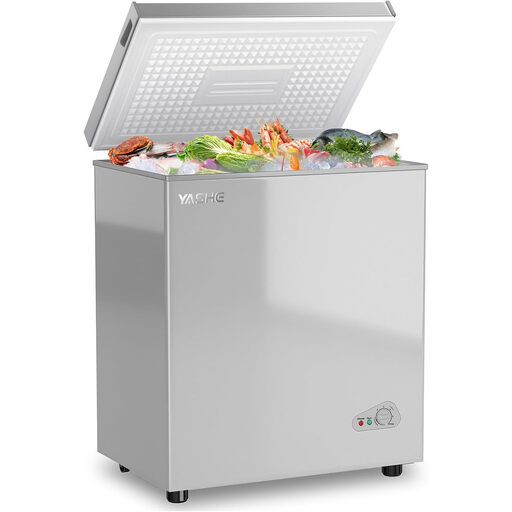 Image unavailable
The two removable baskets can help you keep smaller portions separate; check this model’s freezing capacity before freezing a fresh batch of dough in it.
Capacity: 150 L. Two removable baskets. Six temperature settings.
 Image unavailable
The removable basket can keep smaller items separate; check the dimensions against the available space before choosing this compact model.
Capacity: 95 L. Dimensions: 550 × 475 × 848 mm. Switches between fridge and freezer modes. Removable basket. Energy class E; stated consumption 165 kWh per year.
 Image unavailable
The larger capacity could suit you if you want to store other frozen food as well as dough; measure the available floor space and clearance for opening the lid beforehand.
Capacity: 291 L. Dimensions: 1100 × 597 × 872 mm. Switches between fridge and freezer modes. Removable basket and LED lighting. Energy class E; stated consumption 226 kWh per year.
 Image unavailable
div>
The storage basket can help you keep smaller portions separate; check that the capacity and external dimensions suit your stock and available space.
Capacity: 98 L. Storage basket. Counterbalanced lid. Adjustable temperature control. Energy class E.
 Image unavailable
The stated freezing capacity can help you compare models for a fresh batch of dough; also check that the storage space is suitable for your portions.
Stated freezing capacity: 4.5 kg per 24 hours. Dimensions: 54.5 × 47.6 × 83.5 cm. Storage basket and wire shelf. Castors. Energy class E.
Look at both, but for a fresh batch of dough, kg per 24 hours indicates the stated freezing capacity, while litres describe storage space. Compare the weight of the largest batch you want to freeze in one day with the specifications for the exact model.
No. First, check the lowest temperature in the shed and compare it with the climate class and any additional temperature rating for the specific model. A manufacturer’s rating for one chest freezer doesn’t automatically apply to another model.
Voedingscentrum gives −18 °C as the ideal temperature for a freezer and recommends defrosting meals in the fridge. Wrap and date dough portions individually; don’t automatically apply general advice for prepared meals to the storage life of a particular dough recipe.
Yes. If you actually sell the dough, you’ll need to follow the food safety rules for selling food. The NVWA requires food sold at markets to be prepared, sold and stored safely and hygienically. If you sell at markets several times a year, the NVWA says you must register and work with a food safety plan or hygiene code.