
Weekend pizza maker with limited space
This person wants to make a few portions of dough in advance and check whether their existing freezer is big enough before adding a second appliance.


If you’re making a few portions of pizza dough for a weekend lunch, a separate chest freezer may not be necessary: first check whether they’ll fit in your existing freezer. If you regularly make larger batches or want to store other food too, compare usable capacity, freezing capacity in kg/24 hours, annual energy consumption in kWh and the temperature requirements for the space where the appliance will go. Milieu Centraal advises choosing a suitable size, while Voedingscentrum recommends freezing food in small portions and not adding too much at once.
This person wants to make a few portions of dough in advance and check whether their existing freezer is big enough before adding a second appliance.
This person freezes several portions at once, so they compare not only capacity but also the stated freezing capacity per 24 hours.
This person’s only suitable space may be outside the kitchen, so they need to check that the model they choose is suitable for the temperatures in that room.
Best for: a few individually wrapped portions for a weekend lunch, if there’s enough space.
Trade-off: you won’t need to find space for a second appliance, but the available capacity will remain limited.
Best for: regularly freezing extra portions, if you have room for a chest freezer with a top-opening lid.
Trade-off: the compact models in the examples reviewed differ in their stated freezing capacity and energy rating, so compare the exact model.
Best for: storing dough alongside a noticeably larger food stock, if you have enough floor space.
Trade-off: you’ll get more storage space, but the appliance will also take up more room; compare its stated annual energy consumption in kWh.
First, count the portions of dough and other products that need to fit in the freezer at the same time. The table shows which purchase considerations may matter most to shoppers.
| Consideration | What to look for when buying | Who is this most relevant to? |
|---|---|---|
| Suitable freezer space | Count the wrapped portions and other frozen food; compare capacity and external dimensions, including the space needed to open the lid. | I don’t want to buy more space than I’ll actually use. Around 31% of shoppers are most concerned with having the right amount of extra freezer space. |
| Freezing batches | Compare the stated freezing capacity in kg/24 hours with the amount you’ll add in one day; freeze food in small portions. | If I’m freezing several fresh portions of dough at once, I want to be able to assess the freezing capacity as well as the storage capacity. Around 25% of shoppers are most concerned about freezing in batches. |
| Energy use | For models of a suitable size, compare the energy label and stated annual consumption in kWh. | I want to know how much a second appliance will use continuously, even if I don’t freeze dough very often. Around 25% of shoppers are most concerned about energy use. |
| Where it will go | Measure the available space and check the minimum and maximum temperatures in the room; consult the manual and rating plate for the exact model. | If my chest freezer is going in an unheated storage room, I want to check whether the model is suitable for the temperatures there. Around 19% of shoppers are most concerned about whether the appliance is suitable for their chosen location. |
A second appliance takes up space and uses energy between the times you freeze dough.
First, check how much space is left in your current freezer. Only then compare additional models by capacity and stated annual energy consumption.
Remember to factor in the space the appliance will take up and its ongoing energy use.
Litres indicate storage capacity, not how much fresh food the appliance can freeze in 24 hours according to the manufacturer. Inventum states 4,5 kg/24 uur for the VK562W; Tomado states 2,25 kg/24 uur for the TCF0991W.
If you make larger batches, compare the stated kg/24 hours for the exact models and freeze the dough in small portions.
The suitable ambient temperature varies by model. Consumentenbond advises checking the climate class, so also measure the temperatures in the intended location.
Before choosing a location, consult the rating plate and manual for the exact model. Inventum and Tomado state that the VK562W and TCF0991W respectively can be used down to −15 °C; this information doesn’t automatically apply to other chest freezers.
Inventum describes Low Frost on the VK562W as a way to defrost less often, not as a guarantee that defrosting will never be necessary.
Check the defrosting method and whether there’s a defrost water drain on the model you’re considering.
Allow time and space for periodic defrosting.
The VK562W is an example of a compact chest freezer for anyone looking for extra freezer space.
The TCF0991W is a compact chest freezer with a capacity of 99 litres.
Beko offers compact and larger chest freezers, including the CF100EWN and HSM22340.
The CFd 2085 Plus is a larger chest freezer for anyone who wants to store a bigger stock of food as well as dough.
This selection includes compact chest freezers for extra portions of dough and a larger model for storing dough alongside a bigger stock of food.
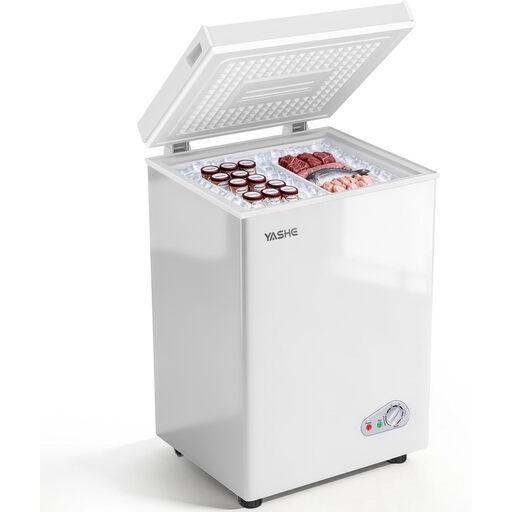 No image available
A compact option if you’re looking for extra space for portions of dough.
The product title states that it has a capacity of 100 litres, two removable baskets and six temperature settings.
 No image available
The extra space may suit you if you want to store other frozen food as well as dough.
The product information states that it has a capacity of 140 litres, a storage basket, a counterbalanced lid, adjustable temperature control and an energy rating of E.
 No image available
A compact option if you’re looking for extra storage and want to take the stated freezing capacity into account.
The product information states that it has a capacity of 99 litres, a freezing capacity of 4,5 kg per 24 hours, annual energy consumption of 169 kWh and an energy rating of E. Not suitable for outdoor use or damp environments.
 No image available
A compact chest freezer for anyone who wants to compare capacity and stated freezing capacity.
The product information states that it has a capacity of 99 litres, a freezing capacity of 4,5 kg per 24 hours and an energy rating of E. The title also mentions a wire basket and a lid that stays open.
 No image available
The larger capacity may suit you if you want to store dough alongside a bigger stock of food.
The product information states that it has a capacity of 291 litres, five temperature settings, a removable basket and the option to switch between fridge and freezer modes. The stated external dimensions are 1100 × 597 × 872 mm.
Voedingscentrum recommends setting your freezer to at least −18 °C. Freeze food in small portions and don’t add too much at once; also follow the instructions in your recipe or on the packaging for the dough.
Not necessarily. Voedingscentrum says an opened thin pizza base can be kept in the freezer for one month and notes that its quality may deteriorate after that. This advice doesn’t automatically apply to homemade dough balls or dough made using a different recipe.
Defrost the dough covered in the fridge and allow plenty of time. Voedingscentrum describes defrosting in the fridge as a general method, but doesn’t give a specific rising time for pizza dough, so follow your recipe or the packaging.
It depends on the exact model and the temperatures in the shed. Consumentenbond advises checking the climate class. Inventum states that the VK562W can be used down to −15 °C, as does Tomado for the TCF0991W; don’t apply this model-specific information to other chest freezers.