Who is a chest freezer for pizza dough suitable for?

Keeping dough in a small space

If you mainly want to store individual portions of dough and have limited floor space, compare the capacity with the external dimensions and the clearance needed to open the lid. The Consumers’ Association points out that chest freezers are available in different sizes.

An unheated storage room

If the freezer will be in a room that can get very cold, check the minimum ambient temperature for the exact model, as well as the installation instructions. Inventum and Liebherr specify operation down to -15 °C for certain models; this rating doesn’t automatically apply to other models.

Large batches of dough

If you make enough dough in one go for several stays or guests, check the stated freezing capacity in kg per 24 hours as well as the storage capacity. For example, Inventum specifies 4.5 kg/24 hours for the VK562W and 14 kg/24 hours for the VK1122W. These are manufacturer figures, not the results of a pizza dough test.

What should you look for when choosing one?

What to consider What to look for Who is this most important for?
Capacity and space Measure the space and access route; compare the model’s external dimensions and capacity, and check its installation instructions. The manual for the Inventum VK562W/01 requires 10 cm of clearance all round. If space is limited, I want enough room for my portions of dough without choosing a freezer that’s difficult to fit in. Around 26% of consumers prioritise a suitable capacity and enough room for installation.
Cold surroundings Decide where the freezer will go and check the stated minimum ambient temperature for that exact model. If my holiday home is sometimes empty for long periods and the storage room gets cold, I want to know whether the model is designed for those conditions. Around 21% of consumers prioritise suitability for a cold location.
Fresh batches of dough Compare the amount of fresh dough you plan to freeze per batch with the stated freezing capacity in kg per 24 hours. The EU definition links a four-star freezer compartment to a target temperature of -18 °C and requirements for freezing capacity. If I’m freezing a lot of fresh dough in one go, I want to consider the batch size rather than looking at litres alone. Around 21% of consumers prioritise freezing larger batches of dough.
Energy use and maintenance Compare the annual energy consumption in kWh on the energy label of models that fit your space. Also check how the exact model should be defrosted. If the freezer stays on between stays, I want to take annual energy use and maintenance into account. Around 16% of consumers prioritise ongoing running costs and maintenance.
Temperature while you’re away Check which alarm features and power-cut storage time conditions apply to the model. The condition of the food also matters after a power cut. If no one is at the holiday home, I want to think in advance about how I can spot temperature problems and what to check after a power cut. Around 16% of consumers pay the most attention to this risk.

Easy-to-miss points when buying

  • Looking only at the capacity in litres

    A chest freezer may seem suitable based on its capacity, but its external dimensions, the clearance needed to open the lid or ventilation requirements could mean it won’t fit properly in the space.

    First, measure the space and access route. Then compare the capacity and dimensions with the installation instructions for the exact model.

  • Assuming every chest freezer will work in a cold shed

    A stated minimum ambient temperature applies to the model specified; it isn’t a general feature of every chest freezer from that brand.

    Before placing a freezer in an unheated room, check the minimum ambient temperature and installation instructions for the specific model you’re considering.

  • Confusing a frost-reduction feature with maintenance-free operation

    Inventum describes Low Frost and Liebherr SmartFrost as features that reduce frost build-up. This doesn’t mean the freezer never needs defrosting.

    Read the maintenance instructions for the exact model and allow for regular defrosting and cleaning.

Brands to consider

Inventum

The models mentioned range from a compact chest freezer to a larger option; the features below apply only to those specific models.

  • Inventum states that the VK562W and VK1122W are suitable for ambient temperatures down to -15 °C, and have super-freeze and frost-reduction features.
  • Inventum lists a capacity of 99 litres and a freezing capacity of 4.5 kg/24 hours for the VK562W, and 293 litres and 14 kg/24 hours for the VK1122W.
  • The stated freezing capacity and temperature apply to these models; they aren’t the result of an independent comparison or a pizza dough test.

Liebherr

The CFc 1875 Plus is a larger chest freezer that can serve as a model to consider when weighing up capacity and available space.

  • Liebherr lists a capacity of 192 litres, external dimensions of 82 × 104 × 71 cm and operation down to -15 °C for this model.
  • The manufacturer describes SmartFrost as a feature that reduces frost build-up.
  • The dimensions and stated operating temperature are manufacturer figures. Also check the required installation space and maintenance for your situation.

Beko

The CF100EWN is a compact chest freezer you can compare with other models of around 100 litres.

  • Beko lists a capacity of 98 litres, a width of 54.5 cm and energy rating E for this model.
  • Before choosing this model for a cold storage room or large batches of dough, check the minimum ambient temperature and freezing capacity for the exact version.

Chest freezers at Joybuy

This selection includes compact and larger chest freezers for storing pizza dough and other frozen food. For each model, check that the four-star freezer compartment, freezing capacity and installation requirements suit how you plan to use it.
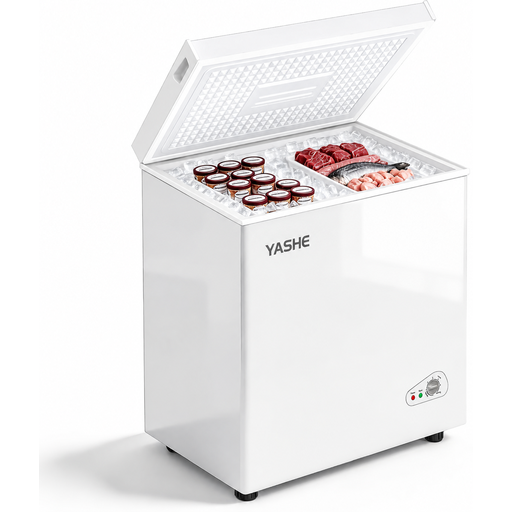
YASHE BC-150Q-EU freestanding 150-litre chest freezer

YASHE BC-150Q-EU 150 L chest freezer

An option if you want to store a larger range of frozen food as well as dough.

150 L; freestanding.

Joybuy

AUCMA convertible 291-litre chest freezer

AUCMA 291 L convertible chest freezer

A larger option to compare if you want to store more food for several stays.

291 L; switches between fridge and freezer modes.

Joybuy

Comfee' RCC143WH2EU(E) 99-litre chest freezer

Comfee' RCC143WH2EU(E) 99 L chest freezer

A compact option to compare if you mainly want to store a small supply of dough.

99 L; switches between fridge and freezer modes; energy rating E.

Check that the stated operating environment is suitable for where you plan to put the freezer.

Joybuy

CHiQ JR99DWE 99-litre chest freezer with four-star freezing

CHiQ JR99DWE 99 L chest freezer

A compact option to compare for individual portions; check that there’s enough space around the freezer.

99 L; four-star freezing.

The product information lists a freezing capacity of 4.5 kg/24 hours; check the figures for the exact version.

Joybuy
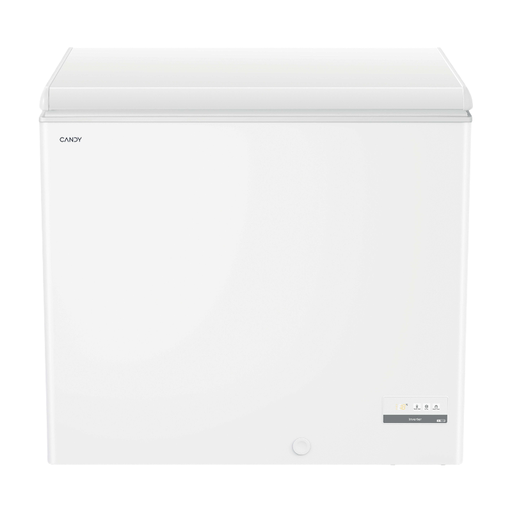
Candy CHAE 2002C 196-litre static chest freezer

Candy CHAE 2002C 196 L chest freezer

A larger capacity to compare if you want to store other frozen food as well as pizza dough.

196 L; static technology; energy rating C; external display.

Joybuy

Frequently asked questions

What temperature should a freezer be set to for pizza dough?

Set the freezer to at least -18 °C. The Netherlands Nutrition Centre recommends this temperature for freezers. Under the EU definition, a four-star freezer compartment has a target temperature of -18 °C and meets requirements for freezing capacity.

Can a chest freezer be kept in an unheated room?

That depends on the minimum ambient temperature specified for the exact model. Inventum states that the VK562W can operate down to -15 °C, as does Liebherr for the CFc 1875 Plus. Also check the installation and ventilation instructions; the manual for the Inventum VK562W/01 requires 10 cm of clearance all round.

How long does pizza dough keep in the freezer?

For an opened thin pizza base, the Netherlands Nutrition Centre recommends storing it for one month; after that, its quality may deteriorate. This advice doesn’t automatically apply to every recipe for homemade, uncooked dough. If you’re using packaged dough, also follow the instructions on the packaging.

What should you do with pizza dough after a power cut?

First, check the condition of the food. According to the Netherlands Nutrition Centre, food that is still hard-frozen can go back in the freezer. If the outside has softened, it’s better not to refreeze it.

How do you compare the energy use of chest freezers?

Compare the annual energy consumption in kWh on the European energy label for models with a suitable capacity and that fit your space. Work out any costs using your own electricity tariff; an energy rating alone doesn’t tell you how much it will cost.
