
Home baker with limited floor space
You want to store portions of dough without the freezer getting in the way in your kitchen. Remember to measure how much clearance you need to open the lid too.


A compact chest freezer could be right for you if you regularly freeze several batches of dough and have enough room to open the lid. Measure the space and compare the layout and freezing capacity with the size of your batch. If floor space is limited or you need quick access to individual portions, consider an under-counter freezer or an upright freezer with drawers too. The Netherlands Nutrition Centre advises setting your freezer to at least −18 °C; compare the annual energy consumption of each model.
You want to store portions of dough without the freezer getting in the way in your kitchen. Remember to measure how much clearance you need to open the lid too.
You make several portions at once, so compare the storage capacity with the freezing capacity per 24 hours. This helps you check that the freezer can handle the amount of dough you add in a day.
You want to find individual portions quickly, so compare a basket in a chest freezer with the layout of an upright freezer with drawers. The Consumers' Association notes that items are easier to reach in an upright freezer with drawers.
Start by checking the space available and how much dough you freeze at once. Then consider how easy it is to reach individual portions and how much energy the freezer uses in operation.
| What to consider | What to look for | Who is this most important for? |
|---|---|---|
| Space and placement | Measure the external dimensions and check that the lid can open fully. If necessary, compare the clearance needed with the door swing of an upright model. | If my kitchen space is limited, the freezer needs to fit without blocking my work area. Around 36% of consumers say placement is their top priority. |
| Batch size and storage | Compare the amount of fresh dough with the stated freezing capacity in kg/24 hours. Use the capacity in litres as a guide to storage space, not as an exact count of dough containers. | If I make several portions at once, both the freezing capacity and the space for packaged portions need to suit my batch. Around 29% of consumers put batch capacity first. |
| Finding individual portions | Check whether a basket keeps smaller portions separate, and make sure your packaging will fit inside. Drawers offer a different layout. | If I often take out one portion, I want to find it without moving the entire contents. Around 21% of consumers prioritise easy access to individual portions. |
| Energy use and maintenance | Compare the annual energy consumption in kWh on the EU energy label for the exact models. Check the defrosting instructions too; Low Frost does not mean you never need to defrost the freezer. | If I want extra storage space without overlooking energy use and maintenance, I compare these points for each model. Around 14% of consumers prioritise running costs and maintenance. |
A chest freezer may look big enough on paper but still not fit your space or freeze enough fresh dough at once.
Measure the external dimensions and the clearance needed for the lid. Also compare the stated freezing capacity in kg/24 hours for the exact model.
Inventum says that the VK562W still needs defrosting, despite its Low Frost feature.
Read the maintenance instructions for your chosen model and allow time to defrost it, as well as somewhere temporary to keep the contents cold.
Defrosting takes time and you’ll need temporary space for your frozen food.
The energy rating alone doesn’t tell you how much electricity a particular model uses each year. A second appliance will also add to your energy use.
Compare the annual energy consumption in kWh on the EU energy labels of the models you’re considering, and think about how often you’ll need the extra storage space.
A second freezer will add to your ongoing electricity costs.
The VK562W is a compact chest freezer worth comparing if you freeze dough in batches and want a temperature alarm.
The white TCF0991W is worth comparing if a relatively small batch of dough per freezing day is enough for you.
The CF100EWN is a compact chest freezer with a capacity comparable to that of other models around 100 litres.
The products below are chest freezers to compare for freezing and storing pizza dough. Choose a capacity and layout that suit what you want to store, and measure the available space, including room to open the lid.
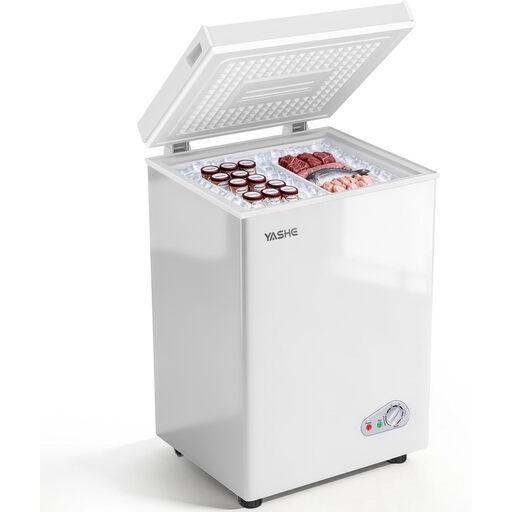 No image available
The two removable baskets provide a separate space for smaller portions of dough.
Capacity: 100 litres. Two removable baskets and 6 temperature settings.
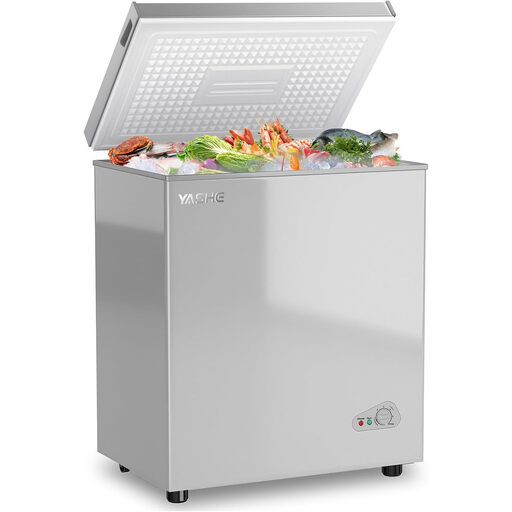 No image available
The 150-litre capacity is worth comparing if you want to store a larger supply of dough. Check that the freezer will fit in the available space.
Capacity: 150 litres. Two removable baskets and 6 temperature settings.
 No image available
The 291-litre capacity is worth comparing if you want to store a large supply. Measure the space beforehand to make sure the freezer will fit with the lid open.
Capacity: 291 litres. Converts between fridge and freezer modes; energy class E.
The stated external dimensions are 1100 × 597 × 872 mm. Check how much clearance is needed above the lid too.
 No image available
The basket provides a separate storage space for smaller portions of dough.
Capacity: 98 litres. Includes a storage basket, counterbalanced lid and adjustable temperature control; energy class E.
 No image available
The 140-litre capacity is worth comparing if you want to store more portions of dough. Measure the space and check that you can reach the basket.
Capacity: 140 litres. Includes a storage basket, counterbalanced lid and adjustable temperature control; energy class E.
The Netherlands Nutrition Centre advises setting your freezer to at least −18 °C. Freeze dough in small portions and don’t add too much food at once. This storage advice doesn’t mean that a particular appliance will maintain this temperature in all conditions.
No. The Netherlands Nutrition Centre gives one month as a guide for an opened, thin pizza base and says that its quality may deteriorate after that. Don’t apply this advice automatically to every recipe or an unopened pack; follow the packaging instructions instead.
You can put it under a worktop only if the lid can still open fully, so measure the clearance beforehand. If you’re placing it somewhere unheated, check the permitted ambient temperature for the exact model. The Consumers' Association warns that not every appliance is suitable for a cold garage or shed.
No. ACM ConsuWijzer explains that your statutory rights exist alongside a manufacturer’s or seller’s guarantee, and depend on what you could reasonably expect from the product with normal use. If a product is faulty, contact the seller.
For catering, artisan food businesses and retail, the Netherlands Food and Consumer Product Safety Authority (NVWA) sets out requirements for hygienic preparation and storage under HACCP. For frozen products, the NVWA specifies −18 °C or below when no storage temperature is given on the packaging. Household storage advice doesn’t replace the rules that apply to your business.