For a few sealed single portions, an extra chest freezer is mainly worth considering if you’re running out of freezer space. If you often cook larger batches, also check the stated freezing capacity. When comparing suitable models, look at the stated capacity, external dimensions, annual energy consumption in kWh and layout, and factor in where you’ll put it and how you’ll defrost it.
Who is a separate chest freezer suitable for?
People living alone with few leftovers
You occasionally freeze a few portions of sauce and want to know whether you need an extra appliance. Voedingscentrum offers guidance on storing leftovers, while Milieu Centraal highlights the importance of choosing the right size.
One-person households that batch cook
You regularly make several portions at once and need enough freezer space and suitable freezing capacity for these batches. Voedingscentrum offers advice on storing leftovers, while Inventum and Tomado publish freezing capacity figures for their models.
Buyers with limited space
You can only fit a chest freezer if its external dimensions, the space needed to open the lid and the intended location are all suitable. Inventum, Beko and Liebherr include dimensions or placement requirements in their model information.
What should you look for in a chest freezer for portions of sauce?
Use your existing freezer space
Suitable if: you only store a few portions at a time and they fit in your current freezer.
Trade-off: you won’t need an extra appliance, but you’ll have less room for larger batches.
A compact chest freezer
Suitable if: you regularly run out of freezer space and have room for a top-opening freezer.
Trade-off: its capacity may be more than you need for a few portions, so also compare its dimensions, annual energy consumption and accessibility.
An upright or under-counter freezer with drawers
Suitable if: you often take out small portions and want to keep everything organised.
Trade-off: drawers generally make the contents easier to access; also compare the capacity, dimensions and energy consumption of the specific model.
| What to consider |
What to look for |
Who it matters most to |
| Capacity you need |
Count how many sealed portions you want to store at once and first check how much space is left in your current freezer. Then compare the stated capacity and external dimensions. |
If I’m only freezing a few containers at a time, I first want to know whether my current freezer will fill up. Around 36% of consumers focus mainly on how much extra capacity they need. |
| Annual energy consumption |
Compare the annual kWh consumption on the energy label for the exact model alongside its capacity. Calculate your own potential costs using your electricity tariff. |
I want to know how much electricity an extra appliance will use each year before adding more capacity. Around 29% of consumers prioritise energy consumption. |
| Larger batches |
Compare the stated freezing capacity in kg per 24 hours with the amount of sauce you usually freeze at once. Also check whether the layout suits your containers. |
When I regularly cook several portions at once, I want to be able to freeze the batch and find it again later. Around 21% of consumers prioritise batch cooking. |
| Placement and maintenance |
Measure the space, including room to open the lid. If the freezer will be in a cold room, check the stated ambient temperature range and factor in defrosting. |
If the chest freezer needs to go in a storage room, having a suitable spot and manageable maintenance are essential. Around 14% of consumers prioritise placement and maintenance. |
Pitfalls to avoid when buying a small chest freezer
-
Buying a separate freezer without checking your existing freezer space
For a few single portions, the extra capacity may be more than you need. A chest freezer also takes up space and uses electricity.
Count how many portions you want to store at once and check whether they’ll fit in your current freezer before choosing an extra appliance.
Factor in the space the appliance takes up and the electricity it uses while running.
-
Looking only at the energy label rating or capacity
The label rating alone doesn’t tell you how many kWh a specific model uses each year. Capacity and external dimensions also determine whether it suits your needs and the space available.
For the exact model, compare the annual kWh consumption on the energy label, the capacity and the external dimensions.
-
Assuming Low Frost means no maintenance
Low Frost doesn’t mean you’ll never need to defrost the freezer. Inventum describes the VK562W as featuring Low Frost; follow the maintenance instructions for the model you choose.
Check the maintenance instructions and see whether the model has a defrost water drain.
Defrosting takes time, and you’ll need somewhere temporary to store your frozen food.
Brands to consider
Inventum
Inventum lists the VK562W as a 99-litre chest freezer with a basket and temperature alarm.
- According to Inventum, the VK562W has a D energy rating and a stated freezing capacity of 4.5 kg per 24 hours.
- Low Frost doesn’t remove the need to defrost the freezer when necessary. The manufacturer’s specifications are not an independent test of freezing pasta sauce.
Tomado
Tomado describes the TCF0991B as a 99-litre chest freezer.
- For this model, Tomado lists a D energy rating, 38 dB, a freezing capacity of 2.25 kg per 24 hours and a defrost water drain.
- Check the energy label for the version on offer before comparing models.
Beko
According to Beko, the freestanding CF100EWN is a chest freezer with a capacity of 98 litres.
- Beko lists an E energy rating and static cooling for this model.
- Compare the annual kWh consumption on the energy label for the exact model.
Liebherr
According to Liebherr, the Liebherr CFc 1875 Plus has a capacity of 192 litres, making it more suitable if you want to store considerably more than just sauce.
- For this model, Liebherr lists SmartFrost and suitability for ambient temperatures down to −15 °C.
- At 104 cm wide, it isn’t a compact choice if you only want to store a few portions of sauce. SmartFrost is the manufacturer’s description, not an independent measure of its effectiveness.
Chest freezers on Joybuy for extra freezer space
The products below are chest freezers that provide extra freezer space. For portions of sauce, focus on capacity, available space and layout.
 No image available
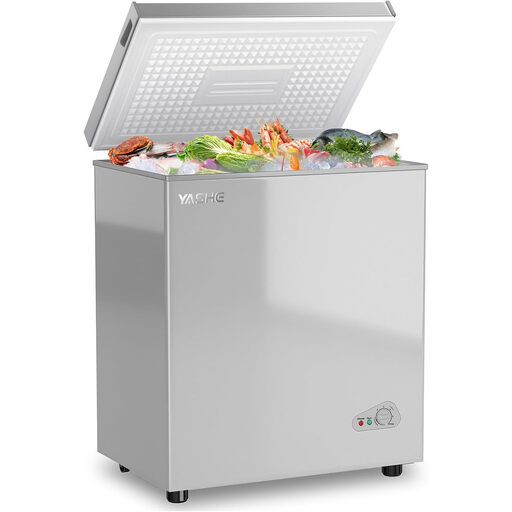
YASHE BC-150Q-EU, 150 litres, silver
The stated capacity and two baskets are useful if you want to store several portions at once and keep smaller packs separate.
150-litre capacity; 2 removable baskets; 6 temperature settings; quick-freeze function; stated noise level of 45 dB.
Joybuy
 No image available
AUCMA chest freezer, 95 litres, convertible
The stated capacity and removable basket are useful if you want to store portions separately; according to the product description, this model can also be switched to fridge mode.
95-litre capacity; 1 removable basket; 7 thermostat settings; convertible between fridge and freezer modes; E energy rating; external dimensions 550 × 475 × 848 mm; defrost water drain.
Joybuy
 No image available
TCL CF126EWE0NL, 98 litres
The storage basket can be handy if you want to keep smaller packs separate.
98-litre capacity; storage basket; counterbalanced lid; adjustable temperature control; adjustable feet; E energy rating.
Joybuy
 No image available
TCL CF182EWE0NL, 140 litres
The stated capacity gives you room for several portions; the basket is designed to keep smaller items separate.
140-litre capacity; storage basket; counterbalanced lid; adjustable temperature control; adjustable feet; E energy rating.
Joybuy
 No image available
Comfee' RCC143WH2EU(E), 99 litres
The stated freezing capacity is useful if you regularly want to freeze several portions at once; the wire basket can keep smaller packs separate.
99-litre capacity; stated freezing capacity of 4.5 kg per 24 hours; 169 kWh per year; 4-star freezer compartment; removable wire basket; stay-open lid; LED lighting; stated noise level of 38 dB; E energy rating.
Joybuy
Frequently asked questions
How do I freeze homemade pasta sauce?
Voedingscentrum advises cooling leftovers quickly and putting them in the fridge or freezer, well sealed, within 2 hours of cooking. Divide the sauce into portions and label them with the date.
How long does frozen pasta sauce keep?
Voedingscentrum says pasta sauce without meat can be kept in the freezer for 3 months; its quality may deteriorate after that. For a homemade recipe with different ingredients, check the storage advice that applies to it.
Can I put a chest freezer in an unheated shed?
Only if the ambient temperature stays within the range specified by the manufacturer for your chosen model. Inventum says the VK562W is suitable for rooms down to −15 °C; that specification doesn’t automatically apply to other models.
Which energy consumption figure should I compare?
Compare the annual kWh consumption on the energy label for the exact model, then multiply it by your own price per kWh to work out your running costs. Milieu Centraal notes that the label also provides information about capacity; the energy rating alone isn’t a complete cost comparison.
Which Dutch rules and rights are relevant when buying?
According to the European Commission, the EU energy label for household freezers has used the A–G scale since 1 March 2021. The Dutch government states that there is no fixed statutory warranty period under the legal guarantee; contact the seller if you have a problem. For online purchases, you generally have a 14-day cooling-off period, subject to legal exceptions.


