Choose a chest freezer that can be set to at least −18 °C and has enough room for your sealed portions. Also compare its freezing capacity in kg per 24 hours with the amount you want to freeze at once, and consider the available space and annual energy consumption. The Voedingscentrum advises cooling leftovers quickly and storing them in small portions.
Who is this guide for?
Family cook preparing several portions
You make mashed potato in one go, and possibly other parts of the meal too. Look for enough storage space and check the freezing capacity against the amount going into the freezer at once. The Voedingscentrum advises freezing food in small portions.
Buyer with space in a shed
You’re looking for extra freezer space outside your heated kitchen. Measure the available space, including clearance for opening the lid, and check the permitted ambient temperature for the exact model. The Consumentenbond stresses that suitability for low ambient temperatures varies by model.
Buyer weighing up energy use and maintenance
You want to factor in energy use and defrosting without buying more capacity than you need. Milieu Centraal advises choosing a suitable size and comparing annual energy consumption in kWh.
What should you look for when choosing?
First, work out how much mashed potato and other food you want to freeze at once. Then compare the internal capacity and freezing capacity: capacity in litres tells you how much you can store, while kg per 24 hours indicates how much food the appliance can freeze in that period. The Voedingscentrum advises freezing food in small portions, while Milieu Centraal recommends factoring in annual energy consumption when choosing a size.
| What to consider |
What to look for |
Who is this important for? |
| Capacity and freezing capacity |
Count the portions and other fresh food you plan to put in the freezer at once. Compare the total amount with the stated freezing capacity in kg per 24 hours. |
I freeze several family portions at once and want to know if the freezer can handle that batch; around 33% of consumers say batch size is their main buying consideration. |
| Location and ambient temperature |
Measure the floor space and the clearance needed for the lid. If you’re putting it in a shed or garage, compare the lowest ambient temperature there with the requirements for the exact model. |
If the freezer is going outside my heated kitchen, I want to be sure it can be kept there; around 27% of consumers say placement is their main buying consideration. |
| Annual energy consumption |
For models with enough capacity, compare both the energy label and the stated consumption in kWh per year. Milieu Centraal advises checking annual energy consumption. |
I don’t want to use more energy than necessary for space I don’t need; around 20% of consumers focus mainly on energy use. |
| Maintenance and organisation |
Check whether the freezer has a basket, interior light or defrost water drain, and whether you can still reach your portion containers easily. Low Frost reduces ice build-up, but it isn’t the same as No Frost. |
If I regularly take out small portions, keeping things organised and reducing maintenance are important; around 20% of consumers say maintenance and finding portions are their main buying considerations. |
How to avoid common buying mistakes
-
Confusing capacity in litres with freezing capacity
A chest freezer may offer plenty of storage space but still be unsuitable for freezing a large amount of fresh food in one go.
Compare the total amount you want to freeze at once with the stated capacity in kg per 24 hours. Divide the mashed potato into small, sealed portions, as the Voedingscentrum advises.
A large batch of fresh food can affect the temperature of food already in the freezer.
-
Looking only at the energy label rating
When comparing models of different sizes, the label rating alone doesn’t tell you how much energy they use each year.
First choose a size that suits the food you store, then compare the stated consumption in kWh per year. Milieu Centraal advises taking annual energy consumption into account.
-
Treating Low Frost as if it were No Frost
Low Frost reduces ice build-up, but it doesn’t mean you’ll never need to defrost the chest freezer.
Check which feature the exact model has and allow for periodic defrosting. The Consumentenbond describes No Frost as a feature that means defrosting isn’t needed because of ice build-up.
With Low Frost, you’ll still need to make time for maintenance and defrosting.
-
Choosing a chest freezer for a shed based on a general claim
Suitability for low ambient temperatures varies by model; a brand name alone doesn’t mean that every chest freezer is suitable.
Measure the temperature where you plan to put the freezer and check the manual or the stated temperature limit for the exact model. The Consumentenbond advises checking this for each model.
Relevant brands to consider
Inventum
The VK952W and VK1285W are models worth comparing if you want to store different amounts of food for the family.
- According to Inventum, the VK952W has a capacity of 198 litres and a freezing capacity of 9 kg per 24 hours; the VK1285W has a capacity of 300 litres and a freezing capacity of 13.5 kg per 24 hours.
- Inventum lists two removable storage baskets for the VK1285W.
- Low Frost reduces ice build-up, but you’ll still need to defrost it manually.
Tomado
The TCF0991W is a compact chest freezer to consider if you need extra space for a limited number of portions.
- Tomado lists a capacity of 99 litres, a four-star freezer compartment, a basket and a freezing capacity of 2.25 kg per 24 hours.
- Compare the stated freezing capacity with the amount you want to freeze in one day; the specification isn’t a real-world test.
Liebherr
The CFe 2080 is worth considering if you’re looking for a spacious chest freezer and the location may be unheated.
- Liebherr lists a capacity of 353 litres and FrostProtect for ambient temperatures down to −15 °C for this model.
- This temperature refers to the air around the freezer, not the food storage temperature. Check that the stated limit suits the location where you plan to put the model.
Beko
The CF100EWN is a compact chest freezer to compare if floor space is limited.
- Beko lists a capacity of 98 litres, energy class E and external dimensions of 84.5 × 54.5 × 54.5 cm.
- Check the freezing capacity of the exact version against the amount you want to freeze for a family meal.
Chest freezers at Joybuy
These product picks are chest freezers for extra storage of family portions. Compare the capacity with the food you store and check the freezing capacity of the exact model against the amount you want to freeze at once.
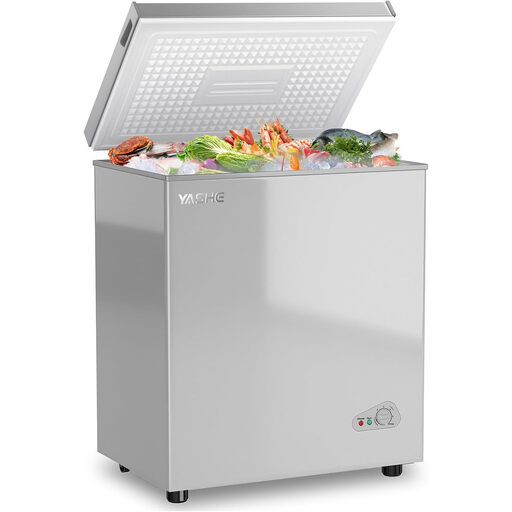 No image available
YASHE BC-150Q-EU chest freezer, 150 l
For extra storage of family portions; check that the freezing capacity suits the amount of fresh food you want to store at once.
150 l; two removable baskets; 6 temperature settings; 45 dB.
View at Joybuy
 No image available
TCL CF126EWE0NL chest freezer, 98 l
An option for extra storage alongside your existing food; match the amount you freeze at once to the model’s specifications.
98 l; storage basket; counterbalanced lid; adjustable temperature control; adjustable feet; energy class E.
View at Joybuy
 No image available
TCL CF182EWE0NL chest freezer, 140 l
For extra freezer space for family meals; check that the capacity and freezing capacity suit the food you store and the size of your batches.
140 l; storage basket; counterbalanced lid; adjustable temperature control; adjustable feet; energy class E.
View at Joybuy
 No image available
Comfee' RCC143WH2EU(E) chest freezer, 99 l
An option for storing extra smaller portions; before freezing a fresh batch, check that the stated freezing capacity suits the amount.
99 l; removable basket; LED lighting; energy class E.
View at Joybuy
 No image available
CHiQ JR99DWE chest freezer, 99 l
For extra storage of portions; compare this model’s freezing capacity with the amount you want to freeze at once.
99 l; four-star freezer compartment; energy class E; wire basket.
View at Joybuy
Frequently asked questions
How do I safely freeze cooled mashed potato for a family meal?
Cool the mashed potato quickly and put leftovers in a sealed container in the fridge or freezer within two hours. Freeze it in small portions at a temperature of at least −18 °C. The Voedingscentrum’s advice to store mashed potato made with potatoes and semi-skimmed milk in the freezer for three months applies to that specific recipe; check the relevant storage advice for other ingredients.
How should I defrost and reheat the portions?
It’s best to defrost a meal portion in the fridge; a small portion can also be defrosted in the microwave. The Voedingscentrum advises reheating defrosted meals thoroughly until piping hot.
Can any chest freezer be kept in an unheated shed?
No, it depends on the model and the temperature in that location. The Consumentenbond points out that suitability for lower temperatures varies by model. Compare the measured ambient temperature with the climate class and any separate temperature limit specified by the manufacturer for that exact chest freezer.
How do I compare the energy use of chest freezers?
First choose a capacity that suits the food you store, then compare both the energy label and the stated consumption in kWh per year. Milieu Centraal highlights annual energy consumption as something to consider; you’ll also need your own electricity tariff to work out your personal running costs.
Does a new chest freezer need an energy label, and what happens to my old appliance?
Freezers must have an energy label. According to the Dutch government, when you buy a new, similar household appliance, the retailer must take your old appliance free of charge. This also applies to online purchases; ask about the options for collection on delivery or at a later date.


