
Meal organiser stocking up on bread
You want to portion and store sliced bread ahead of a meal with family or friends. First check whether the portions will fit alongside your existing supplies and how much extra space you really need.


If your sliced bread, portioned up, fits in your existing freezer, you generally won’t need an extra chest freezer for a single festive meal. If you’ll need extra space afterwards too, choose a capacity that suits your packaged supplies and check the stated freezing capacity if you’re freezing a lot of bread at once. A chest freezer offers open storage space, while an upright freezer with drawers makes smaller portions easier to reach.
You want to portion and store sliced bread ahead of a meal with family or friends. First check whether the portions will fit alongside your existing supplies and how much extra space you really need.
You want everyone to be able to identify and grab their bread portions easily. A basket can help you organise a chest freezer; drawers offer another way to keep everything accessible.
You want to make use of the extra space after the festive meal too, so you’re factoring in energy consumption, where it will go and maintenance.
First check how much portioned bread fits in your current freezer. Then compare only models whose capacity and placement suit your supplies and available space.
| What to consider | What should you check? | Who should pay particular attention? |
|---|---|---|
| Plenty of capacity | Measure your packaged portions and compare them with the chest freezer’s usable capacity and external dimensions. | I want to avoid buying an extra appliance when my bread supplies still fit in my existing freezer. Around 36% of consumers say having enough storage space is their main concern when buying. |
| Finding your portions | Check whether the chest freezer has a basket and how you can organise individual packages. | If several people are taking bread, I want them to identify their portions without searching through all the supplies every time. Around 29% of consumers prioritise being able to find shared portions easily. |
| Energy consumption | For models with a suitable capacity, compare the energy label and the stated annual consumption in kWh. | I want to use the extra storage after the meal too, but I also need to factor in its ongoing energy consumption. Around 21% of consumers say energy consumption is their main concern when buying. |
| A suitable place to put it | Measure the available space and the clearance above the lid. If you’re putting it somewhere unheated, check the permitted ambient temperature for the exact model. | If the chest freezer needs to go in a cramped or unheated space, I want to know in advance whether the location is suitable. Around 14% of consumers start by checking whether the intended location is suitable. |
The number of guests doesn’t tell you how many packaged portions will fit in your existing freezer or how much extra capacity you need.
First work out how much bread you’ll actually freeze and how much spare space you already have. Only then compare suitable models.
Litres indicate storage capacity; the stated freezing capacity tells you how much food a model can freeze in 24 hours.
If you’re freezing a lot of fresh bread at once, compare both figures for the exact model.
A chest freezer has open storage space. According to the Consumers’ Association, the contents of an upright freezer with drawers are easier to reach.
Check the baskets in a chest freezer, and compare it with an upright freezer with drawers if several people often take small portions.
The permitted ambient temperature varies by model. The Consumers’ Association warns that not every appliance works properly below 10 °C.
Compare the temperature in the intended location with the product specifications and instruction manual for the exact model.
The VK562W, with a capacity of 99 litres, and VK952W, with a capacity of 198 litres, give you options to compare for different-sized supplies.
The TCF0991W and TCF1981W offer different capacities to compare.
The CFc 1875 Plus is an option to compare, with a stated capacity of 192 litres and a basket layout.
The HSM22340 is an option to compare if you’re looking for a chest freezer with a stated capacity of 230 litres.
This selection includes chest freezers for extra storage of portioned bread or supplies you’ll keep using after the festive meal. A chest freezer has open storage space; according to the Consumers’ Association, an upright freezer with drawers is easier to access.
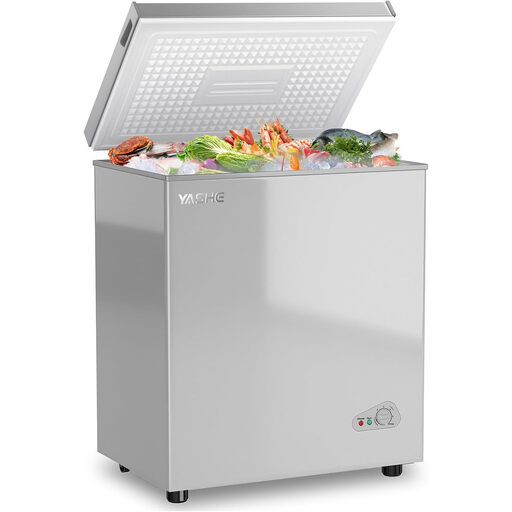 No image available
The capacity and two removable baskets could suit a larger supply that you want to organise into portions.
150 litres; two removable baskets; six temperature settings; energy class E; noise level 45 dB.
 No image available
This more compact capacity could suit you if you want to store a limited amount of extra food and keep portions separate.
95 litres; removable basket; energy class E; four-star freezer rating; can be switched between fridge and freezer.
 No image available
The stated capacity is worth considering if you want to store a larger supply as well as bread.
291 litres; removable basket; digital temperature control; annual energy consumption 226 kWh; energy class E; four-star freezer rating.
 No image available
The capacity and storage basket could suit a smaller extra supply that you want to keep organised separately.
98 litres; storage basket; counterbalanced lid; adjustable temperature control; energy class E.
 No image available
The larger capacity could suit you if you want to store more supplies alongside your bread portions.
140 litres; storage basket; counterbalanced lid; adjustable temperature control; energy class E.
Not if your portioned supplies fit in your existing freezer. First work out how much bread you’ll freeze and how much space you have; an extra appliance uses electricity too.
The Netherlands Nutrition Centre advises freezing bread in portions as soon as you buy it and taking out what you need. Organise the portions so they’re easy to identify; bread can dry out if it’s frozen for longer periods.
It depends on the temperature in that location and the exact model. The Consumers’ Association warns that not every appliance works properly below 10 °C; some manufacturers specify a lower minimum for certain models. Check that the location is suitable by comparing its temperature with the product specifications and instruction manual for your model.
Don’t assume that Low Frost means you never need to defrost. Manufacturers say the feature reduces frost build-up; follow the maintenance instructions for the exact model.
The EU energy label for household freezers lists, among other things, the energy class, annual consumption in kWh and freezer volume. Compare these figures for models with a capacity that suits your supplies.
According to the Dutch government, you’re entitled to a product that works properly when you buy it, and the seller must provide a solution if there’s a problem. A manufacturer’s guarantee is in addition to your statutory rights.