
Batch baker
You regularly freeze small amounts of dough separately and want to find them easily. A storage basket and clearly labelled portions may matter more than maximum capacity.


A separate chest freezer makes most sense when small batches of cookie dough won’t fit conveniently in your existing freezer. If so, consider how easily you can find your portions, how much fresh dough you freeze on a baking day, and whether the freezer will fit with enough ventilation space and room to open the lid. Check the annual energy consumption in kWh too. Manufacturer specifications are useful for comparisons, but they aren’t independent performance tests.
You regularly freeze small amounts of dough separately and want to find them easily. A storage basket and clearly labelled portions may matter more than maximum capacity.
You make several batches of fresh dough in one day. Compare the total weight you prepare that day with the model’s stated freezing capacity.
You’re looking for extra freezer space, but also need to consider the overall dimensions, ventilation and room to open the lid.
First, check whether your existing freezer has enough well-organised space. If you need an extra appliance, weigh up how easy it is to reach your portions, your largest batch, the space available and energy consumption.
| What to consider | What should you check? | Who is this most important for? |
|---|---|---|
| Finding small portions | Check whether the exact model has a removable basket and whether your containers will fit in it. | If I freeze small portions separately, I want to be able to pick out the right container without moving other products first. Around 33% of consumers prioritise being able to find their portions. |
| Amount per baking day | Weigh the largest amount of fresh dough you’d typically make and compare it with the stated freezing capacity in kg per 24 hours. | When I’m baking a large batch, I want to know whether the appliance can handle the amount of fresh dough I’m adding. Around 27% of consumers prioritise freezing capacity for a single baking day. |
| Space for installation | Measure the space and check the required ventilation clearance and room for the lid to open. | If space is limited, I want to know in advance whether the freezer will fit with enough ventilation clearance and room for the lid to open. Around 20% of consumers prioritise the space available for installation. |
| Energy consumption | Compare the annual consumption in kWh on the energy label and first decide whether your existing freezer is sufficient. | I want to weigh up the extra freezer space against the ongoing energy consumption of a second appliance. Around 20% of consumers prioritise energy consumption. |
Litres indicate storage capacity; kg per 24 hours refers to the amount of fresh food a model can freeze in a day, according to the manufacturer. Inventum states a capacity of 4.5 kg per 24 hours for the VK562W, while Tomado states 2.25 kg per 24 hours for the TCF0991W.
Compare both figures with your existing stock and your largest batch. If you store lots of small containers, also check whether the model has a basket.
Tomado’s manual specifies 10 cm of clearance all around the TCF0991W for ventilation. You’ll also need room to open the lid.
Measure the full installation space and read the positioning instructions for the exact model before choosing it.
Inventum describes Low Frost on the VK562W as a feature that means you need to defrost less often, not as maintenance that never requires defrosting.
Check the model’s maintenance instructions and don’t choose solely on the basis of the feature name.
Allow time and space to defrost the appliance if necessary.
An extra appliance continues to use electricity even when it contains very little dough. Milieu Centraal recommends choosing a suitable size.
First, see whether you can organise your portions neatly in your existing freezer. If not, compare the annual energy consumption in kWh of models with enough space.
The VK562W is a compact option to consider if you want to keep portions in a basket and sometimes freeze more dough in one day.
The TCF0991W is a compact model with a basket for storing separate portions of dough.
The CF100EWN is a compact chest freezer to consider alongside models with a confirmed basket layout.
At 192 litres, the CFc 1875 Plus is mainly a comparison point if you want to store a larger stock of food as well as dough.
These chest freezers offer extra storage for small portions. For each model, check that the basket, capacity and installation space suit your needs.
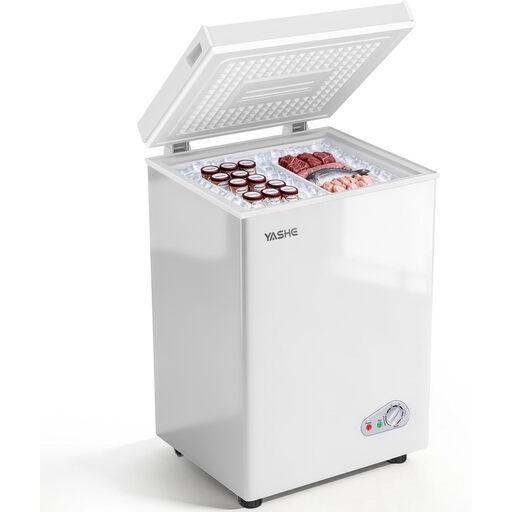 No image available
The two removable baskets give you a way to organise small containers separately.
Capacity: 100 litres.
Energy class E; stated consumption: 185 kWh per year.
The product name states a noise level of 45 dB.
 No image available
The removable storage basket can help keep smaller containers separate.
Capacity: 141 litres.
Energy class E; stated consumption: 179 kWh per year.
External dimensions: 632 × 554 × 848 mm.
Switches between fridge and freezer modes.
 No image available
The removable basket gives you a place to keep smaller containers separate.
Capacity: 95 litres.
Energy class E; stated consumption: 165 kWh per year.
External dimensions: 550 × 475 × 848 mm.
Switches between fridge and freezer modes.
 No image available
The included storage basket is designed to keep products organised separately.
Capacity: 98 litres; energy class E.
Features an adjustable temperature control and a counterbalanced lid.
 No image available
The included storage basket can separate small containers from the rest of the contents.
Capacity: 140 litres; energy class E.
Features an adjustable temperature control and a counterbalanced lid.
Voedingscentrum recommends a temperature of −18 °C in the freezer. Use airtight containers and note what’s inside and when you froze it. A storage period for prepared food or baked biscuits doesn’t automatically apply to raw cookie dough.
No. Freezing doesn’t make raw dough safe to eat. Voedingscentrum warns that raw eggs and flour can contain pathogens and recommends baking the dough. Young children, pregnant women, older people and those with weakened immune systems are particularly vulnerable.
Only if the ambient temperature is within the range stated by the manufacturer for the exact model. Inventum specifies that the VK562W can operate at an ambient temperature as low as −15 °C, as does Tomado for the TCF0991W. Check the ventilation requirements too.
Yes, you may still need to defrost it if frost builds up. Inventum describes Low Frost on the VK562W as a feature that means you need to defrost less often. Follow the maintenance instructions for the model you choose.
For the household fridges and freezers covered, EU energy labelling rules show information including the energy class, annual consumption, capacity and noise level. The European Commission describes the current scale as running from A to G. The class is useful information for comparison, not a requirement for private buyers to choose a particular class.
For an online consumer purchase, ACM ConsuWijzer says you generally have 14 days from delivery to change your mind. The seller is also responsible for offering a suitable solution if the product doesn’t do what you could reasonably expect under normal use. A manufacturer’s warranty doesn’t replace your statutory rights.