
Small-batch baker
You bake cookies now and again and want to check whether your existing freezer has room to pre-freeze portions of dough on a tray.


You don’t necessarily need a separate chest freezer to freeze cookie dough now and again. First, try using a suitable freezer you already have that can reach at least −18 °C and has room for a baking tray. King Arthur Baking explains how to freeze portions on a tray first, then package and label them. If you regularly need extra freezer space, compare compact models by layout, external dimensions, kWh per year and freezing capacity. If you’re planning to keep it in an unheated outbuilding, also check the permitted ambient temperature for the specific model.
You bake cookies now and again and want to check whether your existing freezer has room to pre-freeze portions of dough on a tray.
You prepare dough in advance more often and are looking for extra freezer space, without choosing an appliance that’s bigger than your needs justify.
You’re considering putting a freezer in an unheated garage or shed because there’s little room indoors. Whether this is suitable depends on the ambient temperature and the model.
For long-term storage, a freezer must be able to reach at least −18 °C, according to the Netherlands Nutrition Centre. A freezer compartment with one or two stars isn’t suitable.
Choose this if: your freezer reaches the required temperature and has room for a tray of dough portions, at least temporarily.
Bear in mind: the tray and available space determine how many portions you can freeze at once.
Choose this if: you regularly freeze more dough and other food than your current freezer can hold, and have space for a top-opening model.
Bear in mind: small packs are harder to find in an open compartment. A basket and labels can help you keep things organised.
Choose this if: keeping things organised and accessing small portions matter more to you than having an open compartment.
Bear in mind: drawers limit the shape of larger packs, so check whether there’s room to fit a tray inside.
| What to consider | What should you check? | Who should pay more attention to this? |
|---|---|---|
| Existing freezer space | Check whether there’s room for a tray and make sure the freezer can reach at least −18 °C. | I only freeze dough now and again and want to check first whether my current freezer has enough room. Consumers with this priority make up around 29% of those considering this topic. |
| Capacity and layout | Compare the net capacity and external dimensions, check whether there’s a basket and look at the stated freezing capacity. | I prepare dough in advance more often and want extra space that suits my stock and the space available. Consumers mainly looking for extra capacity make up around 29%. |
| Placement in a cold space | Measure the lowest ambient temperature and compare it with the climate class and any model-specific information from the manufacturer. | I have little space indoors and am considering an unheated outbuilding. Consumers for whom placement in a cold space is the deciding factor make up around 14%. |
| Energy use | Compare the stated annual consumption in kWh for models with enough capacity. For an estimate, multiply this by your own rate per kWh. | I don’t want to run a larger freezer than my stock requires, so I pay attention to annual energy use. Consumers mainly looking to limit their energy use make up around 28%. |
You can first place a baking tray of dough portions in a suitable freezer you already own, then move them into more compact packaging to free up space.
Check the temperature and measure the free space in your current freezer. Only choose extra capacity if you need it regularly.
The energy label, total annual consumption, layout and external dimensions each tell you something different. A larger chest freezer may take up more room, and small packs can be harder to find inside.
Compare kWh per year, the capacity you need, how easy it is to access portions, and the available floor and opening space.
The standard climate class and an additional claim about use at low temperatures aren’t the same thing.
Measure the lowest temperature at the intended location and check the rating plate and documentation for the exact model.
Inventum describes the VK562W as a 99-litre chest freezer with a basket, Low Frost and a temperature alarm.
According to Tomado, the TCF0991W and TCF0991B are 99-litre chest freezers with a basket and fast-freeze function.
Beko describes the CF100EWN as a freestanding chest freezer with a capacity of 98 litres and a width of 54.5 cm.
According to Liebherr, the CFc 1875 Plus is a larger chest freezer with a capacity of 192 litres and external dimensions of 82 × 104 × 71 cm.
These Joybuy products are chest freezers for extra household freezer space, with a range of capacities and layouts. For long-term storage of cookie dough, check that each model can reach at least −18 °C and that its permitted ambient temperature suits the intended location.
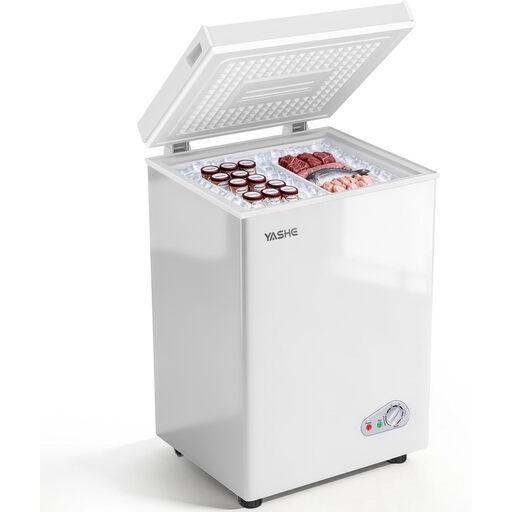 No image available
A good fit if you’re looking for extra freezer space with baskets to organise smaller packs.
 No image available
A 95-litre capacity and a basket may suit you if you want to store extra supplies and keep smaller portions separate.
 No image available
The capacity and storage basket may suit you if you’re looking for extra space for smaller packs.
 No image available
This capacity may suit a household looking for extra freezer space. Check the placement requirements carefully.
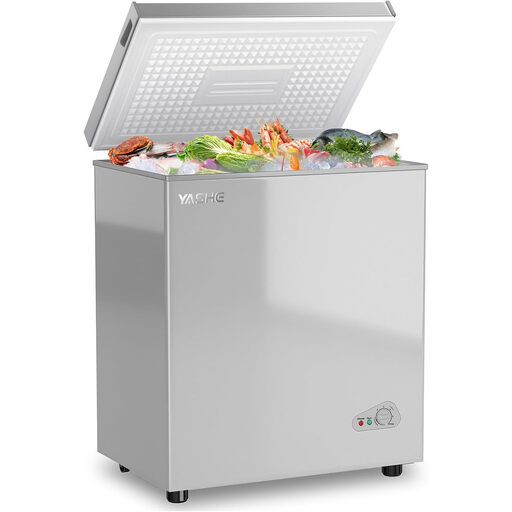 No image available
The larger capacity is designed for anyone who wants to store more frozen food as well as dough. It may be more than you need if you only freeze small amounts.
No, not if your existing freezer has enough room and can reach at least −18 °C. King Arthur Baking explains how to freeze portions of dough on a tray, then package and label them. Check that the tray fits in your freezer at home.
No, always bake raw cookie dough before eating it. The Netherlands Nutrition Centre warns that raw eggs and flour can contain harmful bacteria; freezing is not a substitute for baking.
It depends on the lowest temperature at that location and the specifications of the exact model. Compare the measured temperature with the climate class and check whether the manufacturer gives any additional guidance for using that model at lower temperatures.
Compare the stated annual consumption in kWh for models with enough capacity. Multiply this figure by your own electricity rate per kWh to estimate the annual running cost.
For a standard appliance bought online, you’re generally entitled to a statutory cooling-off period of up to 14 days after delivery. Before ordering, check the applicable returns policy, including how you can send the product back.