If you only have a few portions of cake to store, a separate chest freezer may not be necessary. First, check whether your existing freezer has enough room and can be set to at least −18 °C, as recommended by the Netherlands Nutrition Centre. If you regularly need extra space, compare usable capacity, layout, external dimensions and annual energy consumption in kWh. Also check that the specific model is suitable for the place where you plan to put it.
Who is this choice for?
Living alone and keeping few portions of cake
You want to store a few slices and are wondering whether you need another appliance. Start by checking the space and temperature setting of your current freezer. The Netherlands Nutrition Centre recommends storing frozen food at a temperature of at least −18 °C.
Baking batches regularly
You bake more often and want to find portions easily. So, look at the capacity and layout, including whether there’s an accessible basket. The Consumers’ Association highlights how easy the contents are to reach as one difference between chest freezers and upright freezers.
Freezing larger batches
You regularly freeze larger quantities of freshly baked goods at once. As well as capacity, compare the stated freezing capacity of the specific model: Inventum and Tomado give different figures for the models they have assessed.
What should you look for when buying?
Use your existing freezer space
Best if: you only store a few portions and have room in a freezer that can be set to at least −18 °C.
Trade-off: you won’t need to find space for another appliance, but you’ll need to keep the portions organised.
A compact chest freezer
Best if: you regularly need extra space and have room for a lid that opens upwards.
Trade-off: a basket can keep smaller portions within easy reach, but remember to check what’s underneath and compare annual energy consumption.
A larger chest freezer
Best if: you regularly freeze larger batches and have enough room for a model of around 99 litres.
Trade-off: you may not use the extra capacity if you usually only store a few portions.
An upright freezer with drawers
Best if: you’d rather find portions in separate drawers than in a chest freezer with a lid that opens upwards.
Trade-off: compare specific models. The Consumers’ Association says the contents of an upright freezer, especially one with drawers, are easier to reach, but this alone says nothing about energy consumption.
The main things to consider are how much space you really need, how easily you can find your portions, and whether the model suits your baking routine and the space you have in mind.
| Concern |
What to look for when buying |
Who is this more important to? |
| Capacity and available space |
Measure the floor space and the clearance needed to open the lid; compare this with the amount you usually store and the freezer space you already have. |
If I only store a few portions, I don’t want to take up space with an unnecessarily large freezer. Around 33% of consumers would put a suitable capacity and location first when making their choice. |
| Finding your portions |
Check the layout, the basket and the space beneath it; store portions separately and note the date they were frozen. |
I want to take out a slice without having to search through everything each time. Around 27% of consumers would prioritise keeping things organised and easy to reach. |
| Annual energy consumption |
Compare the stated annual consumption in kWh on the energy label and consider whether you’ll use the extra capacity. |
If I’m considering a second appliance, I want to know how much electricity it uses each year according to the label. Around 20% of consumers would take electricity consumption into account above all. |
| Freezing and location |
Compare the stated freezing capacity in kg/24 hours and the permitted ambient temperature for the specific model; check that it can be set to at least −18 °C. |
If I’m freezing larger batches or putting the appliance somewhere cold, I need to know whether the stated conditions for the model suit how I’ll use it. Around 20% of consumers would consider these baking routines or placement conditions decisive. |
Common buying pitfalls
-
Focusing on capacity alone
An extra freezer uses electricity, even between baking sessions. The European Commission says the EU energy label provides information on annual energy consumption as well as the energy class.
First check whether your existing freezer space is sufficient. If you’re considering another appliance, compare its capacity with its annual consumption in kWh.
-
Assuming ‘Low Frost’ means ‘no defrosting needed’
Despite the Low Frost feature, Inventum recommends defrosting the VK562W two to three times a year. Tomado says the TCF0991W has a defrost water drain for use when defrosting is needed.
Read the care instructions for the specific model and keep the drain accessible.
Allow time and effort for defrosting.
-
Assuming a ‘garage’ label means it’s suitable for any cold space
The permitted ambient temperature varies by model. For the 51-litre Klarstein Iceblokk, Klarstein gives an ideal ambient temperature range of 16 to 32 °C.
Compare the lowest temperature expected in the location with the documentation for the exact model you’re considering.
-
Using the same storage time for every type of cake
The Netherlands Nutrition Centre gives different storage guidance for opened cream cake and opened lemon meringue pie.
Note the type of cake and the date it was frozen on each portion, and check the specific storage guidance or packaging.
A portion that hasn’t been stored correctly may deteriorate in quality and have to be thrown away.
Brands to consider
Klarstein
The 51-litre Iceblokk is one option assessed for anyone looking for a small, separate chest freezer.
- Klarstein lists a hanging basket, a temperature range of −18 to −22 °C and stated energy consumption of 153 kWh per year for this model.
- The stated ideal ambient temperature range is 16 to 32 °C. Don’t assume it’s suitable for an unheated garage based on a general reference to garage use.
Inventum
The VK562W is a 99-litre chest freezer assessed for anyone who needs more space or regularly freezes baking batches.
- Inventum lists a hanging basket, a temperature alarm and a freezing capacity of 4.5 kg/24 hours for this model.
- Inventum says the Low Frost freezer still needs defrosting two to three times a year. These features apply to the VK562W and don’t necessarily apply to other models.
Tomado
The TCF0991W is a 99-litre chest freezer assessed with a removable basket and digital thermostat.
- Tomado lists a freezing capacity of 2.25 kg/24 hours, energy class E and suitability for ambient temperatures from −15 °C for this model.
- Tomado says this model has no interior light. Low Frost doesn’t mean that defrosting will never be needed.
Joybuy products for extra freezer space
This Joybuy selection focuses on chest freezers of around 98 to 150 litres, for extra storage and regular baking batches. For each model, check that its capacity, temperature settings, energy information and placement requirements suit your needs.
 No image available
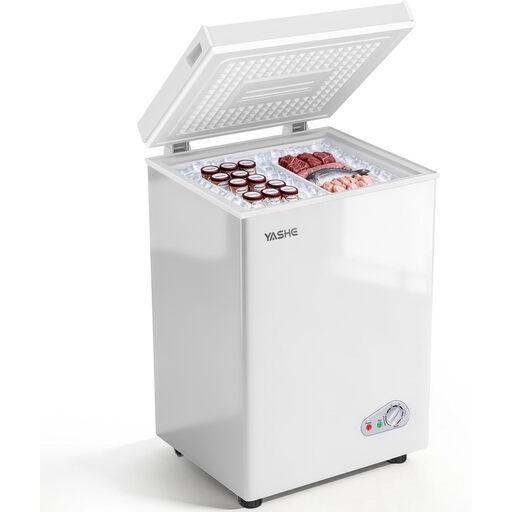
YASHE BC-100Q-EU chest freezer, 100 litres
The two baskets give you a way to organise extra supplies.
Capacity: 100 litres. The product name lists two removable baskets and six temperature settings. Before buying, check that the temperature can be set to at least −18 °C.
View at Joybuy
 No image available
TCL CF126EWE0NL chest freezer, 98 litres
The storage basket gives you an easily accessible place at the top for portions you reach for more often.
Capacity: 98 litres. The product name lists a storage basket, adjustable temperature control, counterbalanced lid and energy class E. Check the temperature settings and placement requirements for the specific model.
View at Joybuy
 No image available
Comfee RCC143WH2EU(E) chest freezer, 99 litres
The removable basket can help you keep portions separate within your extra supplies.
Capacity: 99 litres. The product name lists a removable basket, LED lighting and energy class E. Before buying, check the temperature settings and whether it’s suitable for the space you have in mind.
View at Joybuy
 No image available
CHiQ JR99DWE chest freezer, 99 litres
This capacity is intended for extra storage; check that it suits the amount of cake you keep.
Capacity: 99 litres. The product name lists a 4-star freezer compartment and energy class E. Check the recommended temperature setting and requirements for the space you have in mind.
View at Joybuy
 No image available
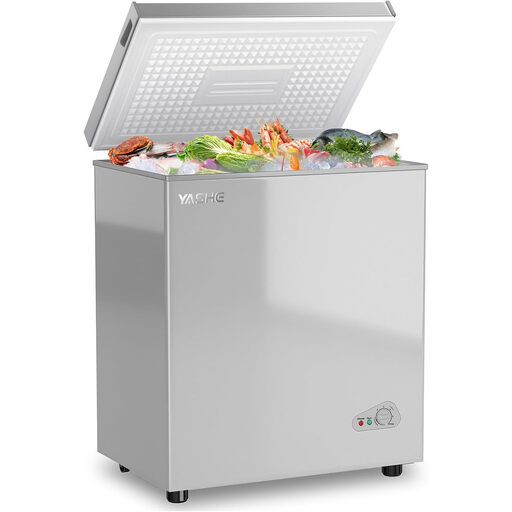
YASHE BC-150Q-EU chest freezer, 150 litres
The larger capacity and two baskets give you room to organise your supplies; 150 litres may be more than you need if you only store a few portions.
Capacity: 150 litres. The product name lists two removable baskets and six temperature settings. Check that the temperature settings and external dimensions suit your needs.
View at Joybuy
Frequently asked questions
Do I need a separate chest freezer for a few portions of cake?
Not necessarily. First check whether the portions fit in your existing freezer and whether it can be set to at least −18 °C for storing frozen food. An extra appliance will also use electricity.
How cold should my freezer be, and can I store all cakes for the same length of time?
The Netherlands Nutrition Centre recommends setting your freezer to at least −18 °C. Storage advice varies by type of cake: for opened cream cake, the Netherlands Nutrition Centre recommends one month in the freezer, and for opened lemon meringue pie, three months. Quality may deteriorate after that. For a sealed pack, follow the label.
How do I use and defrost a new chest freezer?
Follow the manual for your chosen model for installation, first use and defrosting. Don’t freeze too much at once, and divide food into small portions, as recommended by the Netherlands Nutrition Centre. Low Frost doesn’t mean that defrosting will never be needed: Inventum recommends defrosting the VK562W two to three times a year.
Can any small chest freezer be kept in a cold shed?
No. Check the requirements for the specific model. Inventum says the VK562W is suitable for use in a room down to −15 °C, while Tomado says the TCF0991W is suitable for ambient temperatures from −15 °C. For the 51-litre Klarstein Iceblokk, Klarstein instead gives an ideal ambient temperature range of 16 to 32 °C.
What should I check about energy consumption and the legal guarantee?
Check the annual consumption in kWh on the energy label. To estimate your own costs, you can multiply this by your electricity tariff per kWh. In the Netherlands, contact the retailer if a consumer product is faulty. The Dutch Government says there is no fixed statutory guarantee period of two years.


