
A family with limited extra freezer space
You want to prepare dough portions in advance, but have little room for another appliance. Start by working out how much food you need to store and checking the freezer’s external dimensions.


Choose the capacity based on your dough portions and the other food you want to store at the same time. If you only have a few portions, you may not need a large chest freezer. Next, measure the space and check the freezing capacity, energy use and maintenance requirements of the model you choose. King Arthur Baking recommends dividing pizza dough into portions after its first rise, wrapping them and freezing them. Remember to allow time for the dough to defrost before use.
You want to prepare dough portions in advance, but have little room for another appliance. Start by working out how much food you need to store and checking the freezer’s external dimensions.
You’ll use the chest freezer for more than pizza, so you’ll benefit from enough capacity, suitable freezing performance and an interior layout that makes it easy to find things.
If you want to put the chest freezer in a garage or shed, check the permitted ambient temperature for the exact model.
First, estimate how much dough and how many other frozen items you’ll store in the chest freezer at the same time. Then measure the space and compare the energy use, layout and maintenance requirements of specific models.
| What to consider | What to look for when buying | Who is this important for? |
|---|---|---|
| Enough capacity | Estimate how many wrapped dough portions and other items you need to store. Compare the capacity in litres and the usable layout. | If I want to store family food as well as pizza dough, I need enough space. I shouldn’t rely only on the word ‘family’ or the number of litres. Around 33% of consumers are mainly looking for a suitable capacity. |
| A suitable location | Measure the width and depth, and allow room to open the lid. If you’re putting the freezer in a garage or shed, check the model’s permitted ambient temperature. | If I want to put the chest freezer in an unheated space, the exact model must be suitable for the temperature there. Around 27% of consumers consider the location their main priority. |
| Energy use | Compare the energy use in kWh/year on the energy labels of specific models. Use your own price per kWh if you want to calculate the cost of electricity. | If I want to use an extra freezer for a long time, I’ll consider its energy use alongside its capacity and features. Around 20% of consumers focus mainly on energy use. |
| Layout and maintenance | Check how many baskets there are and how easy it is to reach smaller packs. Find out whether the model uses static cooling, Low Frost or No Frost, and what the manufacturer says about defrosting. | If I want to find individual dough portions easily and reduce the amount of defrosting, the baskets and cooling technology matter. Around 20% of consumers prioritise organisation and maintenance. |
For pizza dough, King Arthur Baking recommends letting the dough rise first, then dividing it into portions and freezing them wrapped. The Voedingscentrum recommends −18 °C as the ideal temperature for frozen meals and advises defrosting food in the fridge.
Chest freezers vary in their external dimensions, and a top-opening model needs room for the lid to open. A model with a large capacity won’t necessarily fit the space you have.
Measure the space, the route to it and the clearance above the lid. Also work out how much dough and how many other items you’ll actually need to store at once.
An appliance that’s too large or doesn’t fit could take up unnecessary space or be impossible to put where you planned.
On the Inventum VK952W and VK1122W, Low Frost doesn’t mean you can skip manual defrosting.
Check the cooling technology and maintenance instructions for the exact model before making your choice.
Allow time and effort for regular manual defrosting.
The label alone doesn’t tell you how much electricity a particular model uses each year or what that will cost at your tariff.
Compare the stated energy use in kWh/year and use your own price per kWh if you want to estimate the cost.
The CF100EWN is a compact chest freezer that could be a good option if you want to store a small amount of extra food.
The models mentioned range from the VK952W, with a capacity of 198 litres, to the VK1122W, with 293 litres; the VK980W has a capacity of 233 litres.
The CFc 1875 Plus is an example of a chest freezer with a capacity of 192 litres.
This selection focuses on freestanding chest freezers for dough portions and extra family food. When choosing, consider the capacity, layout and space you have available.
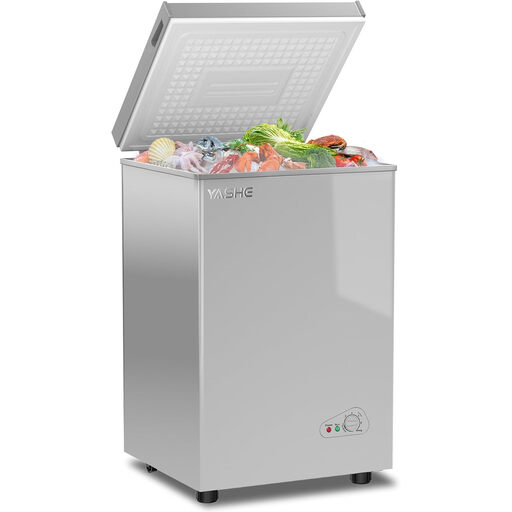 No image available
The capacity and removable baskets make it easy to store dough portions and other food separately.
Capacity: 100 litres.
Two removable baskets and six temperature settings.
 No image available
The storage basket lets you keep smaller items separate.
Capacity: 140 litres.
Includes a storage basket, counterbalanced lid and adjustable temperature control.
 No image available
The capacity and removable basket are useful if you want to store a small amount of food and some smaller items.
Capacity: 99 litres.
The description mentions a removable basket, interior light and switchable fridge and freezer functions.
 No image available
An external digital display could be useful if you want to check the temperature without opening the freezer.
The description mentions an external digital display.
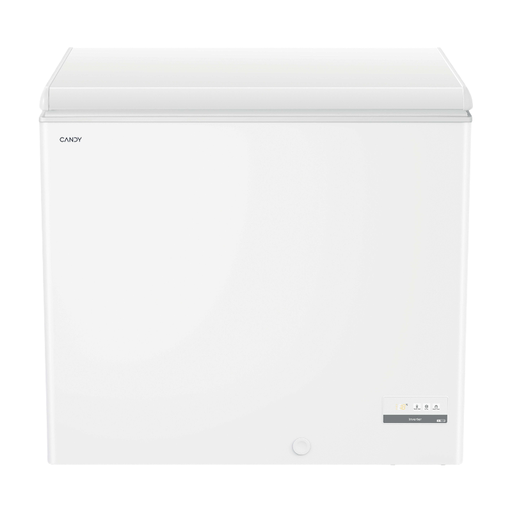 No image available
The stated freezing capacity can help you plan when freezing a larger amount of dough at once.
Stated freezing capacity: 4,5 kg/24 hours.
The description mentions a wire shelf.
Freeze the dough in portions after its first rise. King Arthur Baking recommends dividing the dough and wrapping the portions before freezing them. If you’re using a different recipe or shop-bought dough, follow the relevant instructions.
The Voedingscentrum recommends −18 °C as the ideal temperature for frozen meals and advises defrosting food in the fridge. Label your packages with what’s inside and when you froze it.
No. It depends on the permitted ambient temperature for the exact model. Consumentenbond warns that not every fridge or freezer is suitable for low temperatures. Inventum states that the VK952W and VK1122W can be placed in a room with temperatures as low as −15 °C. Check the model specifications for your space.
Yes. According to the European Commission, household freezers are covered by EU energy labelling and ecodesign rules. Compare the label and, if necessary, check the product record in EPREL.
A manufacturer’s guarantee doesn’t replace your statutory rights. According to the Dutch government, there is no fixed statutory guarantee period in the Netherlands: you’re entitled to a product that meets reasonable expectations. The retailer is your point of contact, and the appropriate solution depends on factors including the fault and how the product has been used.