
Student with limited kitchen space
You want to freeze bread without an extra appliance taking up floor or worktop space. Measure the space available and first check how much room there is in your existing freezer.


If you have enough space in the freezer you already use, you may not need an extra chest freezer for bread. If there isn’t enough room for a shared stock, look for a compact model that will genuinely fit, and compare its annual energy consumption, layout and freezing capacity. The Netherlands Nutrition Centre recommends freezing bread in portions as soon as you buy it, then taking out only what you need.
You want to freeze bread without an extra appliance taking up floor or worktop space. Measure the space available and first check how much room there is in your existing freezer.
You want everyone to be able to find and take out their portions each day. An accessible basket or an agreed layout can help.
You want to weigh up whether you need an extra freezer against its annual energy consumption, and compare suitable models by their stated kWh per year. Milieu Centraal also recommends checking energy consumption.
A good fit if: your bread portions fit in the freezer and are easy to reach.
Consider: you avoid buying another appliance, but organising a full or shared freezer can be trickier.
A good fit if: your existing freezer doesn’t have enough space, several people store bread and you have room for a freestanding appliance.
Consider: check the external dimensions, the space needed to open the lid and the layout inside the exact model.
A good fit if: your housemates want to store a larger shared supply of frozen food as well as bread.
Consider: a larger appliance takes up more space; according to Liebherr, the Liebherr CFc 1875 Plus has a capacity of 192 litres and measures 82 × 104 × 71 cm.
The percentages below show the main consideration for consumers in each row. Measure the space available for a chest freezer and check you can get it into position; the Consumers’ Association lists dimensions and features as factors to consider. For models that fit, compare their stated annual energy consumption on the energy label, as Milieu Centraal recommends.
| What to consider | What to look for when buying | Who is this most important for? |
|---|---|---|
| Space and positioning | Measure the external dimensions, the access route and the clearance above the appliance for the lid. | If my kitchen is small, I want to know whether the freezer will fit without getting in the way. Around 36% of consumers say positioning is their top priority. |
| Energy consumption | For models that fit, compare the stated consumption in kWh per year; if needed, work out the cost using your own electricity tariff. | If I’m considering an extra appliance, I want to compare its annual energy consumption with my own tariff. Around 29% of consumers put energy costs first. |
| Access to portions | Check whether the exact model has a removable basket and think about how your housemates will organise the contents. | When several housemates use the freezer every day, I want to be able to grab the right portion of bread quickly. Around 21% of consumers give shared access top priority. |
| Freezing a batch | Compare the stated freezing capacity in kg per 24 hours with the amount you want to freeze at once. | If I’m freezing several fresh loaves after a food shop, I want to know the freezing capacity. Around 14% of consumers prioritise freezing a batch. |
An extra appliance uses electricity. If your bread portions already fit in the freezer you use, a second appliance may be unnecessary. Milieu Centraal points out that two refrigeration appliances use extra electricity in total.
First, try storing bread in portions in your existing freezer. Then compare suitable models by their stated consumption in kWh per year.
Capacity in litres and the amount a model can freeze in a day are two different figures. The manufacturers state that the Inventum VK562W can freeze 4,5 kg per 24 hours and the Tomado TCF0991W 2,25 kg per 24 hours.
Compare kg per 24 hours with the amount of bread you want to freeze at once. If you’ll be taking portions out every day, consider how easy they are to organise too.
Inventum states that the VK562W still needs to be defrosted 2 to 3 times a year, according to the manufacturer.
Read the care instructions for the exact model and check how to access the drain for defrost water.
Inventum states that the VK562W has a capacity of 99 litres and is 54,7 cm wide.
Tomado states that the TCF0991W has a net capacity of 99 litres and a removable basket.
Beko states that the freestanding CF100EWN has a storage capacity of 98 litres.
Liebherr states that the CFc 1875 Plus has a total capacity of 192 litres and measures 82 × 104 × 71 cm.
These product picks focus on compact chest freezers for a shared supply of bread or other frozen food.
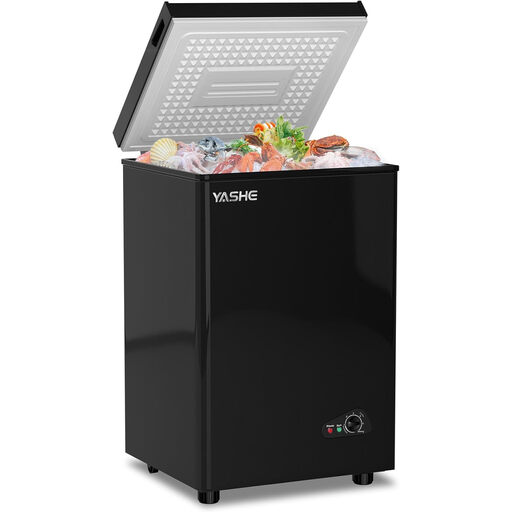 No image available
The two removable baskets can help you keep frequently used items separate.
Capacity: 100 litres. Stated energy consumption: 185 kWh per year. Six temperature settings.
 No image available
The storage basket gives you a way to organise bread portions and other smaller items.
Capacity: 98 litres. The product description lists a counterbalanced lid and adjustable temperature control.
 No image available
The capacity and included storage basket give you room to organise a larger supply of food.
Capacity: 140 litres. The product description lists a counterbalanced lid and adjustable temperature control.
 No image available
The removable basket can help you keep smaller items separate.
Capacity: 99 litres. Stated energy consumption: 169 kWh per year. Freezing capacity: 4,5 kg per 24 hours. The product description says the lid can stay open at up to 75°.
Freeze bread in portions as soon as you buy it, and take out only what you need; this is the advice from the Netherlands Nutrition Centre. The Bewaarwijzer storage guide recommends keeping opened wholemeal bread in the freezer for 1 to 3 months. Its quality may deteriorate after that and the bread may dry out; this storage time doesn’t automatically apply to every type of bread.
The Consumers’ Association recommends −18 °C as the ideal freezer temperature. Set and check the temperature according to your appliance’s manual; the Consumers’ Association says that a lower temperature uses more energy.
Yes. The Dutch Government lists freezers as household appliances that must have an energy label. Use the label to compare the energy class and stated consumption in kWh per year.
In the Netherlands, statutory consumer rights apply, but there is no single fixed warranty period; if a product is faulty, the seller is your point of contact, according to the Dutch Government. When you buy a new, similar appliance, the retailer must take back the old one under the old-for-new scheme. The Dutch Government also explains the conditions for returning an appliance bought online.