What should you look for when buying?
Use your existing freezer space
A good fit when: the bread rolls and other frozen food fit without making the freezer too full.
The trade-off: you avoid buying a second appliance, but have less room left for other food.
A compact chest freezer
A good fit when: you regularly store extra bread rolls or a modest amount of food, and have limited floor space.
The trade-off: check that the capacity and basket suit your packaging. A compact exterior size alone says nothing about electricity consumption.
A larger chest freezer
A good fit when: you regularly freeze larger quantities for the family as well as bread rolls.
The trade-off: more capacity needs more space, and food at the bottom may be harder to reach.
The percentages show the main buying priorities of consumers considering a chest freezer for bread rolls for a family meal.
| What to consider |
What should you check? |
Who is this most important to? |
| Do you need extra space? |
Check the free space in your current freezer, and measure the intended spot and the model’s external dimensions. |
If I only want to store bread rolls for one meal, I want to know whether my current freezer and the space at home are enough. Around 40% of consumers put having suitable extra space at the top of their buying priorities. |
| Capacity and layout |
Work out what you want to store at the same time, then check the capacity, baskets and external dimensions. |
If I freeze larger quantities for the family as well as bread rolls, I want enough space and a clear layout. Around 30% of consumers prioritise space for larger quantities. |
| Annual electricity consumption |
For the exact models, compare both the energy label and the consumption in kWh per year, as well as the capacity. |
If the chest freezer is on often, I want to weigh its annual consumption against the space I’ll actually use. Around 20% of consumers give reducing electricity consumption top priority. |
| Where you’ll put it |
Check the instructions for the exact model, and the temperature and available space at the intended location. |
If the only available option is a cold garage or shed, I want to know whether the manufacturer says the model can be kept there. Around 10% of consumers prioritise suitability for a cold location. |
Milieu Centraal recommends choosing a suitable size. When comparing electricity consumption, also check the stated kWh per year; the energy label letter alone doesn’t give you the same insight as annual consumption. The Sustainable Living Knowledge Centre also highlights annual energy use.
The Netherlands Nutrition Centre recommends freezing bread in portions. This can help you make practical use of the available space, but it doesn’t tell you how many bread rolls will fit in a chest freezer.
Chest freezers at Joybuy
These models offer extra freezer space alongside your existing storage, from a compact option for a modest amount of food to more room for a range of frozen products.
 No image available
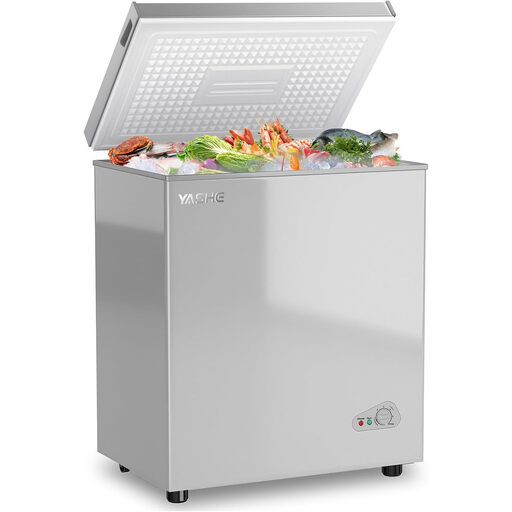
YASHE BC-150Q-EU chest freezer, 150 litres
An option for storing bread rolls alongside other frozen food.
Capacity: 150 litres. Two removable baskets and six temperature settings.
View at Joybuy
 No image available
AUCMA chest freezer, 95 litres
A compact option if you want to switch between the stated fridge and freezer functions.
Capacity: 95 litres. Removable basket, seven-setting thermostat and E energy rating.
View at Joybuy
 No image available
TCL CF182EWE0NL chest freezer, 140 litres
An option if you want to store bread rolls alongside a larger quantity of food.
Capacity: 140 litres. Storage basket, adjustable temperature control and E energy rating.
View at Joybuy
 No image available
Comfee RCC143WH2EU(E) chest freezer, 99 litres
A compact option for extra freezer space, with a convertible fridge and freezer function according to the product name.
Capacity: 99 litres. Removable basket, LED lighting and E energy rating. According to the product information, the appliance isn’t intended for outdoor use or damp environments.
View at Joybuy
 No image available
CHiQ JR99DWE chest freezer, 99 litres
A compact option for freezing bread rolls alongside other frozen food.
Capacity: 99 litres. Four-star freezer rating and a wire shelf.
View at Joybuy
Frequently asked questions
How should you store bread rolls for a family meal?
It’s best to freeze bread in portions, so you only take out what you need. For soft white rolls and part-baked rolls, the Netherlands Nutrition Centre recommends keeping them frozen for 1–3 months; after that, their quality may decline. Follow the label for a sealed pack.
What temperature should you set your freezer to?
The Consumers’ Association says −18 °C is the ideal temperature for a freezer. Refer to your appliance’s controls and instruction manual to select this setting; according to the Consumers’ Association, a lower setting uses more energy.
How do you compare the running costs of two chest freezers?
Compare the consumption in kWh per year on the energy labels for the exact models. For an estimate on the same basis, multiply that figure by your own price per kWh. Also compare the capacity with what you actually want to store.
What should you look for if the chest freezer will go in a cold shed?
Check the documentation for the exact model to see what ambient temperature the manufacturer allows, then compare it with the temperature at the intended location. Don’t assume a claim for another model applies to yours.


