You don’t automatically need a separate chest freezer. If your existing freezer has enough space and can be set to −18 °C or colder, it may be suitable for small portions of blanched carrots. If you need extra space, compare the weight of fresh carrots you freeze at a time with the stated freezing capacity in kg/24 hours. Also check the external dimensions, how easy it is to find bags and the annual energy consumption.
Who is this buying guide for?
If you freeze small portions of carrots
You blanch carrots occasionally and want to know whether your existing freezer has enough space and how many fresh carrots you can freeze at a time. The Netherlands Nutrition Centre advises freezing vegetables in portions after blanching.
If you want to store more food in a limited space
You want to store other food as well as carrots, so you need to weigh up the capacity against the external dimensions and how easy it is to reach small bags. The Consumers' Association explains that food is easier to reach in a model with drawers than in a chest freezer.
If you’re factoring in the energy use of an extra freezer
You’re considering an appliance that runs continuously and want to work out which size is right for you first. Energielabel.nl also recommends comparing annual consumption in kWh, not just the energy rating.
What should you look for when buying?
Using your existing freezer
Suitable if: the cooled portions fit without overloading the freezer and the appliance can be set to −18 °C or colder.
Trade-off: you don’t need to make room for another appliance, but you’ll have less space left for other food.
A compact chest freezer
Suitable if: you’re looking for extra space for small portions and need a compact appliance.
Trade-off: capacity in litres doesn’t tell you how many fresh carrots you can freeze in 24 hours, so check the freezing capacity too.
A larger chest freezer
Suitable if: you regularly store other food as well as carrots and have enough room for the freezer and its open lid.
Trade-off: the extra capacity takes up more space. Compare the annual energy consumption of models that suit the amount you store.
A freezer with drawers
Suitable if: you want to find small bags quickly and find it awkward to reach food stacked in an open chest freezer.
Trade-off: check the usable capacity and freezing capacity of the model you choose.
First, work out whether you can use your existing freezer. Then compare additional models for space, freezing capacity and energy consumption.
| What to consider |
What should you check? |
Who is this important for? |
| Capacity and available space |
Compare the net capacity and external dimensions with the amount of carrots and other food you store. Measure the access route and the space needed for the lid too. |
If you’re looking for an additional freezer, you’ll want enough room for your food without choosing a chest freezer that won’t fit in the intended spot. Around 31% of consumers prioritise suitable capacity and space. |
| Freezing capacity |
Weigh the usual amount of fresh carrots you freeze at a time and compare it with the stated freezing capacity in kg/24 hours for the exact model. |
If you want to freeze blanched carrots in one go, look beyond the number of storage litres. Around 25% of consumers give freezing capacity their highest priority. |
| Keeping portions organised |
Check whether there’s a basket and whether small bags will be easy to reach. Label portions with their contents and freezing date. |
If you often take out small bags, you’ll want to find them without having to search through the whole freezer. Around 19% of consumers prioritise an organised layout. |
| Energy consumption |
For models with enough capacity, compare annual consumption in kWh on the energy label as well as the energy rating. |
If you’re considering an additional appliance, you’ll want to know how much energy a suitable model uses each year. Around 19% of consumers start by looking at energy consumption. |
| Placing it in a cold space |
Will the freezer be in an unheated shed or garage? Compare the lowest expected ambient temperature with the instructions for the exact model. |
If you only have an unheated storage space available, you’ll want to know in advance whether the chosen appliance can be placed there according to its specifications. Around 6% of consumers prioritise this placement requirement. |
Common buying mistakes
-
Confusing storage capacity with freezing capacity
A chest freezer may hold a lot of food that’s already frozen, while the amount of fresh food you can freeze in 24 hours may be lower.
Compare the weight of your usual fresh load with the stated capacity in kg/24 hours for the exact model. If necessary, divide a larger load between several batches.
-
Buying an extra chest freezer without checking your existing freezer
Your existing freezer may be suitable for small portions if there’s enough space and you can set it to −18 °C or colder. An additional appliance also uses energy.
First check the available space and temperature settings. If you do need an extra chest freezer, compare the annual energy consumption of models with suitable capacity.
-
Assuming a basket or Low Frost means no maintenance
A basket doesn’t automatically keep every bag within easy reach, and Low Frost doesn’t mean you’ll never need to defrost the appliance.
Label and date portions, defrost the appliance when needed and follow the instruction manual. Choose a model with drawers if quick access is essential for you.
Brands to compare
Tomado
The TCF0991W and TCF0991B are compact 99-litre chest freezers.
- Tomado lists a basket, Low Frost and a freezing capacity of 2.25 kg/24 hours for both models.
- Tomado lists energy rating E for the white TCF0991W and rating D for the black TCF0991B. Compare the absolute consumption in kWh/year too; Low Frost doesn’t mean you’ll never need to defrost the appliance.
Beko
Beko offers models including the 98-litre CF100EWN and the 198-litre CF200EWN.
- Beko lists energy rating E and static cooling for both models.
- For your usual fresh load, also compare the freezing capacity in kg/24 hours for the exact model.
Liebherr
The CFc 1875 Plus is a larger chest freezer for those who want to store more than just carrots.
- Liebherr lists a capacity of 192 litres, external dimensions of 82 × 104 × 71 cm and FrostProtect for ambient temperatures down to −15 °C.
- Its external dimensions mean it takes up more space than a compact chest freezer. SmartFrost and StopFrost are manufacturer claims about reduced frost build-up, not the results of an independent performance test.
Inventum
The VK562W is a compact 99-litre chest freezer; according to Inventum, the VK952W offers 198 litres.
- Inventum lists a basket, alarm and Low Frost for the VK562W.
- Different energy ratings and freezing capacities are listed for the VK562W. Check the product information sheet for the version on offer before comparing these figures.
Chest freezers at Joybuy
This selection includes compact and larger chest freezers for extra freezer space. Choose according to the space available and the food you want to store. For blanched carrots, also check whether the exact model can be set to −18 °C or colder.
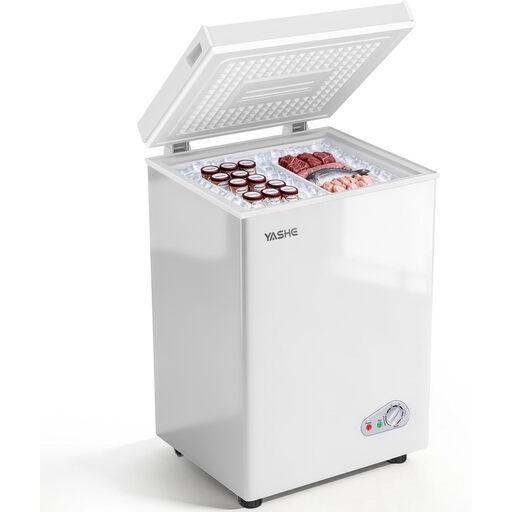 Image unavailable
YASHE BC-100Q-EU chest freezer, 100 litres
A compact option for extra space and keeping small portions separate.
Capacity: 100 litres. Two removable baskets and six temperature settings.
For carrots, check that the temperature and freezing capacity of the exact model suit your needs.
Joybuy
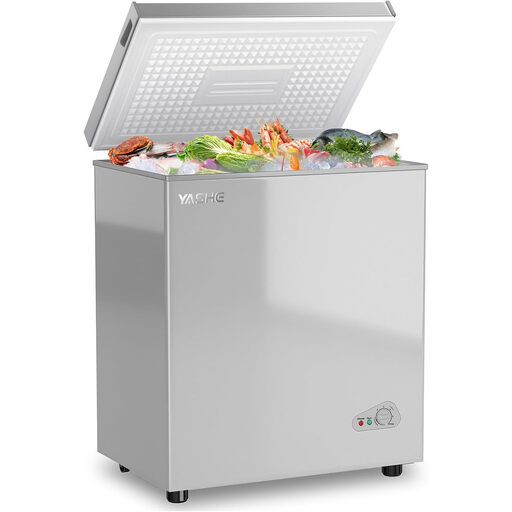 Image unavailable
YASHE BC-150Q-EU chest freezer, 150 litres
The larger capacity may suit you if you want to store other food as well as small portions of carrots.
Capacity: 150 litres. Two removable baskets and six temperature settings.
Measure the available space and check the temperature settings and freezing capacity of the exact model.
Joybuy
 Image unavailable
AUCMA chest freezer, 141 litres
An option if you’re looking for extra storage space and want to factor in the convertible fridge and freezer function.
Capacity: 141 litres. External dimensions: 632 × 554 × 848 mm. Energy rating E, seven thermostat settings and a removable basket.
Stated energy consumption: 179 kWh/year. Check that the temperature settings are suitable for storing carrots.
Joybuy
 Image unavailable
AUCMA chest freezer, 95 litres
The compact capacity may suit you if you need little extra space and also store other food.
Capacity: 95 litres. External dimensions: 550 × 475 × 848 mm. Energy rating E, seven thermostat settings and a removable basket.
Stated energy consumption: 165 kWh/year. Check that the temperature settings are suitable for storing carrots.
Joybuy
 Image unavailable
AUCMA chest freezer, 291 litres
This larger capacity is for those who want to store considerably more food as well as portions of carrots.
Capacity: 291 litres. External dimensions: 1100 × 597 × 872 mm. Energy rating E, digital temperature control with five settings and a removable basket.
Stated energy consumption: 226 kWh/year. Measure the available space and check the temperature settings for storing carrots.
Joybuy
Frequently asked questions
Should I let blanched carrots cool first?
Yes. The Netherlands Nutrition Centre advises cooling carrots quickly in iced water after briefly blanching them, then draining and drying them thoroughly. Freeze them in small portions and don’t add too much at once.
How cold should the freezer be for blanched carrots?
Set the freezer to −18 °C or colder. The Netherlands Nutrition Centre states that a freezer compartment with a one- or two-star rating cannot reach this temperature.
Can any chest freezer go in a cold shed?
No, it depends on the instructions for the exact model. Tomado states an ambient temperature down to −15 °C for the TCF0991B, and Liebherr states the same for the CFc 1875 Plus. This limit doesn’t automatically apply to other chest freezers.
Does Low Frost mean I’ll never need to defrost the freezer?
No. Low Frost doesn’t mean you’ll never need to defrost the appliance. Follow the instruction manual, switch it off and unplug it before defrosting. Don’t use knives, screwdrivers or other sharp objects to loosen the ice.
Do my statutory rights end when the manufacturer’s guarantee expires?
No. According to the Dutch Government, there is no fixed statutory guarantee period in the Netherlands. If a product is faulty, the seller must offer an appropriate solution. What you can expect depends, among other things, on the product and normal use.
What happens to my old freezer when I buy a new one?
If you’re a private consumer replacing a similar household appliance, the seller is required by the Dutch Government to take the old appliance away, including when you buy online.


