
Family with a seasonal harvest
Wants to freeze several portions of home-grown berries after harvesting, so looks at how much can be frozen in a day and how much can be stored.


For one small batch of home-grown berries, you don’t automatically need a separate chest freezer: your existing freezer may be sufficient if it has enough free space and freezing capacity. If you regularly have larger harvests, a separate freezer can be useful. Compare more than just its capacity: check its freezing capacity in kg/24 hours, external dimensions, annual energy consumption and permitted ambient temperature.
Wants to freeze several portions of home-grown berries after harvesting, so looks at how much can be frozen in a day and how much can be stored.
Needs extra freezer space, but also has to consider the freezer’s external dimensions and the clearance needed to open the lid.
Wants to choose a chest freezer with a capacity and annual energy consumption that suit the amount of food the family actually stores.
Start by considering how many berries need to go into the freezer at once on your busiest harvest day. The Voedingscentrum recommends a freezer that can be set to −18 °C or colder. Inventum’s product specifications also show why capacity in litres and freezing capacity in kg/24 hours are separate points to compare.
Choose this if: you’re freezing a small batch of berries and your freezer has enough free space and freezing capacity.
Consider: you won’t need another appliance, but your existing freezer must be able to reach the required temperature.
Choose this if: you regularly freeze a modest amount of extra food and have limited floor space.
Consider: when you have a large harvest, freezing capacity may be a limiting factor before storage capacity is.
Choose this if: you want to store larger harvests as well as other food for your household.
Consider: allow for the space it needs, access to the lid and annual energy consumption.
Choose this if: your harvest and other frozen food genuinely call for the extra capacity.
Consider: extra capacity isn’t necessarily useful if you’re only freezing berries for one family meal. Check the freezing capacity, annual energy consumption and dimensions of the exact model.
| What to consider | What to check before buying | Who is this important for? |
|---|---|---|
| Freezing fresh produce | Estimate the largest quantity you’ll harvest in one day in kg and compare it with the stated freezing capacity in kg/24 hours. | If lots of berries ripen on the same day, I want to know how much I can freeze at once. For around 36% of consumers, daily freezing capacity is their main concern. |
| Capacity and where to put it | Measure the available space and check the external dimensions and the clearance needed to open the lid. | I want to store extra food, but the freezer also needs to fit in the space I have. For around 29% of consumers, suitable external dimensions are a priority. |
| Energy consumption | Compare the energy label and annual kWh figures for the exact models. | If the freezer is on all year, I want its energy use to suit how I use it. Around 21% of consumers say annual energy consumption is their main concern when choosing. |
| Portions and maintenance | Check how many baskets the model has and whether it needs to be defrosted manually. | I want to find small bags easily and know how much maintenance defrosting involves. Keeping portions organised and maintenance are the main concerns for around 14% of consumers. |
Capacity in litres doesn’t tell you how many kilos of fresh berries a freezer can freeze in 24 hours. Storing a large amount and freezing a large harvest in one day are two different requirements.
Compare the expected amount on your busiest harvest day with the stated capacity in kg/24 hours. Don’t choose based on storage capacity alone.
If your daily harvest exceeds the freezer’s capacity, you may need to freeze it over several days.
The Inventum VK952W is described as having less ice build-up, but that doesn’t mean it never needs defrosting.
Check whether the exact model needs to be defrosted manually and whether it has a defrost water drain.
Allow time for defrosting and make temporary arrangements for storing the contents.
Your existing freezer may be enough for a small batch if it has the space and freezing capacity.
First, check the temperature setting, free space and freezing capacity of the freezer you already have.
An extra chest freezer will still use energy outside the harvest season.
Permitted ambient temperature ranges and placement instructions vary by model.
Check the requirements and ventilation instructions in the manual for the exact chest freezer you’re considering.
Inventum offers compact and medium-sized chest freezers, including the VK562W and VK952W.
The CFc 1875 Plus is a chest freezer with a stated total volume of 192 litres, which you can compare with the space available where you plan to put it.
The Beko HSM22340 is a chest freezer with a stated storage capacity of 230 litres.
The Whirlpool W3RHS19EW2 is a model with a stated capacity of 198 litres, which you can compare in terms of storage space and maintenance.
This selection includes compact to larger freestanding chest freezers for anyone looking to freeze extra portions of home-grown berries and other food. Compare the capacity, layout and stated usage information with your own harvest and the space you have available.
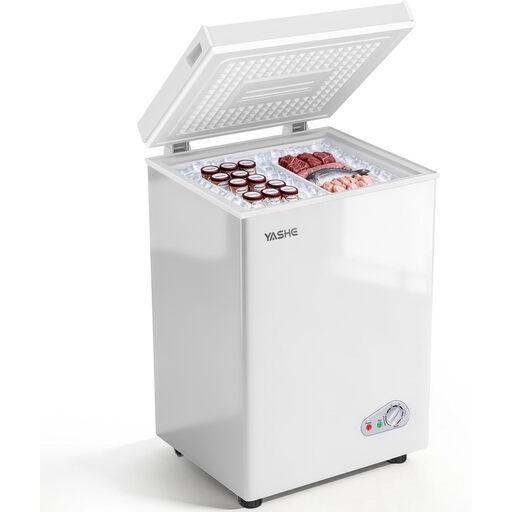 Image unavailable
A compact option for extra freezer space and keeping portions separate.
Capacity: 100 litres. Two removable baskets. Energy class E.
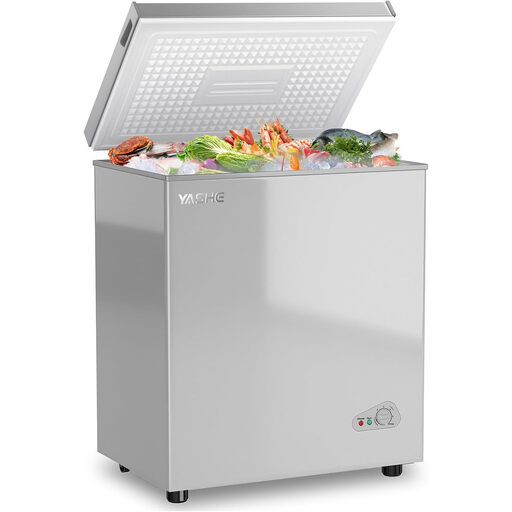 Image unavailable
An option for a household wanting to store several extra portions.
Capacity: 150 litres. Two removable baskets. Energy class E. Stated consumption: 157 kWh per year.
 Image unavailable
A medium-sized option for extra household storage; this model switches between fridge and freezer modes.
Capacity: 141 litres. 4-star freezer compartment. Removable basket. Energy class E. Stated consumption: 179 kWh per year.
 Image unavailable
A compact convertible option for households looking for extra space and a way to keep portions separate.
Capacity: 95 litres. 4-star freezer compartment. Removable basket. Energy class E. Stated consumption: 165 kWh per year.
 Image unavailable
A larger option for households wanting to store plenty of food as well as berries.
Capacity: 291 litres. 4-star freezer compartment. Removable basket and built-in LED lighting. Energy class E. Stated consumption: 226 kWh per year.
Wash the berries, pat them dry and first freeze them separately on a tray; then pack them into portions. The Voedingscentrum recommends setting your freezer to −18 °C or colder and advises against freezing too much at once.
According to the Voedingscentrum, redcurrants can be kept in the freezer for one year and blueberries for 8–12 months; after that, their quality may deteriorate. Check the Storage Guide for the type of berry you have.
Only if the temperature in the room stays within the permitted range for that exact model. Inventum says the VK562W is suitable for rooms down to −15 °C, while Liebherr lists FrostProtect for the CFc 1875 Plus for ambient temperatures down to −15 °C. Also check the placement and ventilation instructions in the manual; these specifications don’t automatically apply to other chest freezers.
Compare the energy label and annual kWh figures for the exact models. In the Netherlands, freezers must have an energy label, as stated by Business.gov.nl; an energy class alone doesn’t tell you how many kWh a particular model uses each year.
Contact the retailer about your statutory guarantee rights. According to the Dutch government, there is no fixed statutory guarantee period for all products in the Netherlands; what you can expect depends in part on the product and normal use. A manufacturer’s guarantee is in addition to those statutory rights.