
Holidaymaker with limited space
This holidaymaker wants to freeze a small portion of banana now and then, and first wants to know whether a separate freezer and the space it needs are worth it.


For a few portions of banana slices, a separate chest freezer only makes sense if your existing freezer space isn’t enough. An extra appliance takes up space and continues to use electricity if you need to keep food frozen. If you do need a separate freezer, choose one based on how much you freeze at a time, its external dimensions and its annual energy consumption in kWh. If it will be kept in an unheated space, also check the permitted temperature range for that exact model.
This holidaymaker wants to freeze a small portion of banana now and then, and first wants to know whether a separate freezer and the space it needs are worth it.
This owner weighs up the extra freezer space against the electricity use and considers how to keep food frozen when the property is empty for a long time.
This user wants to freeze several portions at once, so looks at the usable capacity and freezing capacity.
| Concern | What should you check? | Who should prioritise this? |
|---|---|---|
| Capacity and available space | Measure the space, including the room needed to open the lid. Then compare the external dimensions and capacity with the amount you want to store. | I don’t want to put in a large freezer just for a few bags of banana; around 31% of consumers prioritise suitable capacity and available space. |
| Electricity costs when use varies | Compare the annual energy consumption in kWh of models with a suitable capacity. Work out any costs using your own electricity tariff and period of use. | If my food needs to stay frozen while I’m away, I want to know how much electricity the appliance uses in a year; around 25% of consumers prioritise electricity costs when use varies. |
| Freezing fresh slices and finding them again | Check that the freezer is suitable for freezing fresh food, its freezing capacity in kg per 24 hours, and whether it has a basket for small portions. | I want to freeze fresh banana slices and easily find small portions later; around 25% of consumers prioritise suitability for freezing and storage layout. |
| Cold installation space and power cuts | Check the permitted ambient temperature range in the manual for the exact model. After a power cut, assess the condition of the contents. | My chest freezer will be in a cold space, or power cuts are a concern here; around 19% of consumers prioritise these conditions. |
A generous capacity isn’t automatically useful if you only store a little banana now and then; the appliance also takes up space and uses electricity.
First check whether your existing freezer space is enough. Then compare the capacity, external dimensions and annual energy consumption of models suited to the amount you store.
A stated temperature range may apply only to a specific model and be subject to conditions, such as the setting used.
Compare the lowest temperature in the installation space with the manual for the exact model, and check any conditions for use in cold temperatures.
How to handle food after a power cut depends on its condition; a stated storage time alone doesn’t guarantee that every item will be safe.
Check the contents after a power cut and follow food storage advice for anything that has partially or fully defrosted.
According to Beko, the CF100EWN is a freestanding 98 l chest freezer with an E energy rating; compare its dimensions with the space available.
Tomado lists a 99 l capacity, a storage basket and a super-freeze function for the TCF0991W.
According to Candy, the CHAE 2002C Artico has a 196 l capacity and a C energy rating.
Liebherr lists a 192 l capacity and FrostProtect for the CFc 1875 Plus, designed for larger quantities and potentially cold installation spaces.
This selection includes compact and larger chest freezers. Compare the capacity with the amount you want to store, and the external dimensions with the space available.
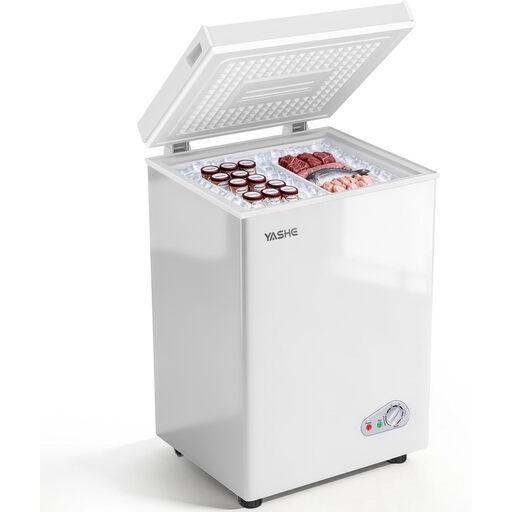 Image unavailable
A compact option to consider if you’re looking for separate freezer space for a small amount of food.
100 l capacity, two removable baskets, six temperature settings and 45 dB according to the product name.
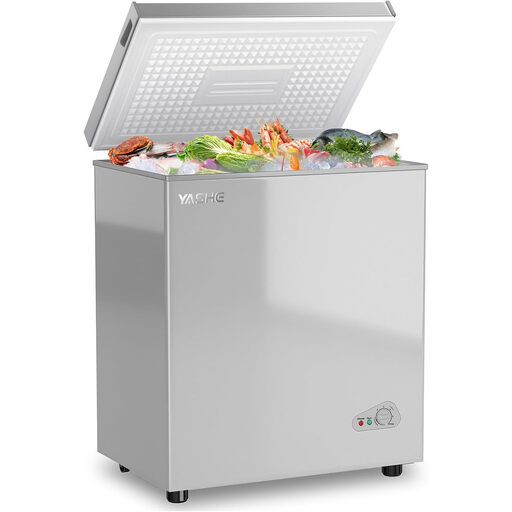 Image unavailable
The larger capacity could suit you if you want to store more food at once; measure the space and room for the lid beforehand.
150 l capacity, two removable baskets, six temperature settings and 45 dB according to the product name.
 Image unavailable
The generous capacity is most relevant if you want to store other food as well as bananas and have enough space for the appliance.
291 l capacity, E energy rating, convertible between a fridge and freezer, removable basket, LED lighting and five-level digital temperature control.
 Image unavailable
A medium capacity to consider if a compact freezer won’t provide enough room, but you don’t need a larger freezer for storing a big supply.
140 l capacity, storage basket, counterbalanced lid, adjustable temperature control, adjustable feet and E energy rating according to the product name.
 Image unavailable
A compact option to consider, while also checking whether it’s suitable for freezing fresh food.
99 l capacity, E energy rating, removable basket, inverter compressor and 38 dB according to the product name.
Peel the banana, cut it into smaller pieces if you like, then put them in an airtight container or freezer bag. Voedingscentrum recommends storing bananas in the freezer for 8–12 months; after that, their quality may decline.
No, you can’t tell from the type of appliance alone. Check the permitted ambient temperature range and any conditions for the exact model. Candy says the CHAE 2002C works at −15 °C when the appliance is set to maximum power.
First, check the condition of the contents. Voedingscentrum advises putting food that is still frozen solid back in the freezer. If the outside has softened, it’s best not to refreeze it; put it in the fridge and eat it within two days instead.
When you buy online from a business, you generally have 14 days to change your mind, according to the Rijksoverheid. If a product is faulty, the seller must offer a solution; any manufacturer’s guarantee does not replace this responsibility.
According to the European Commission, the current energy label shows information including the energy rating, annual energy consumption and capacity. When you buy a similar new appliance, a shop in the Netherlands must take an old appliance from a household free of charge under the old-for-new scheme; the Rijksoverheid also explains how to arrange this when buying online.