
Home office with lots of similar-looking cables
If you want to tell charging cables apart, it helps to use tape designed to wrap around cables. Brother Netherlands and DYMO describe specific flexible tapes for this purpose.


Start by deciding whether you want a flag label or a wrap around the cable. Then check that the printer and cassette are suitable for it. A basic P-touch may be enough for a small number of cables; for regular cable labelling, specialist models offer dedicated wrap or flag functions, but choosing the right cassette and version is still important.
If you want to tell charging cables apart, it helps to use tape designed to wrap around cables. Brother Netherlands and DYMO describe specific flexible tapes for this purpose.
If you need to identify the right cable quickly among several, compare a protruding flag label with a wrap around the cable. Brother Europe describes a cable flag function for the PT-H110.
If you often create new labels, compare how the printer works, the cassette options and the consumables. Brother and Brady describe different ways to make cable wraps and flag labels.
First decide whether you want a flag or a wrap. Then check that the printer and cassette are compatible, and choose controls that suit the way you work.
| What to consider | What should you check? | Who is this important for? |
|---|---|---|
| Fit on the cable | Check whether the tape is designed for cable wraps or flags, and whether the cassette fits the printer. For self-laminating tape, also check the specified cable diameter range. | If I label cables of different thicknesses, I want to know whether the tape will fit. Around 36% of consumers put fit and adhesion first. |
| Readability | Compare a protruding flag with a wrap around the cable, and check that the printer supports the labelling function you want. | I want to identify the right cable quickly among others. For around 29% of consumers, readability comes first. |
| Ease of use | Check whether you enter text directly on the printer or design labels via Bluetooth, and find out which app or connection you need. | If I regularly make new labels, I want a process that suits me. Around 21% of consumers put ease of use first when labelling repeatedly. |
| Printer and consumables | Check which cassette and power supply are compatible with the exact version, and which tape is suitable for it. | I want to know in advance which tape and power supply I’ll need, as well as the printer. Around 14% of consumers put purchase and running costs first. |
Manufacturers distinguish between standard tape and flexible ID and cable wrap tape. So a printer that makes ordinary labels won’t necessarily work with the cassette you want to use for cables.
First choose between a flag and a wrap, then find the cassette designed for that use and your printer.
You may need a separate flexible ID or cable cassette for labelling cables.
The stated range applies to the specific cassette: Brady gives a cable diameter of 2,00 to 3,00 mm for the M21-750-427, while Brother gives 3,0 to 6,6 mm for the TZe-SL251.
Measure your cable and compare it with the specification for the exact cassette before ordering.
Brother lists an optional adapter for the PT-H110. DYMO states that AA batteries aren’t included with the Rhino 4200 QWERTY version reviewed.
Check what comes in the box for the exact version, including the power supply and tape code.
You may need to buy suitable tape, an adapter or batteries separately, depending on the version and what’s included in the box.
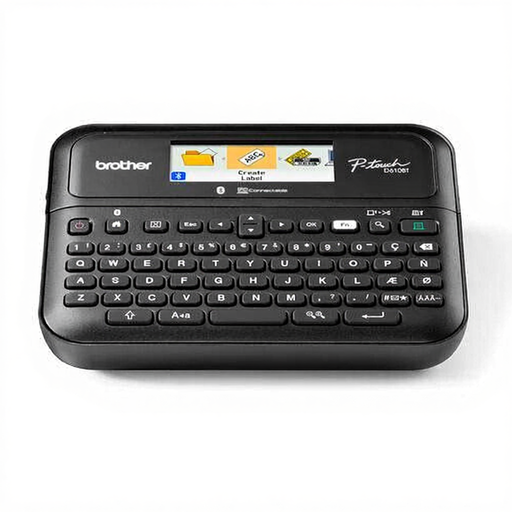
Brother offers P-touch models for entering text directly and designing labels via Bluetooth, with separate tapes for cable labelling.
According to DYMO, the Rhino 4200 QWERTY has shortcut keys for cable wraps and flag labels.
Brady describes the M210 as a printer for cable, data and electrical identification, with automatic formatting for applications including cable flags and wraps.
These label makers are designed for creating and printing labels, including via Bluetooth. Before buying, check that the exact printer and tape are suitable for the cable labelling you want to do.
 No image available
Suitable if you want to design labels via Bluetooth; check separately whether the printer and tape are suitable for labelling cables.
Bluetooth; includes one roll of white paper labels. Runs on 4 AA batteries, which aren’t included.
 No image available
An option to compare if you want Bluetooth controls; check whether the exact TZe tape is suitable for the cables you want to label.
Thermal transfer; 180 × 360 DPI; print speed up to 30 mm/s; wired and wireless.
Choose a flag if you want the text to stick out and there’s room for it; choose a wrap if you want the label to go around the cable. In either case, check that the printer function and cassette are designed for that use.
No. Check compatibility for each printer model and cassette. Brother lists compatible P-touch printers with a TZ or TZe designation for the TZe-FX241; DYMO lists flexible Rhino nylon labels for specific Rhino models. Also check the supported tape width.
For eligible online purchases from a business, you generally have 14 days to change your mind, according to the Dutch government. This is separate from your statutory rights if a product is faulty: in the Netherlands, there’s no fixed statutory guarantee period, and you should contact the seller.
The relevant European product safety rules apply to electrical and electronic equipment. According to Business.gov.nl, once the applicable requirements have been met, the manufacturer must affix the CE marking and draw up an EU declaration of conformity. Models with Bluetooth may also be subject to radio equipment rules. Check the documentation for the exact version.