In a reverberant rehearsal room, a dynamic microphone positioned close to each speaker is often a practical place to start: according to RØDE, greater distance can bring more room echo and background noise into the recording. A condenser microphone is an option if you can keep the room quiet and want to capture vocal detail. Also check that the connections, recording channels and accessories you need are compatible with your setup; product specifications alone can’t predict how a microphone will sound in your room.
Who is this buying guide for?
Performer in a reverberant room
You want to record character voices while the rehearsal room is clearly audible in the recording. Pay attention to distance and microphone placement; don’t expect a microphone or software to silence the room by itself.
Voice actor with an expressive performance
You switch between quiet lines and loud exclamations, and want to test the distance, plosives and recording levels in advance.
Ensemble with overlapping dialogue
You want to be able to edit voices separately later. So consider how many microphones you need for each speaker and how many recording inputs are available.
What should you look for when buying?
Start by assessing the room and the way you perform. Then choose a microphone setup and check that it works with your recording equipment.
| What to consider |
What should you check? |
Who is this important for? |
| Reverb and background noise |
Test the distance and direction with a trial recording at your rehearsal spot. |
If the room has noticeable echo, I want to be able to speak close to the microphone and test its position. Around 29% of consumers say reverb and background noise are their main concern when buying. |
| Quiet and loud performances |
Record the quietest and loudest passages, then check the position, pop filter and levels. |
When whispering and shouting, I want to know how my entire recording chain handles it. Around 23% of consumers prioritise capturing expressive changes in volume. |
| Separate dialogue tracks |
Count the speakers talking at the same time, microphones and inputs; also test how much each voice bleeds into the others’ tracks. |
If I want to edit dialogue separately later, I need separate tracks and want to assess audio bleed in advance. Around 18% of consumers prioritise separate dialogue tracks. |
| Connections and setup |
Compare USB and XLR with the connections on your computer, recorder or interface. |
I want to be able to record quickly with equipment I already own, so I check the connections for each model. Around 18% of consumers say compatibility with their equipment is their main concern when buying. |
| Complete setup |
Check what’s included and whether you also need an interface, recorder, cable, stand, pop filter or headphones. |
When assessing the full setup, I look beyond the microphone itself. Around 12% of consumers prioritise having the complete recording chain they need. |
Common pitfalls
-
Expecting a directional microphone to silence a reverberant room
RØDE warns that being further from the microphone can result in more room echo and background noise. A microphone’s polar pattern or noise-processing feature won’t eliminate the room’s acoustics.
Start with a trial recording where you’ll be performing and compare different distances.
Allow time to try different positions and improve your recording space.
-
Choosing a microphone without checking the connection
An XLR microphone needs compatible recording equipment. Other models also offer USB, and accessories vary between versions.
First work out the complete, compatible recording chain you need, then compare your options.
Depending on your setup, you may also need a recorder or interface, cables and a mount.
-
Choosing one microphone when you need separate dialogue tracks
A shared recording won’t give you the same individual control over voices as a setup with separate microphones and recording channels.
Count how many performers speak at the same time and decide which voices you’ll want to edit separately later.
Separate recordings may require extra microphones and recording inputs.
Brands to consider
Shure
The MV7+ is a dynamic microphone for speech, with USB-C and XLR connections for a flexible solo setup.
- Shure lists a headphone output and automatic level control.
- Claims about voice isolation and noise processing come from the manufacturer; test the recording in your own rehearsal space. Also check whether you need a stand.
Audio-Technica
The AT2040 is a hypercardioid dynamic microphone with an XLR connection, designed for close-up speech.
- Audio-Technica lists an integrated shock mount and a multi-layer windscreen. The brand describes it as suitable for use with multiple microphones close together.
- The manufacturer’s claim about voice isolation can’t predict how much audio bleed you’ll hear in your room. Assess this with a trial recording.
RØDE
The dynamic PodMic USB offers USB and XLR connections; the NT1 5th Generation is a condenser microphone with the same two connection options.
- RØDE lists a headphone output and pop filters for the PodMic USB, and a supplied shock mount and pop filter for the NT1 5th Generation.
- These are different types of microphone. Assess the room and speaking distance before comparing manufacturers’ claims about their sound.
Sennheiser
The e 835 is a wired dynamic XLR vocal microphone for performers who hold the microphone while performing.
- For this model, Sennheiser describes a cardioid pattern and sound reproduction when moving off-axis.
- The manufacturer’s description isn’t a guarantee for every performance style or recording space. Test handling noise and freedom of movement too.
AKG
The P120 is a cardioid XLR condenser microphone for speech and singing when a fixed recording position suits your setup.
- AKG’s specifications list a switchable low-cut filter and a pad switch.
- Check the version, power requirements and included accessories before buying.
Joybuy products
This selection includes wireless systems with transmitters for conversations between one or two speakers, as well as a USB condenser microphone. A lavalier microphone is a different setup from a fixed speech microphone; check that the receiver and connection are compatible with your recording equipment.
 Image unavailable
DJI Mic Mini 2S (2 TX + 1 RX + Charging Case)
This set is an option for recording two speakers using transmitters; the product description also mentions use with a computer.
The model name specifies two transmitters, one receiver and a charging case. The description mentions built-in microphones in the transmitters; check that the connection and recording format are compatible with your equipment.
View at Joybuy
 Image unavailable
Lark M2 Wireless Lavalier Microphone System, 48 kHz/24-bit
This wireless lavalier system is an option when the speaker wears a transmitter instead of standing in front of a fixed microphone.
The product name lists 48 kHz/24-bit, a transmitter weight of 9 g and a transmission range of 300 m. The description mentions a camera receiver; check the connection and test the set in your own rehearsal space.
View at Joybuy
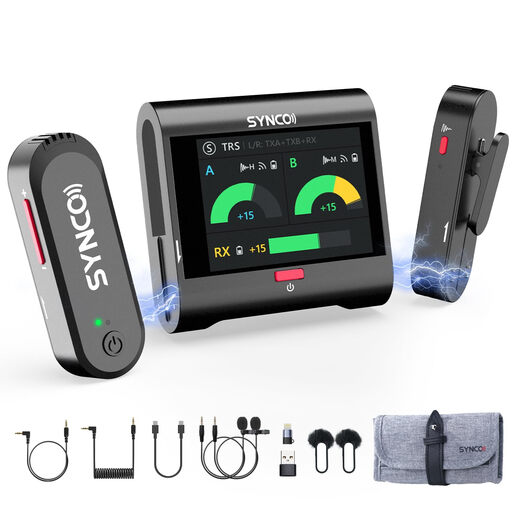 Image unavailable
SYNCO G3PRO Wireless Lavalier Microphone System, 2.4 GHz, Dual Lapel Mics
With two transmitters, this system is an option for recording two speakers at the same time; check which recording channels you need in advance.
The description lists mono and stereo modes, a safety channel, and TRS, TRRS and USB-C outputs. Check which output is compatible with your recording device.
View at Joybuy
 Image unavailable
USB Condenser Microphone, Cardioid Pattern
This USB condenser microphone is an option for a fixed vocal setup; make a trial recording to assess how much the room comes through.
The description lists a cardioid pickup pattern, headphone output, gain control and mute function. It also mentions a boom arm, shock mount and pop filter; check that the connection works with your computer.
View at Joybuy
 Image unavailable
Moman MB1C Clip-on Microphone, 1TX + 1RX, USB-C
This clip-on system is an option for one speaker to wear a transmitter, rather than standing in front of a fixed microphone.
The product name lists one transmitter, one USB-C receiver and iPhone 18/17/16. The description mentions automatic pairing and hands-free recording; check that the receiver is compatible with your device.
View at Joybuy
Frequently asked questions
How should you position a microphone for your first test recording?
Start with the microphone close to the speaker, point the front in the right direction and record a few lines at your actual performance volume. RØDE warns that greater distance can result in more room echo and background noise. According to the manual, the recording side of the NT1 5th Generation is the side with the gold mark.
Can you edit two performers separately when using one microphone?
Choose separate microphones and suitable recording inputs if you need separate dialogue tracks. Audio-Technica describes the AT2040 as suitable for use with multiple microphones close together; test how much each voice bleeds into the others’ tracks in your own room.
How can you reduce plosives and vibrations?
Check whether a pop filter and shock mount are included with the version you choose, then test with plosive sounds and movement around the microphone. RØDE describes a pop filter as helping to reduce bursts of air and a shock mount as a way to isolate vibrations.
What warranty applies when buying as a consumer in the Netherlands?
According to the Dutch government, you’re entitled to a product that meets your reasonable expectations; if a product is faulty, the seller is your point of contact for a solution. There is no single fixed statutory warranty period for all products in the Netherlands. For distance purchases from a business, you’ll often have a 14-day cooling-off period; check whether it applies to your purchase.
Can you publish recordings of other performers?
If a publication contains other people’s personal data, the Dutch Data Protection Authority says that, in principle, you need a lawful basis under the GDPR; consent is one possible basis. The Authority notes an exception for purely personal or household use. Whether these rules apply to a particular voice recording and publication depends on how it is used and the circumstances.


