
Desk listener with limited space
If you listen close to your desk, your stereo pair needs to fit without getting in the way of your screen or workspace. Genelec recommends symmetrical placement as a starting point for monitor speakers.


If you listen close to your desk and don’t want a separate amplifier taking up space, start with a compact active stereo set that has inputs suited to your music source. If you already have a suitable amplifier, or want to choose your speakers and amplification separately, compare passive pairs and check the requirements for the exact model. Genelec recommends a symmetrical arrangement. The right choice also depends on your room, and no single specification can predict how chamber music will sound in your home office.
If you listen close to your desk, your stereo pair needs to fit without getting in the way of your screen or workspace. Genelec recommends symmetrical placement as a starting point for monitor speakers.
If you want to play music from a computer or another source without first putting together a separate amplifier, compare the inputs on active sets. Edifier describes the MR4 and R1280DB as active options with different connections.
If you already have an amplifier, or want to choose one separately, check the passive model’s amplifier requirements and make sure you have room for the speakers. For example, KEF lists an amplifier requirement of 10–150 W for the Q1 Meta.
For chamber music at a desk, the key factors are speaker placement, connection to your source, amplification and how the speakers sound in your own room.
Choose this if: you listen close to your desk and don’t want a separate amplifier taking up space.
Bear in mind: inputs vary by model, and integrated amplification gives you less freedom to replace just the amplifier.
Choose this if: you already have a suitable amplifier or want to choose your speakers and amplification separately.
Bear in mind: you’ll need amplification and possibly cables; check the requirements for the exact model.
| Consideration | What should you check? | Who is this important for? |
|---|---|---|
| Stereo image and placement | Measure the space available for two speakers and check whether you can place them symmetrically, at the same height and aimed at your listening position. | I want to fit the pair beside my screen and angle the left and right speakers properly; around 29% of consumers prioritise placement. |
| Connection to your source | Compare the output on your computer, interface or streamer with the inputs on the exact model. Don’t assume it has Bluetooth or USB unless this is confirmed for that model. | If I want to listen from my computer without a separate amplifier, the right input is essential; around 29% of consumers prioritise an easy connection to their source. |
| Existing amplifier | Check the type of amplifier and the requirements for the specific model. Also check what is included with the speakers. | If you already have an amplifier, you’ll want to know whether it’s suitable for the passive pair before you choose; around 21% of consumers prioritise using their existing hi-fi equipment. |
| Sound at your listening position | Compare familiar recordings at your usual listening volume and, where possible, assess the pair in the intended position. | I mainly want to hear how strings and piano sound where I’ll be listening, rather than relying on a single specification; around 21% of consumers prioritise judging the sound of instruments. |
Passive speakers need a suitable external amplifier. For example, KEF lists the Q1 Meta as a passive model with an amplifier requirement.
Before buying, check whether you already have suitable amplification and review the requirements for your chosen model.
If you don’t, you’ll also need to allow space for a suitable amplifier and cables.
Edifier lists different connection options for the MR4 and R1280DB. So an active model won’t necessarily connect to your source in the same way as every other model.
Compare the output on your music source with the inputs on the exact model, and check separately whether it has the USB connection you want.
If the connections don’t match, you may need an additional suitable connection to your source.
A specification or manufacturer’s claim about detail can’t, on its own, predict how a recording will sound where you listen. Your room and the placement of the left and right speakers also make a difference.
Check whether you can position the speakers symmetrically and, where possible, listen to familiar music in the intended position.
Edifier offers active options for desktop use, including the MR4 and R1280DB.
The passive Q1 Meta is an option to compare if you want to use a separate amplifier.
The passive 607 S3 is a compact bookshelf speaker to compare if you’re using a separate amplifier.
The passive Stage 250B is a stereo pair with a rear-facing bass port.
The compact passive 3010c is an option if space for speaker placement is a key constraint.
These Joybuy products include passive bookshelf pairs for use with a separate amplifier and computer speakers for desktop use.
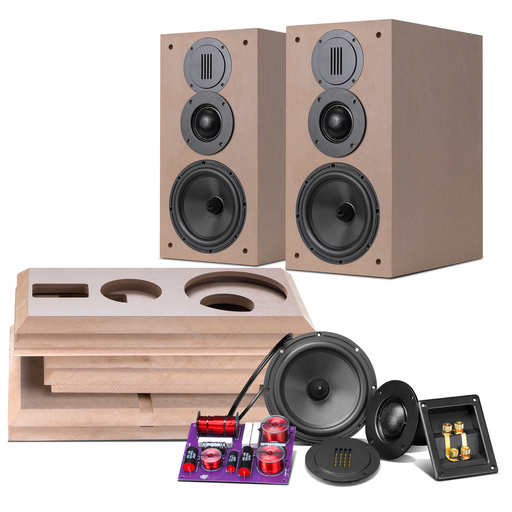 No image available
A good fit if you’re looking for a passive bookshelf pair and want to choose the speakers separately from the amplification; you’ll need a separate amplifier.
The product name specifies a pair and 6.5 inches.
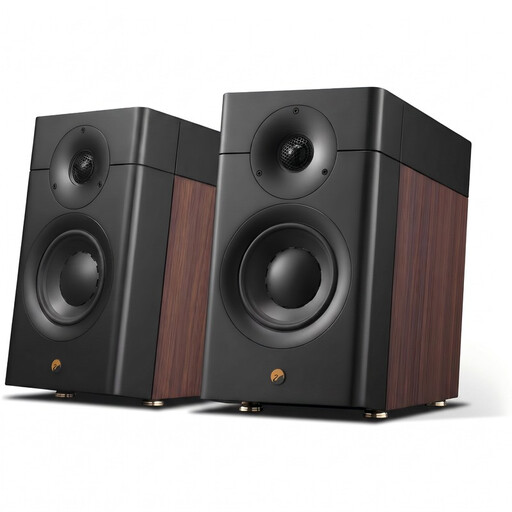 No image available
A passive pair for anyone who wants to choose speakers and amplification separately. Check that your amplifier is suitable for the model you’ve chosen.
The product name specifies a pair and 6.5 inches.
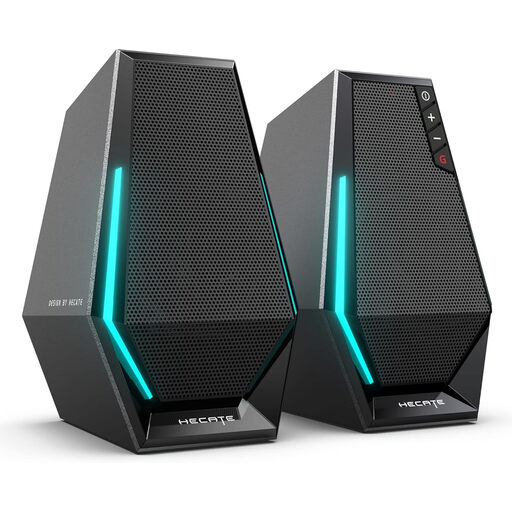 No image available
The product name positions this set for computer and desktop use. Check which connection matches the output on your music source.
The product name specifies Bluetooth 5.3, USB and 3.5 mm AUX.
No, it depends on whether the speakers are active or passive. The active Edifier R1280DB has built-in amplification, while the passive KEF Q1 Meta needs a suitable external amplifier. Always check the exact model.
Start with a symmetrical left-and-right arrangement, at the same height and aimed at your listening position. Genelec recommends an equilateral triangle with around 60° between the speakers for monitor setups. Treat this as a starting point, not a guarantee that the arrangement will be practical or optimal in every home office.
For online purchases from a business, consumers generally have a 14-day cooling-off period, according to the Government of the Netherlands. Products must also be of satisfactory quality; the Government of the Netherlands states that there is no fixed statutory guarantee period in the Netherlands. If a product is faulty, the seller is generally your point of contact.