
Vandaag of morgen in huis

Kwaliteit gegarandeerd

Welkomstaanbiedingen ontgrendelen: GRATIS bezorging | Tot 80% korting | Gratis 30 dagen JoyPlus-proefperiode
Download de app
A ceramic pan set may seem easy to choose at first glance. However, coatings, hob compatibility, maintenance and storage convenience can vary considerably between sets. If you focus only on a low price or the words “non-stick”, you could find yourself dealing with a pan with baked-on food, a loose handle or a set that does not work properly on an induction hob after just a few months.
This guide helps home cooks, families and people with small kitchens translate marketing claims into verifiable product specifications.
Many ceramic pans consist of an aluminium or stainless-steel base with a ceramic non-stick coating. This is different from fully ceramic cookware. An aluminium core can heat up quickly and evenly, while the ceramic coating provides the food-contact surface.
Therefore, always check:
The term “healthy pans without Teflon” is primarily a search term, not an independent quality standard. Look at the specific material details rather than relying solely on the packaging.
According to the product information, a ceramic frying pan may be suitable for cooking with little oil. This does not mean that preheating it dry, using high heat or using metal utensils will always be without consequences. Several product descriptions specifically advise adding oil or ingredients before heating.
Preferably use:
A dishwasher-safe pan set can be convenient, but several brands recommend hand washing to extend the life of the ceramic coating.
An induction pan set needs a magnetically suitable base. Also check the diameter of the cooking zone and the diameter of the pan base. For example, a 28 cm pan may have a smaller effective base.
Pay attention to the oven limit too. A detachable handle can save space and make the pan suitable for use in the oven, fridge or on the table, but according to the product warnings, the handle must not be exposed to a direct flame or high heat.
Look for a clear mention of PFAS-free, PTFE-free and PFOA-free. These terms describe different substances and should not be treated as synonyms. Some sets also state that they are made without lead and cadmium.
Pay attention to the wording: claims about non-stick performance and durability come from the brand’s product description. A brand’s own research may present performance in a positive light, so do not regard such claims as a guarantee for every cooking style or lifespan.
An aluminium pan generally heats up quickly and is relatively light. Cast iron retains heat for longer, but is heavier and usually less suitable for small kitchens or campervans.
For a household of one to three people, frying pans measuring 20 to 24 cm are often practical. A 26 to 28 cm pan provides more space for family meals, stir-fries or several portions.
When checking a set, look at:
A large set is not automatically better value if you rarely use several of the items.
“Dishwasher-safe” usually means that the pan can be placed in the dishwasher according to the product description. Manufacturers often still recommend hand washing. Also check for exceptions: with sets featuring a detachable handle, the handle generally needs to be removed first.
A ceramic non-stick pan set will remain usable for longer if you:
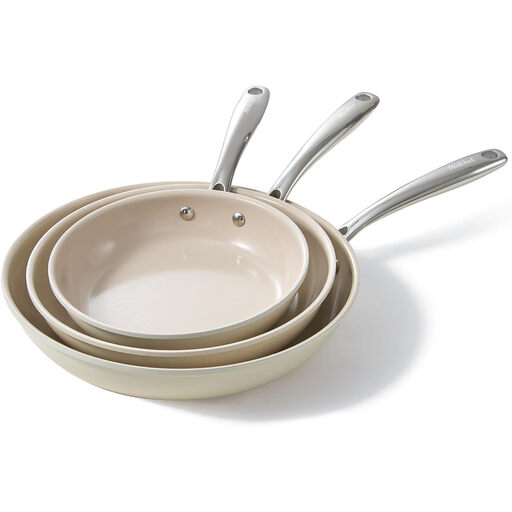
Why it suits this profile: The three sizes—20, 24 and 28 cm—provide a straightforward starting point for everyday frying without the need to buy a large collection of pans.
The product information states that it has a ceramic coating and is compatible with induction, gas and electric hobs, as well as dishwasher use. Hand washing is recommended to protect the coating.
Three useful diameters, an aluminium construction and oven use up to 842°F according to the product description.
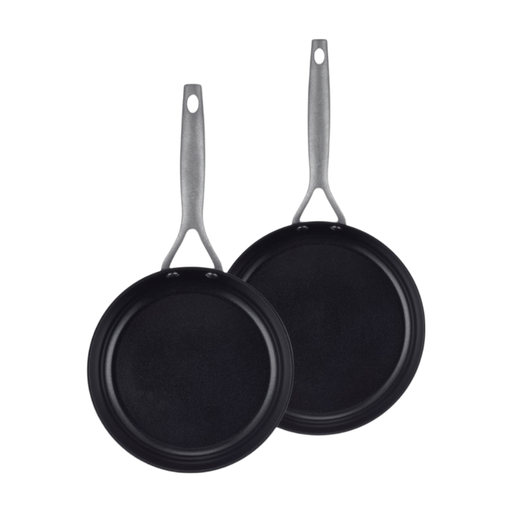
Why it suits this profile: This set is aimed at shoppers who care about material choice, certified recycled aluminium and a sturdy fixed handle.
The coating is described as PFAS-free, and the set is suitable for induction, gas, electric, ceramic and halogen hobs. The oven limit is clearly stated: 200°C maximum.
20 and 24 cm sizes, 100% recycled forged aluminium according to the product information, and dishwasher-safe.
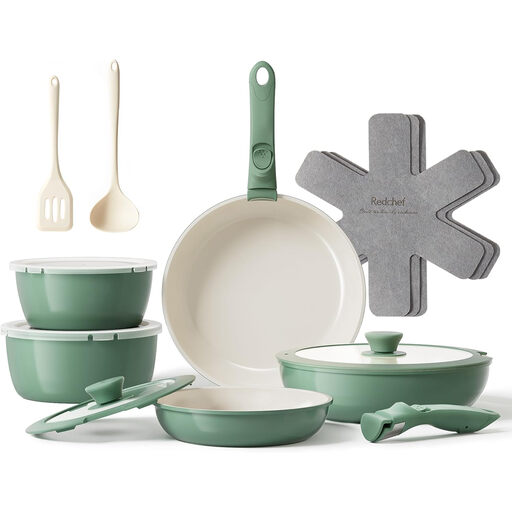
Why it suits this profile: Suitable for families, campervans and small kitchens thanks to its stackable pieces, two saucepans, two pans and detachable handle.
The set explicitly states that it is made with PFAS-, PTFE- and PFOA-free materials and is compatible with gas, electric and induction hobs. The handle must be secured properly before moving the pan.
Stackable design, detachable handle, oven use according to the product description, and dishwasher use after removing the handle.
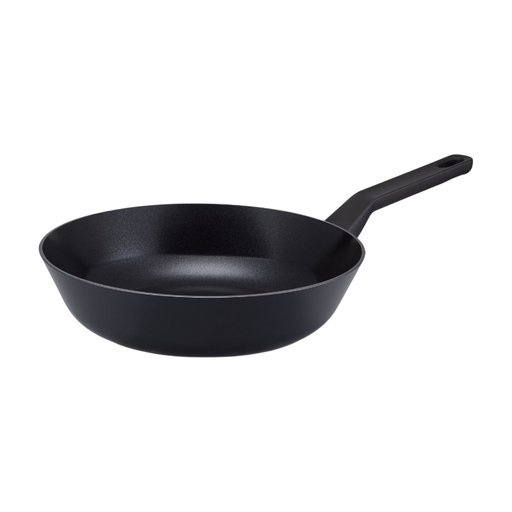
Why it suits this profile: The spacious wok shape is practical for noodles, vegetables, meat and stir-fries for several people.
The product information states that it has a PFAS-free ceramic coating, an aluminium base and is compatible with all common hobs. Hand washing is recommended despite being dishwasher-compatible.
28 cm diameter, recycled aluminium, PFAS-free coating and an oven- and heat-resistant handle according to the product description.
We have put together a complete, up-to-date list of products that fully meet these strict selection criteria and the applicable European safety regulations.
It can be, but always check the product specification. A pan needs a suitable magnetic base. In the product information discussed, several sets are listed as suitable for induction, gas and electric hobs. Also check that the diameter of the pan base corresponds to the induction zone.
Its lifespan depends on temperature, frequency of use and maintenance. There is no fixed period that applies to every pan. Avoid heating the pan empty, using metal utensils and using abrasive scourers. Hand washing with a soft sponge can help keep the coating in good condition for longer.
No, these are different descriptions. PFAS is a broader group of substances, while PTFE is a specific type of plastic coating. If you want to avoid both, choose a product whose manufacturer states that it is PFAS-free and PTFE-free. Also check whether PFOA-free is mentioned separately.
