
Vandaag of morgen in huis

Kwaliteit gegarandeerd

Welkomstaanbiedingen ontgrendelen: GRATIS bezorging | Tot 80% korting | Gratis 30 dagen JoyPlus-proefperiode
Download de app
Ceramic plates can quickly add atmosphere to a table, but a beautiful photo does not tell the whole story. A glossy glaze may be prone to scratching, an irregular shape can be awkward to stack, and a set may sometimes turn out to be smaller than expected. If you focus only on colour or price, it is easy to end up with tableware that feels less practical after a few months.
Use these checkpoints to make a more informed choice between dinner plates, breakfast plates, salad plates, serving dishes and a complete plate set. The selection below is based on verifiable product information, such as the material, dimensions, pack contents and stated care instructions.
An unusual shape or colourful finish can make a plate appealing, but also check the diameter and intended use. A salad plate of around 15 cm is suitable for smaller portions, bread or appetisers, while a dinner plate measuring approximately 26 to 27 cm offers more space for a main course.
Pay attention to the rim, too. A low rim can be useful for pasta or salad, but less suitable for dishes with sauce. An uneven rim creates a handcrafted look, but often requires a little more care when stacking and washing up.
Check whether the product description explicitly states that the plate is suitable for the dishwasher and microwave. This is clearly indicated for some items, while the information is less complete for others. If in doubt, follow the instructions on the product page and check the marking on the underside of the plate.
A glaze can be damaged by abrasive sponges, metal cutlery or sudden temperature changes. Microwave-safe plates are not automatically suitable for use in an oven, on a hob or over an open flame. These uses must be stated separately.
A product title containing “set” does not always mean that you will receive a complete dinnerware set. Check the number of items in the pack. A set of three or four plates may be practical for a small household, but you may need several sets for six people. With individual decorative plates, it is useful to order only the number you need for serving or table decoration.
Ceramic is made from a fired clay mixture and is often finished with glaze. Look for terms such as food-safe glaze, high-fired ceramic and the care instructions. According to Dafuceramic’s product description, the plates have a food-safe, glossy glaze with relief patterns. YumiPLUS specifies a reactive glaze finish. The appearance of this type of finish may vary from one piece to another; this is characteristic of the production method and does not guarantee an identical colour.
An aluminium plate, such as the Secret de Gourmet Osara, is not a ceramic plate. It may be an alternative for decorative serving, but it does not belong to the ceramic tableware category. An acacia wood serving board also requires different care: the stated 18 x 70 cm board is not suitable for the dishwasher.
Use this practical guide as a starting point:
A round shape is usually easy to stack. A shell shape or irregular rim adds character, but may take up more cupboard space.
Look specifically for the labels dishwasher-safe plates and microwave-safe plates. Both are stated for the YumiPLUS Star Blue and Fog Green salad plates mentioned above. The product information also advises against using a scourer or metal kitchen utensils, and says not to place the plate on a hob, in an oven or over an open flame.
It is still wise to handle ceramic with care. Stop using a plate if it develops a deep crack or sharp chip. Allow hot plates to cool slightly before rinsing them with cold water. This reduces the risk of damage caused by a sudden change in temperature.
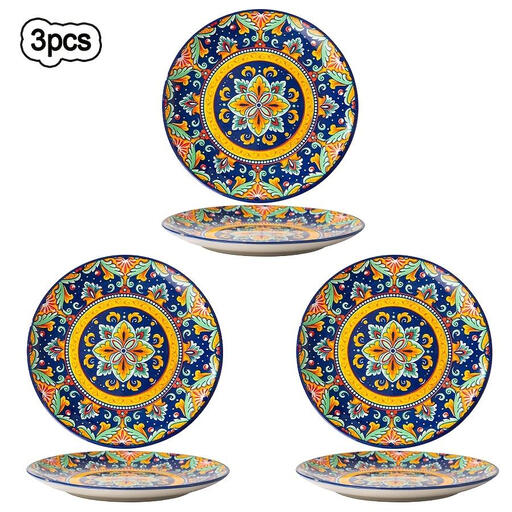
Why it suits this profile: This set of three round ceramic plates is suitable for a small household, desserts, salads and appetisers. The colourful boho pattern adds style without requiring you to buy a complete dinnerware set straight away.
The number of pieces is stated, so you will not mistakenly expect a single plate when you are looking for a small set. Use the care information for the glaze as a guide.
Three round ceramic plates with a food-safe coloured glaze, suitable for everyday serving according to the product description.
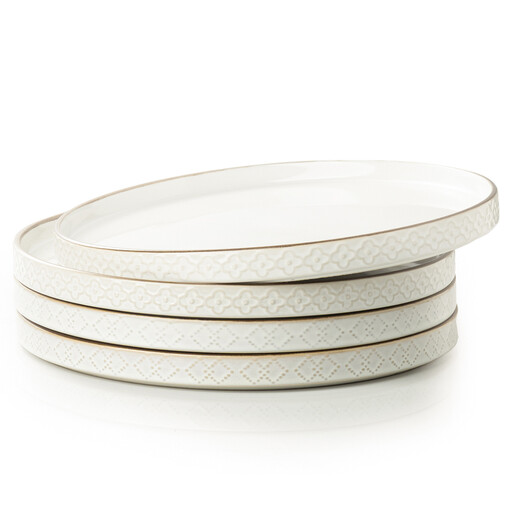
Why it suits this profile: This set of four is designed for main courses and larger portions. With a diameter of 10.25 inches, or approximately 26 cm, it is a practical size for everyday dining.
The product information specifies the material, dimensions and pack contents. This means you can compare the size and quantity before placing your order.
Set of four ceramic dinner plates with a relief pattern, suitable according to the product description for use in the microwave, oven, fridge, freezer and dishwasher.
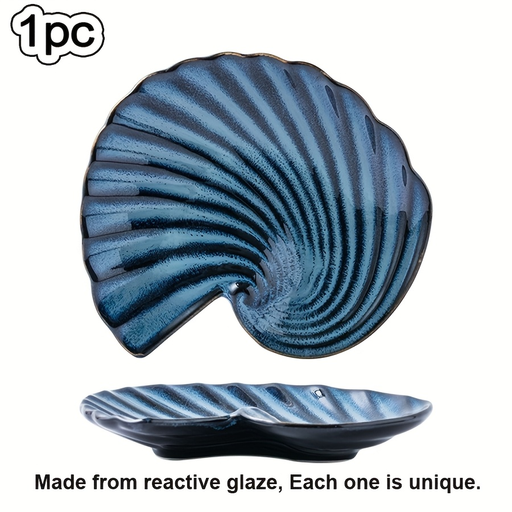
Why it suits this profile: The irregular shell shape is ideal for restaurants, caterers and households looking for a distinctive serving plate for salad, sushi, pasta or appetisers.
The product description clearly states that this is one plate. The warning about scourers, metal cutlery and temperature changes helps protect the finish.
High-fired ceramic with a reactive glaze finish, suitable according to the product description for use in the microwave and dishwasher.
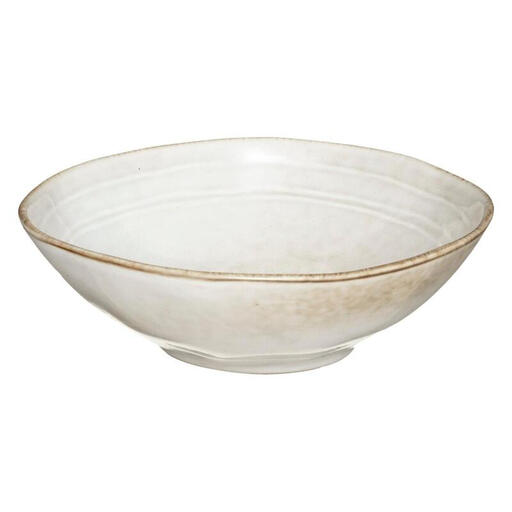
Why it suits this profile: This compact plate or small dish has a flower shape and pearl-grey colour. It is ideal for small appetisers, desserts and decorative serving, for example as a house-warming gift.
The dimensions of 15 x 15 cm and a height of 4.8 cm are stated. This makes it clear that it is not a large dinner plate.
Stoneware construction, a flower shape and a size suitable for small portions or decorative presentation.
We have put together a complete, up-to-date list of products that fully meet these strict selection criteria and the applicable European safety regulations.
It varies by product. Look for an explicit statement confirming dishwasher safety and follow the care instructions. For decorative glazes, it is best to avoid abrasive sponges, even when dishwasher use is permitted.
For a main course, a diameter of approximately 26 to 28 cm is practical. A smaller plate is often sufficient for breakfast, dessert or small appetisers. As well as the diameter, check the height of the rim and whether the plates can be stacked.
Avoid sudden temperature changes, metal cutlery on delicate glazes and scouring sponges. Do not place plates on a hob or over an open flame unless the manufacturer explicitly states that they are suitable. Check ceramic items regularly for cracks and sharp chips.
